Perhaps the most looming unknown for almost any undergraduate is their future professional career. Although the benefits of a well-rounded liberal arts education are innumerable, finding ways to translate courses in Maritime Literature or Medical Anthropology into a concrete post-grad job can feel daunting.
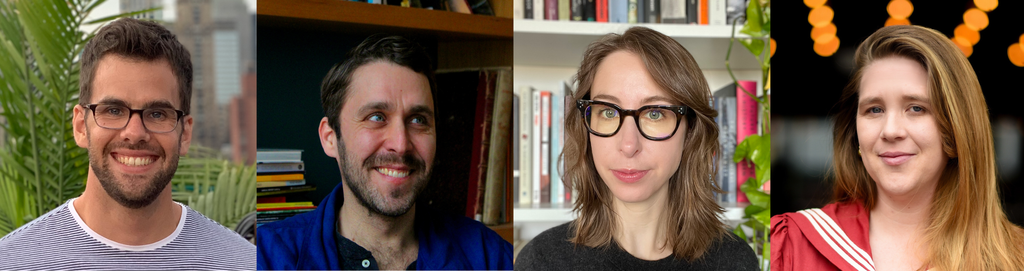
Last fall, the New England Review invited four Middlebury College and NER intern alumni to campus (virtually) to share their experiences in navigating a literary life after Middlebury. Today, they work across the literary landscape: agent Alison Lewis ’14, screenwriter Thomas Kivney ’13, novelist and journalist Chris Knapp ’07, and poet and The Iowa Review managing editor Alicia Wright ’11.5. Their careers span publishing houses, literary magazines, graduate programs, Hollywood, and independent presses. Below is a synthesis of their most valuable insights and advice organized into five main categories. For their full bios, scroll to the end of the article.
Roundabout Paths
A career in literature is far from linear, and every panelist ended up somewhere vastly different from where they thought they were headed when they left Middlebury.
For Alison Lewis, moving to New York after graduation seemed like the reasonable thing to do. She arrived in the city with no connections besides one distant family friend who worked in sales at W. W. Norton. That contact landed her a part-time internship, and she lived with other people from Middlebury while working on the side as a tutor for kids on the Upper East Side, which she explains “was enough to, for the time, make ends meet.”
As for her getting into book publishing, she notes that, “There are a lot of pathways that aren’t trying to become an editorial assistant, which is the position that’s the most visible and most competitive to get. You can get an internship in publicity, or marketing, or at a scouting agency, and come to know the industry and get to know people, and then work your way towards figuring out what part you want to work in.”
That’s exactly what she did. When her internship ended, she took a job as an assistant in a “little department of Norton that did books for therapists.” She also reflected on the time she spent at the Bread Loaf Writers’ Conference. There she “met, or heard, or read, some amazing contemporary poets and fiction writers,” which gave her “a feel for what’s being published and what [she] likes.” She notes the importance of understanding your taste when applying for jobs. explaining that “being able to explain why you like what you like” is an invaluable skill.
Thomas Kivney, who admitted that he was always flirting with the idea of Hollywood, took a similar approach. After completing the Columbia Publishing Course in New York, he started in the audiobook department at Macmillan. After a while, “Moving out to California [still felt] very scary,” so while building up the courage, he took a position at a scouting agency, where he eventually helped acquire film rights. Building familiarity with the industry made the move less daunting, and that job “was kind of the entryway into this world out here,” he reflected, “which I think in some ways made it feel a bit more accessible and allowed me to feel that I could make that jump.”
Carolyn Kuebler, editor of New England Review and the panel’s interviewer, offered her own take: “Taking those jobs—doing the things that you don’t really think are very literary or maybe aren’t what you want—can lead to other more interesting opportunities. So don’t be afraid that you’ll be stuck forever in an assistant to an assistant role getting paid $12 an hour. It does get better.”
Alicia Wright echoed that sentiment, drawing on a misstep of her own. After college, she interned with an editor who “was up-and-coming then and now is really established.” Near the end of her internship, he suggested she take an assistant job at an agency that did more commercial work. “I was so embarrassed by the idea of commercial work that I was like, oh no, no thank you, I’ll pass,” she said. “I’m telling this story because this was my mistake!”
Chris Knapp, who currently works as a journalist and teacher in Paris, first spent a decade in New York bartending before he enrolled in an MFA. In 2024 he published his first novel, and he continues to organize his professional and personal time around literary writing, even if it means supporting himself in adjacent careers. “The idea was always that I was going to do something and write. And I’m not recommending this, I don’t want to get emails from people’s parents being like, how could you tell my kid to do this? Though my mom was actually the one who said, you know, you could just go be a waiter in New York.”
And while all four of them have found lives in the realm of writing, Alison is the only one still working in New York City. In short, they all encouraged taking roundabout paths and saying yes to opportunities, even if they might not entirely align with the vision you have for yourself.
To MFA or Not To MFA?
Whether or not to pursue the MFA is perhaps the most divisive subject among peers, mentors, and advisors who offer advice about the literary world. In the end, the right answer depends on the individual and their circumstances. All four panelists had thoughtful insight into their own relationships with the degree and with advanced study more generally.
Alicia and Thomas both began with the Columbia Publishing Course, a six-week program that prepares students for entry-level jobs across book, magazine, and digital publishing. Thomas credits it with being “very good at placing you in entry-level assistant roles” and, through that, he “landed a position at Macmillan in their audio book department, which was a great place to begin.”
Alicia’s path after the course was less direct. She worked as a scout in New York before going on almost seventy interviews for editorial jobs, and the rejection was constant. “Everyone was like, you’re great, but you’re just not quite it. You’re a little too this or a little too that, but I’ll forward you to my friends. So I was passed along as this potential assistant, and it never quite worked out—I think because I was such a specific kind of literary weirdo who needed to go to grad school but hadn’t realized it yet.” Graduate school gave her room to embrace her niche, but she cautioned attendees that if they choose that route, they should under no circumstances go into debt for it. Instead, she said, “You should wait and find a place that will support you.” Alicia earned both an MFA at the Iowa Writers’ Workshop and a PhD in Literary Arts at the University of Denver and is now the managing editor of The Iowa Review, while also running her own lit mag, Annulet, and a reading series.
For Thomas, an MFA was a way to center writing in his life. He entered a writing program at the American Film Institute, which gave him the time to refine his scripts, and by the end of it a manager was interested in his work.
Chris’s route was the most drawn out. After years of bartending and writing on the side in New York, he quit his job, as he had promised himself he would, and, not knowing what to do next, applied to MFA programs, eventually earning his degree at the University of Virginia. The first round of applications brought no acceptances, not even a waitlist. “It was extremely demoralizing, and I don’t even know where I found the strength of will to apply again, but the next time I applied, I got in.”
He wishes he had gone sooner. The program “turned out to be just such a productive time,” and it taught him how to push his writing, because he knew he would have to “sit in a room and listen to people tear it apart.” It also gave him an agent and group of likeminded individuals, which led him to start “thinking about community as being a really important part of my writing life.” Chris also advised taking time before applying to “professionalize” on the side. He suggests interning at a literary magazine, reading submissions, or picking up freelance editing and writing gigs, “including some copyediting, with skills that I learned way back when I was at NER.”
Sustenance Through Community
For all the talk of the solitary writer, the panelists kept returning to the importance of the people around them. The writing may happen alone, but nearly everything that sustains it doesn’t.
Thomas put it most simply when describing what he loves about screenwriting: “It’s a lot of working with other people, which I really enjoy. Directors, producers, other writers.” The collaboration, he said, “very much gets you out of your own head.”
For Alison, it came through her colleagues. After years of working her way up, she became a full agent at a new agency, where having coworkers made the job “so much more fun and livable.” She described the simple pleasure of going into the office to “talk through your annoyances and strategize together and read for each other.” It’s “a very different form of community,” she said, “but something that I’ve found is I definitely couldn’t have done it without that.”
Her own path to that office was shaped by community too, though she didn’t always see it that way. For a long time she thought she would become a novelist or write literary biographies and write short stories on the side. Then she began interviewing authors and reporting for the online magazine Electric Literature, and the work slowly pulled her toward the people and books that would define her career.
Balancing Passion and Profession
Alison has found a version of balance between her passions and profession in the work itself. Much of her work as an agent is in nonfiction, which means she gets to “find a historian in a field that is exciting to [her], or a sociologist, or whatever it might be, and learn from them” while helping to “clarify the ideas and find the kind of kernel of the book.” There’s a generosity in how she described it and the way in which her job fulfills her passion. “I like to advocate for other people,” she said, “and make sure that writers can have careers in a very tough industry, generally, and a pretty hard moment, currently.”
Additionally, before finding that balance, Alison and some friends had once filled “the gap in [their] souls” by running a literary magazine together called American Chordata. She found so much fulfillment in talking through submissions and pairing them with art. She also found that working in publishing while writing on the side didn’t mix well for her. “I know a couple people who do that,” she said, “but I think [publishing] has ended up taking up that creative side of my brain, fully.” She wasn’t mourning it however: “I feel very happy about that in the end, and I don’t need to be a writer, and I love to edit.” Editing is where she’s at her best, and a blank page, she admitted, “is really just terrifying.” She’s glad not to face one anymore and “be mad at [herself] for not writing.”
Chris tried to work not for a career but for money while he tended to his writing. While in his twenties he could work two nights a week and “make as much money as [he] really needed, and then some, to get by.” He was quick to add that “New York was quite a bit cheaper back then.” The rest of the week was his to write. This feels like a distant past; these days, one entry-level job will seldom make you enough money to live in NYC.
Alicia, who knew from the start that she wanted to be a poet, described the problem from a different angle. Even straight out of Middlebury, she was sure she “needed to work in an industry,” in part because poetry is “a slightly different economic proposition even than being a novelist, or an essayist.” Her explanation was blunt and funny: “Poetry is un-money and anti-money, you know, in every way.” She thus turned to the industry to support her career, finding fulfillment in both.
Thomas, meanwhile, is still in the middle of answering the question. His recent work has drawn attention and led to “a lot of little jobs,” mostly rewrites and opportunities to pitch on larger projects. He’s trying to get funding and cast in place for an independent feature, but it’s still a lot of time working “on spec.” When asked about his goals, he reflected on the monetary perspective: “probably just to secure more paid work that will allow me to continue doing this long-term.” Specifically, he’d love to get staffed in a television writers’ room.
Making Space for Creativity
Resonant with all our panelists is the notion that “nobody is ever writing as much as they want to be writing.” Chris offered this statement and himself as an example. His immediate goal is “just to get back in the rhythm of writing, which is always a struggle, but it’s been particularly a struggle in the past few weeks.” He made it clear that even a seasoned professional experiences the same guilt that so many beginning writers feel around their half-finished drafts.
In order to make space for creativity, Chris offered a strategy borrowed from his bartending days, when he held himself accountable to write for a set number of hours per week and logged them “the way athletes log their workouts.” He also recommended finding a place you like to go. For him, that’s the National Library, where explains that being in a room full of other people keeps you honest. “If you’re surrounded by people you feel like you have to just kind of be sitting upright, and you’re actually working,” he said, as opposed to slumping in your chair and scrolling on Instagram.
Thomas’s advice leaned on the community theme that ran through the whole session. Noting the privilege it is to take a creative writing class at Middlebury, he recommended “staying in touch with those people after graduation…or just find other friends who like to write, hold on to those connections.” His own writing group meets once a month, sets goals, and brings bagels. Anyone who misses a goal, chips into the “bagel fund.” The penalty is only about five dollars, but, he said, it does offer “a little bit of an incentive to meet a deadline.”
Thomas Kivney ’13 is a Los Angeles-based writer and a graduate of the AFI Conservatory. A lifelong bookworm, he began his career in publishing, working as a literary scout advising clients like Netflix and Warner Bros. His feature script, “Max & Tony’s Epic One Night Stand,” was featured on the 2021 Black List and was later optioned by Yellow Film & TV. In 2024 he was named as a participant in the Film Independent Screenwriting Lab and he currently has a feature under development with Film Independent’s Imaginar Producers Residency. He is represented by Michael Wilson at Kaplan / Perrone Entertainment.
Chris Knapp ’07 is a writer whose work has appeared in The Paris Review, n+1, Granta, and the New England Review, among others. His first novel, States of Emergency, was published in 2024 by Unnamed Press. He’s been a fellow at the Bread Loaf Writers’ Conference and has earned an MA in journalism and international affairs from SciencesPo in Paris in addition to an MFA in fiction at the University of Virginia. He lives in Paris.
Alison Lewis ’14 is a VP and Senior Literary Agent at Frances Goldin Literary Agency, where she represents a wide range of nonfiction, spanning cultural criticism, history, investigative journalism, popular science, social science, and literary true crime, as well as select literary fiction. She began her career in book publishing first at W. W. Norton, and then at the Zoë Pagnamenta Agency. For five years, she was also editor of the Whiting award–winning literary magazine American Chordata.
Eliza Tiles ‘27.5 is currently a New England Review intern and an undergraduate at Middlebury College, where she studies environmental studies and creative writing. Her work explores the intersections of ecology, community, and place. Originally from Santa Monica, California, she is the President of Middlebury Geographic, a student-run outdoor interdisciplinary magazine, and an alumna of the Bread Loaf Environmental Writers’ Conference.
Alicia Wright ’11.5 is a poet and editor. She is the author of You’re Called by the Same Sound (Thirdhand Books, 2025) and A Coin, A Moth, A Literary Journal, an essay chapbook forthcoming from DoubleCross Press. She has received fellowships from the Iowa Writers’ Workshop (MFA, 2016) and the University of Denver (PhD, 2025), where she served as the 2020–2021 Denver Quarterly Editorial Fellow (Associate Editor). Her poems appear in The Paris Review, Kenyon Review, Chicago Review, and elsewhere. The founding editor of Annulet and Annulet Editions, she works as Managing Editor of The Iowa Review and lives in Iowa City, where she runs the reading series Normie Creep in the Sacred Grove.