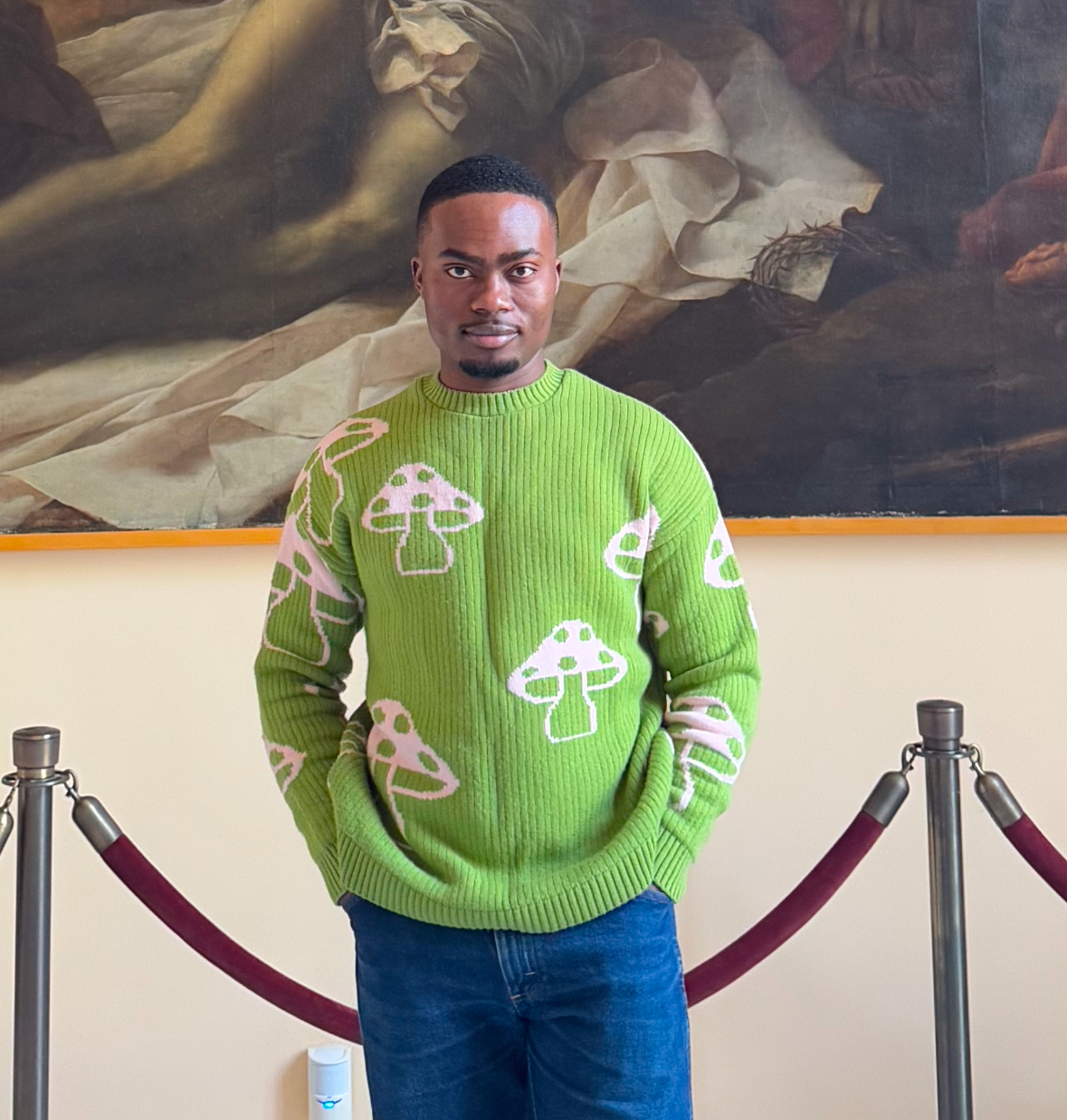
NER 46.3-4 author Olakunle Ologunro talks with staff reader Zara Karschay about looking back versus looking at, the behavioral consequences of heat, and breaking his own heart while writing his story “Home Training.”
Zara Karschay: You paint a realistic portrait of many suburban neighborhoods and the communities that develop there, as well as how simultaneously supportive and destructive such close-knit places can be. You have lived in big cities throughout your life: Lagos, where this story is set, as well as Baltimore. To what extent did you draw on your own experiences when imagining the social and spatial dynamics of this story?
Olakunle Ologunro: To a great extent. This story emerged from a state of deep nostalgia. In the early 2010s, I think, a brothel opened up in our neighborhood in Lagos, Nigeria, and some of the ladies who worked there would come to my mother’s shop to buy things, talk, or just hang out. Some years later when I was in Baltimore, miles away from home, I was suffused with a specific kind of longing, so I reached for this memory.
I’m currently working on a collection of stories and a novel and I’m often plagued with moments of uncertainty where I think, “Will anyone get it? Does this even matter?” To keep me going, I often return to this quote from Lorde on the making of her album Pure Heroine: “Each of us have a handful of songs inside us that are ours, and only ours, to sing. Your specific interests and upbringing and physiology and experiences exist only in you; you are sitting on a gold mine that no one can rob.” I tapped into that gold mine for this story. My mother’s shop, the neighborhood, the brothel, the family dynamics, etc. A lot has been heavily fictionalized, of course, but the kernel of the story came from a nostalgic longing for home.
I have lived in big cities throughout my life. Right now I’m based in upstate New York and it’s kind of small and rural, so it’s been a bit of an adjustment. Who knows, maybe in the years to come I’ll feel a longing for it and write a different kind of story!
ZK: Do you think it’s helpful to get some distance from a place before writing about it? Maybe the light catches the places we once lived in a different way, when we’re several months (or miles) away from them?
OO: I like your phrasing of it! I completely agree. Nostalgia and memory lend a certain shimmer to the places we have lived before. I was born and raised in Lagos, but I couldn’t really write about it the way I wanted to until I moved out of it. It felt too outsized to fit on the page, larger than life. But after I moved away, it was easier to look back at things.
There’s a line from Amy Hempel’s short story “In the Cemetery Where Al Jolson Is Buried” that I often turn around in my head: “I don’t know why looking back should show us more than looking at.” Sometimes, looking back at a place you’ve lived in—or even an experience you had—shows you more than looking at.
ZK: Tomiiwo’s mother fills a role that goes well beyond that of a shopkeeper. As a mediator, connector, and counselor, she controls the social climate of the neighborhood. It’s a burden she seems acutely aware of. She censors her new customer, Anjola, first by adding a loaded suffix (-oluwa) to the new resident’s name and then by making the young woman’s work at the local nightclub, Fun Embassy, more “palatable” by revising the history of why she ended up there. Do you see the way Mummy Tomiiwo interacts with her son as a result of all this pressure she feels to uphold a moral standard for the neighborhood?
OO: I don’t think it’s a pressure to uphold a moral standard for the neighborhood, per se. I feel like it’s more of a moral standard for her child. We have a saying where I’m from, “A bad child brings reproach to his mother.” (I looked up the provenance of this saying, and strangely enough, it has its roots in the Book of Proverbs.) The belief is that a poorly trained child reflects terribly on the mother. Tomiiwo’s mother is training her son to be good and well-mannered, but I don’t think she considers how tricky children can be. Sure, they learn from what you say, but there’s also what you do, and that’s a stronger—and quite often, more effective—model of behavior for them.
To connect this to your question, a roundabout way to view things would be that Tomiiwo’s mother, in training her son to be good and respectful, might end up controlling the social climate of the neighborhood in her own small way. Children can be a kind of social currency; people see a respectful child and they accord the mother some kind of respect, too. It might be a grudging respect, but it’ll be respect nonetheless. “Her children are so well-behaved,” they’ll say.
ZK: Your decision to write “Home Training” from the perspective of Tomiiwo allowed us to fully experience how he reads the adult world around him. We can forget exactly how insightful and resourceful children can be. How did you find the voice of this character?
OO: In the earlier drafts, I truly believed I was writing a story about Fun Embassy. But in between edits, my advisor Lysley Tenorio asked, “What do you think this story is really about?” And I realized it was about Tomiiwo’s mother, her relationship with Tomiiwo, and how Anjola’s presence complicates this and reveals new things about both characters. Years ago, I was in a nonfiction workshop and one of the prompts was to write about ourselves from the point of view of one of our parents. That prompt has stuck with me ever since. I think I finally used that prompt here, although it’s for fiction. I had Tomiiwo talk about his mother from his own point of view.
ZK: Some writers say they need to know what they are writing about before they put pen to paper. It sounds like you find this approach restrictive to creative work and that “theme” can sometimes only emerge after you’ve let your characters explore and play?
OO: Very rarely do I go to the page knowing exactly what I want to write. Sometimes it happens but like I said, it’s rare, and only after I’ve done a lot of thinking. I am always open to surprise: surprising myself and being surprised by my characters. To leave room for the unexpected. It’s always a rewarding experience.
ZK: Heat moderates action in the story. People seek an escape from it. Tomiiwo struggles to concentrate, to work, and later, to keep secrets from his mother. Was it a conscious decision for you to use heat as a behavioral modifier for your characters?
OO: I wasn’t thinking of it as a behavioral modifier, but you’re right! Heat does affect a lot of things in the story. To be honest, I deliberately set the story in June, the peak of summer, or as we call it in Nigeria, dry season. That way, Tomiiwo’s mother offering Anjola a drink wouldn’t seem too strange. And having Anjola work on Mummy Qoyum’s farm, too, wouldn’t be too farfetched. I should also say, when I first thought of this story, the very first scene I saw clearly was Tomiiwo standing in the sun and sweltering in the heat.
ZK: At the end of “Home Training,” you reach ahead in time, revealing how Tomiiwo and his mother’s relationship eventually falls apart. The sudden leap into the future, and only right at the climax of the story, was so unexpected and it brought the story to a heartbreaking and powerful end. Why did you decide to shift focus here and have us reflect on long-term consequence?
OO: I’d been thinking about the story’s ending and knew that something wasn’t working. After the story was accepted, I worked with NER editor Carolyn Kuebler on edits (she is so wise and brilliant, I had a lot of fun working with her!), and she said she’d been thinking of how Tomiiwo would go on after the shift in dynamic with his mother, how he would learn to separate himself from her. Honestly, the future seemed the best place to look.
I’m interested in how we look back on our actions with regret, wishing we could have done better but also understanding that we did the best we could at the time, before we had the benefit of hindsight. Tomiiwo and his mother love each other—that much is clear. And they’re also similar in ways they perhaps hadn’t considered until Anjola mentions it. So it only seemed right to break their hearts in this way (it broke my heart too, I have to admit).
Zara Karschay’s fiction has appeared in Ploughshares, The Baffler, The Gettysburg Review, and elsewhere. She received the Harper-Wood Award for English Poetry and Literature from the University of Cambridge in 2017–18, was shortlisted for The Alpine Fellowship’s Prize for Poetry in 2024, and was awarded second prize in Zoetrope: All Story’s Short Fiction Competition in 2025. Zara lives in Germany, where she is completing a novel.
Olakunle Ologunro is a 2025–2026 Olive B. O’Connor fellow in fiction at Colgate University. His writing has been awarded an Elizabeth George Foundation grant, a Tennessee Williams Scholarship for the Sewanee Writers’ Conference, and a Juniper Summer Workshop Scholarship, and has been nominated for a Pushcart Prize. His work has also received support from the Virginia Center for the Creative Arts (VCCA), Vermont Studio Center, and Aspen Words, where he was named a 2025 Emerging Writer Fellow in fiction. He received his MFA from Johns Hopkins University and is at work on a collection of stories and a novel.