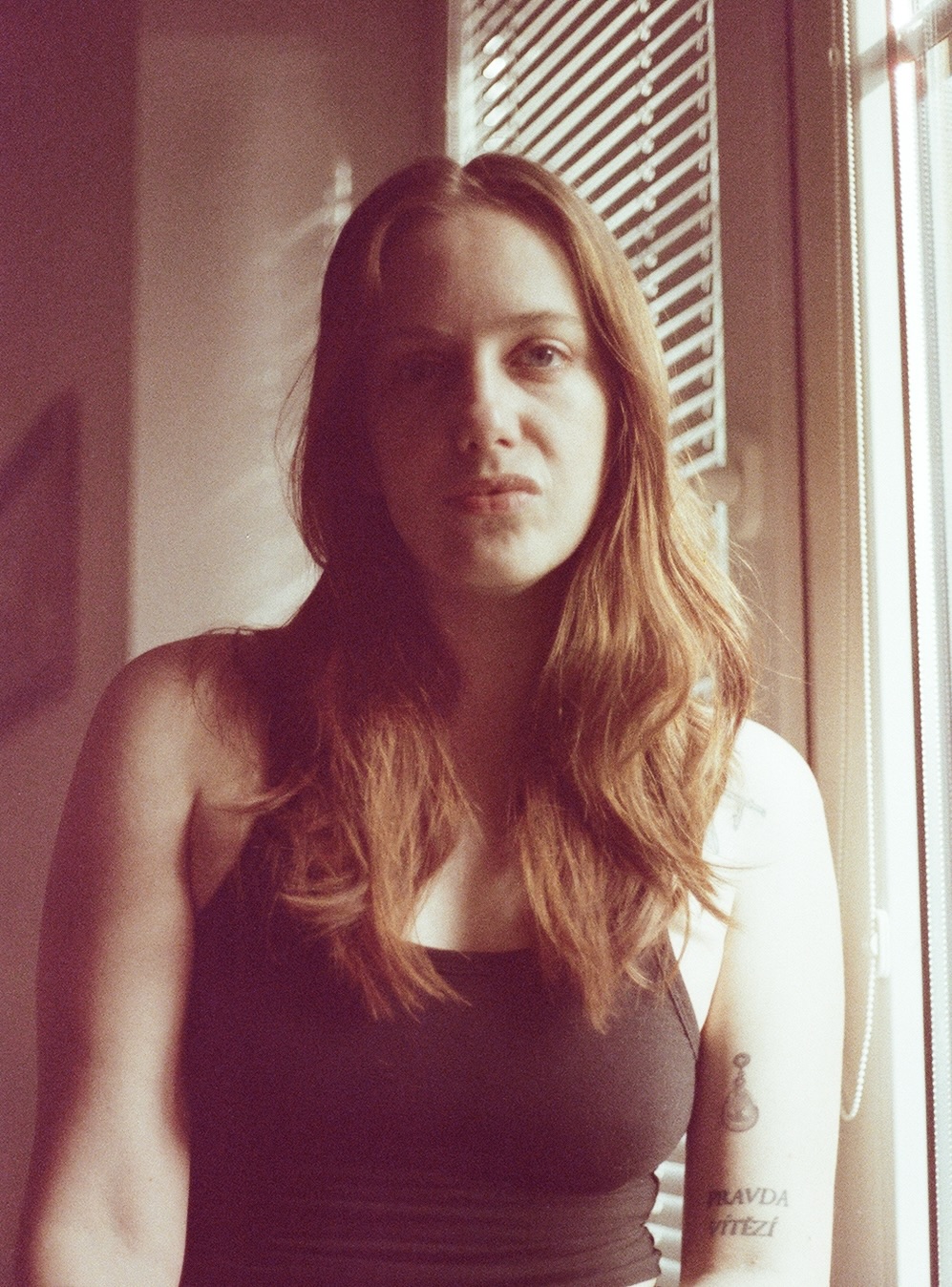
NER 46.3-4 author Alisha Dietzman talks with managing editor Leslie Sainz about the meditative power of repetition, fixed moments of sensory memory, and the generative influence of film and TV on her recent poems.
Leslie Sainz: Though we’ve known each other for over a decade and are good pals, I don’t think I’ve ever asked you outright about the function of repetition in your work. Given your background and the way your writing often circles capital G God, I’m inclined to compare it to the repetitive structure of prayer. What informs your penchant for repeating certain words, phrases, or sentences within an individual poem or poem sequence? Do you have any internal rules for how or when to apply this (often manipulated) circularity?
Alisha Dietzman: I think you’re right that my faith likely informs my use of repetition. I currently worship in a high church environment that prioritizes liturgy because I’m a “post”- evangelical cliché (I hate the term post-evangelical), but I was raised in a low church tradition, so prayer tended to be free-form and loose; I do think that even the loosest prayer, however, often has a particular cadence and rhythm that trends toward repetition. More than prayer, though, I think I owe my love of repetition to scripture, especially the use of parallelism and repetition in the poetic books of the Bible, which I have always loved deeply. Growing up, my family read the Bible together every day and I was encouraged and expected to memorize verses. I continue to read scripture daily; if I feel chaotic and scattered, I’ll just read Psalms, but always a Psalm, at least one Psalm. so that music always lurks in the background of what I write. I think there’s also something in Southern syntax, too, that makes beautiful, assertive use of repetition, and that has likely affected my writing. To me, it sounds eerie and forceful and adds a kind of surreal clarity, like I will say this word again and again and again until you truly hear this word, in all its nuance and possible shapes; say the word ‘cherry’ ten times in a row and if feels different the tenth time than it did the first time. Repetition is aggressive, but softly so. I like that. I really like that, personally and politically and poetically. I like the tenacity and stubbornness and strangeness of repetition.
LS: This may be sheer coincidence, but both your poems in this issue are formally preoccupied with the number seven. The three stanzas that comprise “Czech Movies” are a tidy seven lines each. And each stanza/individual page of “California” contains seven lines. I don’t think of you as a numerology person, so is this a total red herring? If so, talk to me about your current philosophy on form. I’ve had the pleasure of reading some your unpublished work and I think your newer writing is consistently more symmetrical, and both shorter and “neater” than the poems in your book Sweet Movie, for example.
AD: These questions are making me realize that so often when we talk, we don’t talk about poetry! We talk about what we’re reading and what we’re seeing and thinking about (and skincare and our parents and our cats and Vanderpump Rules), but form, not so much. That’s also because you are a form girl, though, too, like a real form-head—which I admire—and I’m just floating off in space, by which I mean that I often don’t know why I make the decisions that I do, poetically, or otherwise. I love this kind of question, though, because it forces me to consider my actions.
It is sheer coincidence, truthfully, but I’m a fatalist with a mystic bent, so I think there’s something going on subconsciously, at least. Lately, I have been drawn to a certain tidiness and neatness in my work. I’m writing poems that feel emotional to me in a new and sometimes terrifying way. My current manuscript, “XOXO” feels like the most vulnerable work of my life thus far, and I think I retreat sometimes into smallness, shorter, tighter lines, for example, to counter how overwhelming the content feels to me as I write. It grants me a sense of control to write these brief, intense poems focused almost entirely on language and image. I want the reader to feel the intensity that I feel as I write, lurking, but on a language-level, in the condensed syntax and bright, sharp sounds, in the smallness. I want the poems to look and read like little screams. I am learning restraint and confidence, too, as a writer, and that is translating to an investment in a more, I don’t know, delicate, less sprawling poetic. I am less concerned with mass legibility, and more with personal and particular experience, my own, and the reader’s. I think I felt a lot of pressure as a younger poet to communicate through my natural opacity—which often meant adding content to clarify, and prioritizing this clarity over formal tightness—but increasingly, I don’t feel that burden.
LS: You’ve spoken elsewhere about your affinity for ekphrastic writing and your insistence on not referencing the art object when writing towards or around your experiencing of that art object. To me, the lines “I don’t remember specifics; I remember / specific feelings” in “California” embody this approach. With that in mind, could you speak to the process of writing your poem “Czech Movies,” which perhaps because of the title’s plurality, presents a recurring cast of assured concrete images and characters, i.e., “specifics”?
AD: Even for recent events, I don’t have a good memory, and what remains usually appears in my mind as sensation, and color: was I scared, were the walls particularly green? Both of my earliest memories are just of flowers, sunflowers somewhere in South Dakota—I think—when my family drove across the US, and irises, the irises someone gave my mother at the airport when we moved to Prague. Other people have filled in the details, but I don’t remember anything else in these “scenes,” just flowers. I’ve learned to let this guide my writing, and I see it as kind of a weird gift that I am so focused on strange minutia over any overarching narrative or meaning or structure. When I experience a work of art, and I choose to write it, I am always trying to “do justice to that event,” the strange little event of my strange little experience, so my ekphrastic work typically strays fairly far from the original, and doesn’t concern itself all that much (or at all, really), with accuracy vis-à-vis the art-object in question. “Czech Movies” draws primarily from František Vláčil’s Marketa Lazarová. I talk about this film a lot because I love it a lot, and I love it because it makes me feel certain things: cold, hot, lonely; it makes me smell snow, and horses and blood and wet, late winter. The images are assured, I guess, and concrete, but still mostly a responsive, gut-level slurry that—ideally—expresses the (minor) event of my experience of watching a few particular scenes in Marketa Lazarová (which in that moment, to me, were muddy and gruesome and tender and made me think about God).
LS: I’ve always admired your fragmented syntax and the way your commas seem to function as film transitions do. They dissolve, cut, wipe, etc. This, to me, is another signature of your work, something you were doing even when we were in graduate school together. And I think your sequence “California” showcases my “comma as shot transition” theory rather well. Take, for example, the lines: “Nude by the window on another clean night, / I watch two girls ignore the train, look just like horses, / running, jasmine.”
How does cinema—its production and the experience of watching it—inform your poetics?
AD: Okay so this question is smarter and more perceptive than any answer I will be able to give, but I’ll try.
I have a complex relationship to movies. I almost feel like I don’t like movies. I never think: I want to watch a movie, you know, but I watch a lot of movies, and they kind of set my brain on fire. I find them tremendously, tremendously generative. It’s the speed, in part, the transitions, the constant motion. I’m usually responding to scenes, or shots, not films in their entirety. This makes the event, the experience, so brief and so difficult and just wild to translate poetically, but so thrilling. Like, what did the pears in the corner of the screen that might have been pinkish-green, maybe, I can’t remember exactly, mean, to me?
(Also, thanks for this lovely observation about my work.)
LS: Okay, I have to include a “fun question” to be cheeky. What question did I not ask you that you were hoping to answer?
AD: This is too much freedom for me. You asked this of me because you knew I’d panic. Let me think. Maybe a nice, friendly softball question that isn’t The Best Question EverTM (I know you too well, sorry).
Here, I’ll be you – Alisha, what’re you working on these days?
I’m so glad you asked, Leslie. A “novel” (look, I’m a poet), called “Strange Country” that is maybe about reality TV and the desert and also a third poetry manuscript that is currently in God’s hands re: topic.
Alisha Dietzman is the author of Sweet Movie (Beacon Press, 2023), selected by Victoria Chang for the National Poetry Series. A finalist for the Kate Tufts Discovery Award and the Oregon Book Awards, Sweet Movie was also shortlisted for the John Pollard Foundation International Poetry Prize. Her creative and critical work has received support from the Rebecca Swift Foundation, the Jeffrey Rubinoff Sculpture Park, the Barbara Deming Memorial Fund, the National Endowment for the Arts, and the US-UK Fulbright Commission.
Leslie Sainz is the author of Have You Been Long Enough at Table (Tin House, 2023), winner of the 2024 Audre Lorde Award and a finalist for the Poetry Society of America’s Norma Farber First Book Award, the New England Book Award, and the Vermont Book Award. The daughter of Cuban exiles, her work has appeared in Poetry, the Academy of American Poets’ Poem-a-Day, The Yale Review, The American Poetry Review, and elsewhere. She’s received fellowships from the National Endowment for the Arts, CantoMundo, and the Stadler Center for Poetry & Literary Arts at Bucknell University. She teaches in the Newport MFA program at Salve Regina University.