Sholeh Wolpé | Literature & Democracy
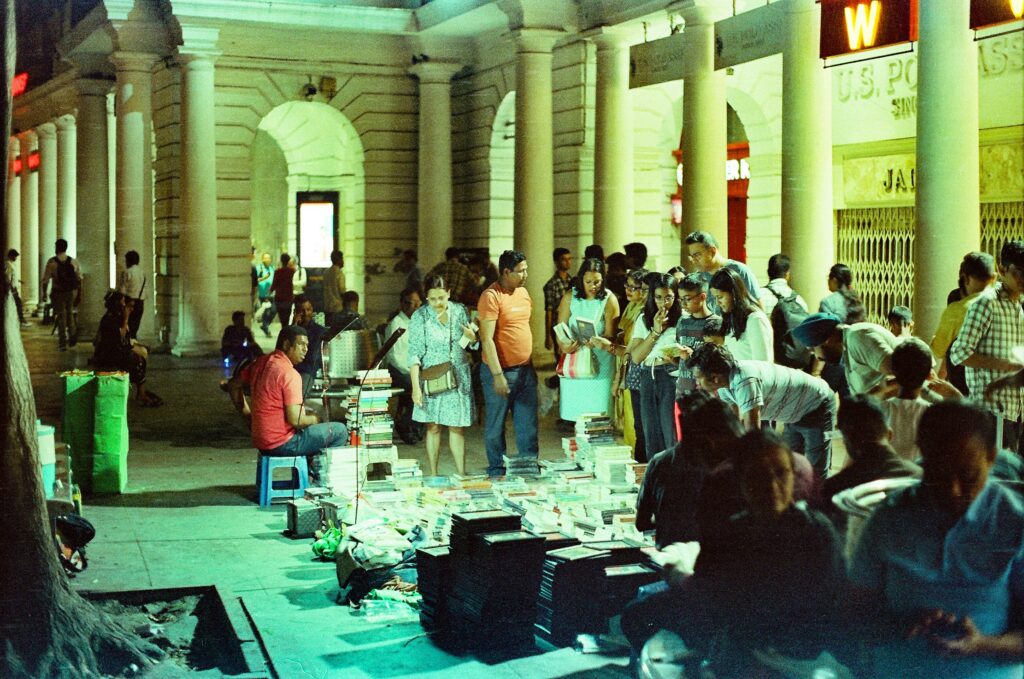
Delhi, India. Photo courtesy of Kunsh Ahuja.
I belong to the minority of Indian English writers who—maybe because of my small-town background and my socialist understanding of history—had suspected all along that many of the vaunted features of Western democracies were an attribute of their wealth and privilege, born from centuries of colonial and imperial domination, and that these features would crack once the going got less comfortable. Some years ago, I had come to the conviction that maybe 80 percent of what passes as tolerance in any age or culture is essentially just a reflection of privilege. That is why the dominant cultures of an age—ranging from some Muslim cultures of the past, such as the Mughals in India or the Ottomans, all the way through the British at their colonial apogee, and to the U.S. in the second half of the twentieth century—usually come across as surprisingly tolerant for their periods. It is easy to be generous or tolerant—which can be just a kind of assured absent-mindedness—when you are in a position of largely uncontested power. It is when your power starts feeling shaky that you come to the test. Many, for obvious reasons, throw overboard many of the ideals that they had once touted—and often used to castigate other people, even wage wars on them. Others, for admirable reasons, hold on more obdurately to those ideals. When I talk about literature and democracy, I talk about these few. And, in times like this, literature is one of the things that matters.
Despite its history of banning occasional books and films, mostly under colonial British laws, post-independence India has not curbed progressive literature excessively. In pre-British India, more than three hundred versions of the revered epic Ramayana existed in South Asia, and there are now estimated to be at least 1,200 versions of the Mahabharata. While Brahminical religious tracts were jealously guarded by the priestly castes, and the lowest castes were mostly denied access to them, there was still a long tradition of popular religious compositions, which could even result in a new religion, as epitomized by Guru Granth Sahab of the Sikhs, or give rise to legendary poets whose works are still recited, such as the roving fifteenth-century sage-poet Kabir, who did not mince words in criticizing the rich or the pretentious, priests and preachers, kings and businessmen, Hinduism and Islam, and promoted a concept of universal love:
Pothi padhi padhi jag mua pandit bhaya na koi
Dhaai aakhar prem ka padhey so pundit hoi
(The world has turned ancient reading thick books but that hasn’t made anyone learned;
They who can spell out the meager alphabets of love, only those persons are learned.)[*]
Despite this inheritance, both under the British and afterwards, writers and dramatists have at times been attacked and murdered in India for their writings. One thinks of the communist playwright Safdar Hashmi, murdered on January 1, 1989, while performing the street play Halla Bol (Raise Your Voice!) in a village outside Delhi. The centrist Indian National Congress party’s workers were accused of that murder. One thinks of Paash (Avtar Singh Sandhu), a major Punjabi poet of his generation, killed by Sikh extremists on March 23, 1988. One thinks of the radical feminist writer and editor Gauri Lankesh, shot dead by unknown assailants outside her home on September 5, 2017. Unidentified adherents of the Hindu nationalist conglomerate were accused of that unsolved murder. There were others, too, as well as the occasional ban on a book. Most infamously, one can recall the ban on Salman Rushdie’s The Satanic Verses in 1988; India, under the centrist Congress party, was the first country to ban the novel. The ban was rescinded in 2024 by the courts.
More recently, in Hindu nationalist-corporatized India, books are simply rewritten, or they disappear from reading lists. This has happened to the work, including the brilliant short stories, of Bengali writer Mahasweta Devi, in the Hindi heartland. Her uncompromising accounts of the precarious and state-traumatized experience of marginal, particularly aboriginal, communities, made many “Proud to be Indian” nationalists uncomfortable. India, of course, has extensive practice, starting with centrist Congress regimes in the 1970s, of making the poor disappear from view instead of eradicating poverty. But when the excellent English poems, not political but simply modernist and ironic in tone, of Arun Kolatkar’s Jejuri, start getting dropped from some university curricula, as has happened recently in Delhi and elsewhere, one wonders.
Take my shirt off
and go in there to do puja?
No thanks.
Not me.
But you go right ahead
if that’s what you want to do.
(Kolatkar, Jejuri)
To better undertstand such corporatized “re-ordering” of libraries and curricula in India, a practice that is sadly even more advanced in the U.S. today, I spoke to Mridula Koshy, an author who works as a librarian and community organizer with the Community Library Project, which runs four free community libraries in Delhi NCR.
Koshy was born in New Delhi in 1969 and migrated to the U.S. at the age of fourteen. She returned to India in 2004, and has subsequently written and published three books and a number of essays, stories, and articles. Her collection of short stories, If It Is Sweet, won the 2009 Shakti Bhatt First Book Prize and was shortlisted for the 2009 Vodafone award. Her first novel, Not Only the Things That Have Happened (Harper Collins, 2012), was shortlisted for the 2013 Crossword Book award.
Tabish Khair: Mridula, I first met you as a writer—in print. That was when you had published If It Is Sweet, which I read with admiration and reviewed. About twenty years have lapsed since then. You have lately been much more active as a community organizer. What is the relationship between writing and organizing for you?
Mridula Koshy: My family and I migrated to the U.S. when I was a teenager, and as with migrants everywhere we were unequal members of the society in which we found ourselves. Organizing in the trade union movement was an answer to the question of how I could find power for myself and others. Later, I returned to India and my writing was a new tool for questioning inequality. I think both writing and organizing allow us to question our society, but their methods to power are otherwise quite different.
TK: In India, you have been involved in providing free libraries to children in working-class neighborhoods, thus addressing an important aspect of inequality—not just literacy but also the availability of books to those who have literacy but lack sufficient means. Would you tell us more about it and the relationship of reading/books/libraries to democracy?
MK: We serve children and adults in the three brick-and-mortar and one digital branch of our free library. After all, children become adults eventually, and if we have done our work well with them in childhood they will not only need but also want to continue engaging with text and ideas and the community experience of reading and thinking together, which good libraries everywhere provide.
Free membership in a library is an exceptional experience in India, where most libraries charge membership fees even for the most basic services. The notion of free is radical in our capitalist world, which commodifies the basic necessities people need to live well and with dignity, in many cases effectively excluding them from those necessities. These market-driven, class-based exclusions act in concert with other historic and contemporary systems of exclusion, such as race or gender, and, in the case of India, caste, so that people are further organized into ossified hierarchies. The injustice is multiplied and people experience severe loneliness under the burden of such injustice. Because it is free, the community library in Delhi is able to undo the commodification of information. This opens the door to a welcome for all people; people sit together to share books and ideas. I often see people in the library experience what Dr. Ambedkar described as fraternity, an idea that he rooted in the Buddhist teaching of metta (metta in Pali, maîtri in Sanskrit), which he considered central to the project of democracy. He is not only revered for drafting the constitution of India, but he is also understood as the most profound critic and political thinker of how democracy might succeed or fail in India.
TK: All around the world, democracy does not seem to be in good health these days. This applies to India as well. What do you think has been happening, and what is likely to happen?
MK: Things are not easy for young people these days anywhere. In the library, each year we lose young adult members to low-wage jobs that leave them little or no time for reading or socializing. And the adult section of one of our branches is nearly always full of members studying for high-stakes, competitive school or civil service examinations. They know that even if the exams they are studying for are not canceled, as many exams are, they are up against very long odds: In India, even among those who manage to get a college degree, the unemployment rate is close to 30 percent, and about half of graduates who are employed end up doing low-skill jobs.
The frustration and disillusionment that result from these economic conditions are bound to put pressure on democratic institutions. The ideological and economic structures that we generally refer to as “neoliberalism” no longer seem capable of delivering what they long promised: increasing individual freedom in a world where rapid economic growth raises standards of living for more and more people. In recent years, the limited economic growth we have seen has been concentrated at the top, leaving broad sections of society competing over a smaller section of a stagnating pie. It is easy to see how this can lead to an erosion of democratic values such as fraternity: in order to avoid addressing root causes, politicians blame immigrants or other groups of minorities and pit them one against the other. The library’s job in this environment is important and various. We provide communities with access to powerful information, and a place for people to meet and learn from each other. But, as mentioned above, we also incubate fraternity, which is the best antidote to far-right, divisive politics.
TK: In your community libraries you describe “incubating fraternity.” What does a text that sustains fraternity look like on the page—at the level of voice, address, or plot—compared to a text that merely elicits self-congratulatory empathy?
MK: When we talk about incubating fraternity, we are talking in the library about undoing the historic exclusion of large numbers of people in India from reading and literature. A text that sustains fraternity is a text that is equally available to everyone. It is any text on an open shelf in a free library where everyone has a right to enter and where everyone is equally welcome. Perhaps there are texts that sustain fraternity through technique, style, and plot. But in the context of how literature has served us all along, as the great human project of discovering ourselves as human, it matters less what the text says or does, and matters more that anyone and everyone can reach for it, and in reaching for it, reach for one another.
Reading in India was prohibited to the lowest castes and to Dalit people, i.e., those outside the caste system, on the basis of the scriptural text Manusmriti. Women were also prevented from reading and writing through social norms and practices such as early marriage and child-bearing. Women and many Adivasi or indigenous peoples were only able to access schooling beginning in the nineteenth and twentieth centuries through the influence of Christian missionaries and Indian social reformers, such as the Phules.
Although today there is nearly universal enrollment of children in schools, there is no emphasis on literature and critical thinking in the public school system. Children have access to extremely limited quantities of text in the form of textbooks. There is little by way of a public library system. The working poor are as excluded from reading in this century as in the last many. As a result, Indian literature—in most Indian languages and in English—is the narrow purview of the few.
In the library movement that is growing in India we speak often of reading as socially constructed. Our library leaders, many of whom are quite young and fit the description of first-generation students, speak in public forums as part of their library movement activism. I recall one such event at the Foundation for Indian Contemporary Art, where a member of the audience said with surprise and pleasure, “but you are changing reading.” This was in response to the stories the young leaders from the movement had been sharing about how, in the libraries with which they are familiar, people most often read collectively and discuss what they have read collectively. Most of the readers being described do not have private collections to read and personal space in their own homes to read; the library is the space where they read together. Their entry into reading—as often collectively as individually—changes that narrowly created literature, interrogating and broadening it to serve more people.
At the Jaipur Literature Festival some years ago an important Dalit writer was asked by a member of the audience when Dalit literature would mature to move beyond the memoir. The person asking the question was herself an influential literary figure. The insult might have been grave if the question was in itself not foolish. The gradation of literature into a hierarchy of maturity is of course a reflection of a highly gradated society. I can imagine a future with more people reading and writing memoirs and other works in a spirit of increasing fraternity that topples the self-congratulatory literary figure from her lonely heights.
TK: Thank you, Mridula. This is such a rich and fraught area. As a writer, and before that a reader, I am pessimistic about the way things are shaping up, but your answers also provide one with a glimmer of hope. Let’s hold on to the hope.
[*] Translated by the author.
Mridula Koshy is an Indian writer and free library movement activist. She migrated to the U.S. at the age of fourteen, returned to India in 2004, and now lives in New Delhi with her three children. She has published three books and a number of essays and stories. She is the winner of the Shakti Bhatt First Book Prize.
Tabish Khair grew up in a small town of the state of Bihar in India. At the age of twenty-four, he left his town to work as a journalist in Delhi. A few years later, he moved to Denmark to do a PhD. He currently teaches at Aarhus University and is the author of eight novels, two collections of poems, a collection of short stories, one play, and various studies and articles.
This is the fourteenth installment in our “Literature & Democracy” series, which presents writers’ responses to the threats to democracy around the world.
Subscribe to Read More