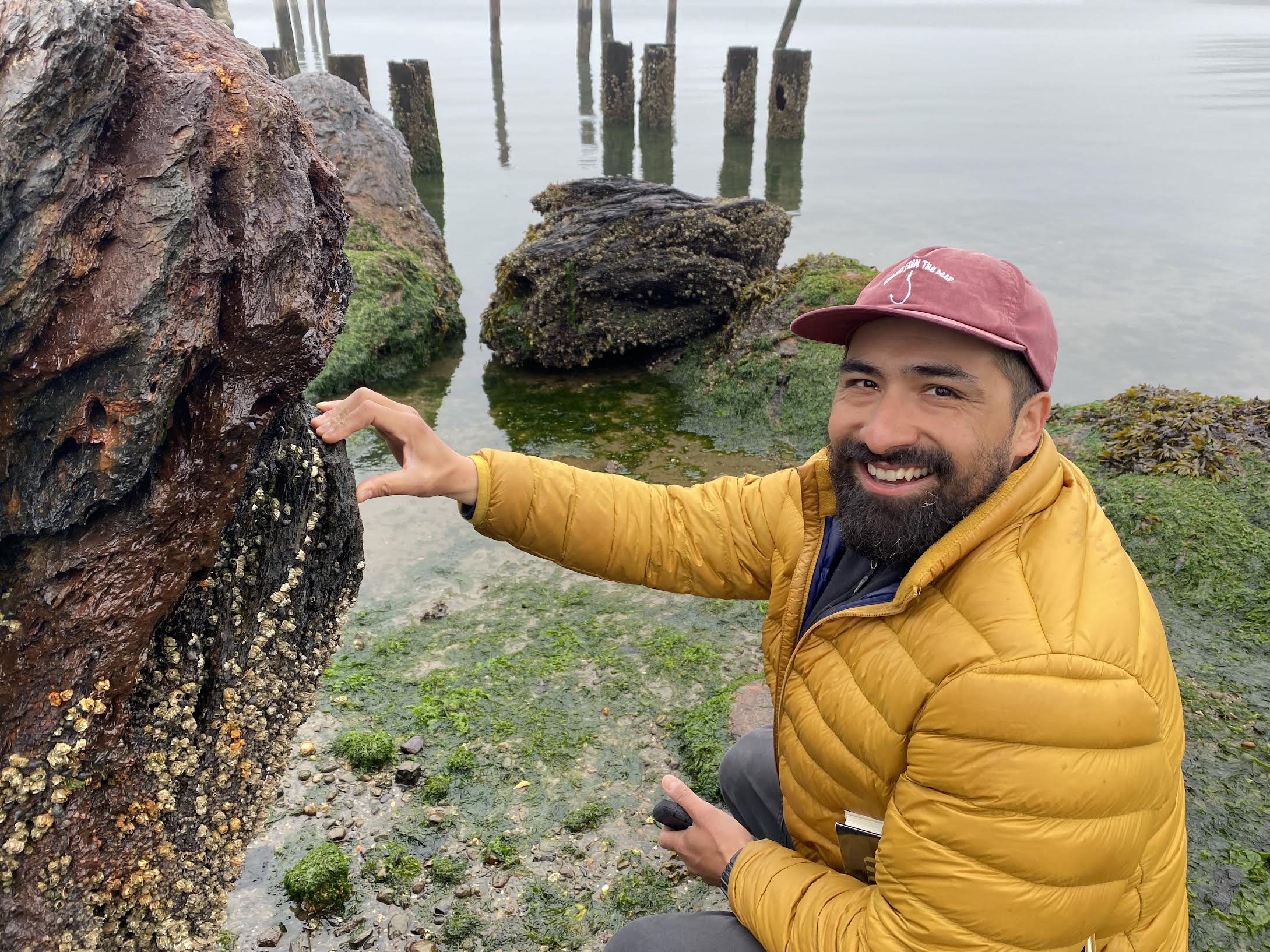
Staff reader Zara Karschay talks with writer José Orduña about ambiguity, refracting the immigrant experience, and the question of fate in his story “Night Blindness” from NER 47.1.
Zara Karschay: “Night Blindness” opens with the young Marcos confronted with the gruesome sight of a corpse. What made you choose to start the story at this moment?
José Orduña: What I felt was central to this story’s events and every character’s experience of them was precipitated by a historical moment in Ciudad Juárez around 2010. Juárez has gone through ebbs and flows over the years, but the escalation of violence sixteen years ago still stands out to me; it feels like everyone in the city was somehow touched by or proximate to it.
So, in many ways, starting with Marcos’s discovery of the body was the story’s inciting incident, but it’s also a false one. Later on, readers find out that his mother, Susana, had already made the decision to send him across the Mexico-U.S. border for his protection and for economic reasons, but she kept postponing it. The moment of hyperviolence in Marcos finding the corpse is the final prick of the pin that sets Susana’s decision in motion. I wanted these multiple crisis-points to mirror how varied the conditions are for a lot of immigrants, especially those from border towns like Juárez.
ZK: Susana decides the time is right to send her son across the border after the reported death of one U.S. citizen among the Juárez killings: “There were lines, she thought, even in Juárez.” The attention given to the death of this woman is particularly apposite in that she is given a name, where all the other casualties—Mexican citizens—are left unnamed.
JO: I wanted to accentuate how certain people are named and mourned while others are not. In All They Will Call You, Tim Z. Hernandez travels to Mexico to search for the names of the men who were killed in a notorious plane crash that Woody Guthrie wrote about in his song “Deportee (Plane Wreck at Los Gatos)”. Guthrie acknowledges that all the news reports called them “migrants,” and their names were never printed. Likewise, Hernandez does the incredibly beautiful, gestural work of finding these men’s families and learning their names.
Most recently in the U.S., everyone was rightfully outraged by the horrendous killing of Renee Good and Alex Pretti. I don’t think it’s wrong that people are outraged by that. But in the month they were killed, six other people died who were not made known. You really have to search for their names; even news reports don’t always include them: Geraldo Lunas Campos, a father from Cuba, died. He was imprisoned at the Camp East Montana facility in El Paso. His cause of death was ruled a homicide due to asphyxiation. Luis Gustavo Núñez Cáceres, Luis Beltrán Yáñez–Cruz, Parady La, Herber Sánchez Domínguez, and Víctor Manuel Díaz—names we don’t hear, let alone know. But we should know these people, too. We should know their stories and how and when they died.
This disparity didn’t just start in 2026. In doing research for my memoir, I came across a case that has lodged itself in my brain ever since. In 2012, a boy by the name of Jose Antonio Elena Rodríguez was shot by U.S. Border Patrol agent Lonnie Swartz. The defense said that the agent felt in fear of his life, and he had to shoot this boy. It was a cross-border shooting, where the agent shot from the U.S. side into the Mexican side. At the place where the shooting occurred is an approximately twenty foot, all-metal border wall where the pylons are inches apart, and it’s up on an embankment. The ground on the Mexican side is significantly lower than that of the U.S. side. The official story is that the boy was throwing rocks and the agent was in fear for his life. Well, I stood in the spot where the agent stood. And I couldn’t understand how someone in the agent’s position could feel threatened. The rock would have had to go over the wall and suddenly defy gravity and drop straight down. The Arizona Republic acknowledged that the agent fired several shots when the boy was already face down on the ground, and that the agent ran out of bullets, pulled back from the border wall, reloaded, and went back and kept firing. This man was found not guilty by a jury of his peers. A dedicated group of people know the boy’s name and kept his story alive, but the broader American public don’t know Jose Antonio Elena Rodríguez.
To get back to “Night Blindness,” the U.S. citizen who is killed in Juárez is named in a report that Susana reads; I always wanted this news to be kept at a distance. It’s not something she personally witnesses or has contact with, but it still has an effect on her.
ZK: You apply proximity and distance to reveal the disparities of looking across borders from one side versus the other. Susana seems constantly confronted by the border between the U.S. and Mexico. She works at a maquila in a border town. Her sister, Graciela, a mirror image of her, works across the border, and Susana sees her as a lifeline for Marcos. You’ve also set a hard border in your story’s structure, defined as ‘I’ in Mexico and ‘II’ in the U.S. I’m assuming that decision was deliberate.
JO: I tell my creative writing students all the time that works are made in revision. At a certain point, I realized I could cleave the story right down the middle, and it would feel meaningfully true to these characters’ experiences as people with immigrant backgrounds. I realized each of these characters was a version of something I have felt. Each one was a refraction of the immigrant experience, which is usually homogenized. We can categorically say “an immigrant experience,” but there’s such heterogeneity within that container. It’s a unity, but so many differences are contained within that unity. When I read an account, when I hear someone with a migrant background tell me their story, it is unique to them, but they all cut just as deeply. When we cross, we do so in ways that are unique to us; the action actually fragments us into multiple pieces, and our makeup isn’t binary in the way borders suggest. And yet, it is often the binary that comes to represent who we are, especially in government documentation.
ZK: Juan, a graduate student who is solicited as a Spanish-language translator by the U.S. school where Marcos appears, has had to grapple with the disconnect between the painful history of fellow Mexicans migrating to the U.S. and the experiences of his students who can afford to live in ignorance of them. I was struck by how elegantly you wove historical context into “Night Blindness” to explore this. How did you balance Juan’s fictional narrative arc against the historical forces that have moved him?
JO: I wanted Juan to appear “successfully assimilated”; enough to be in a graduate program, for example. But this assimilation has come at a cost to him that is not necessarily elaborated on in this story. It’s a cost that I’ve seen in myself and in many others, one that we don’t always know is being extracted from us. I wanted Juan to be damaged but accomplished. He is not in the same position as someone newly arrived like Marcos, but he still bears the burdens of crossing and departure.
Juan’s immigrant background also makes him a man with a perpetually tenuous destiny, and that’s why it made sense for me to end his arc on an uncertain verge. I’m reminded of the ending of “Seven” by Edwidge Danticat, which feels incredibly organic but is so well constructed in its ambiguity. By the end of the piece, not only do you not know the future of the main characters, but you get the sense that they don’t know what’s going to happen either. This uncertainty, to me, reveals the truth of the moment. I wanted to strike a similar tone at the end of “Night Blindness” where, even if we as readers are aware of that historical moment from 2010, Juan cannot know what happened to Marcos for certain, and I think that’s one of the most devastating aspects of the immigrant experience.
ZK: The story also leaves Marcos at a point where his fate is in the balance.
JO: Yes. Something I came across in my research was the concept of “ambiguous loss,” which explains the phenomenon of grieving missing people. Sometimes death is presumed but there’s no evidence to confirm it, so families have no closure. I wanted to instill in Juan this feeling of ambiguous loss for Marcos. Neither he nor the reader knows if Marcos was apprehended, or if the mother of the boy who Marcos pushed called ICE on him, or if he left with someone else because they were preempting what might happen.
I also wanted to leave the ending open because I thought “Night Blindness” might be the beginning of something longer!
ZK: We’d love to see your story continue. That’s a nice inroad to ask you about your writing process: As this is your first short story, did you plan it all in advance, or did a natural rhythm emerge over time?
JO: I wrote this story in chunks. The middle was the end, and everything else was out of order and out of time. It wasn’t until other people gave me great notes that it took shape.
I do have a writing discipline though, so I guess stamina rather than strategy was most important to finishing “Night Blindness.” Depending on my teaching schedule, I’ll push everything aside to write. I maintain several creative projects, which helps to keep momentum. I write on my laptop and whatever image or moment I finish on, I’ll jot it down in my pocket notebook. That way, when I’m walking around, or taking my kids to the park, I’m thinking about where I left off and how to move things forward so it doesn’t feel like I’m having to start the engine again when I get back to my desk.
ZK: Many writers seem to use fiction to find patterns and familiarity in things they wouldn’t otherwise understand, or that seem downright absurd. Patterns are everywhere in your story, and they take on different meanings to different characters. Running blue tape into webs across his room gives Marcos a sense of order and control. For Susana, patterns appear in her factory work, and they can be frustrating, even disorienting, in their repetitiveness. I wonder if your approach to writing your first short story came from a similar desire?
JO: That’s interesting! Your description feels applicable to the essay, where I see an elegant, winding, and strange through-line that connects dissimilar ideas and contexts. The magic of the essay is that is connects these dissimilar things via the personhood of the narrator. But I guess that’s also true of fiction and the short story. Understanding what moves the characters and then making those motivations collide with what will happen to them gives me a logic by which to progress the narrative. Maybe that’s it; I finally realized what writing fiction is.
José Orduña earned an MFA at the University of Iowa’s Nonfiction Writing Program. His first book, The Weight of Shadows: A Memoir of Immigration and Displacement, published by Beacon Press in 2016, explores his experience as a Mexican immigrant living in a post-9/11 United States. You can find his work in Timothy McSweeney’s Quarterly Concern, The Believer, and The Nation, among other publications, and on his website: joseorduna.com.
Zara Karschay’s fiction has appeared in Ploughshares, The Baffler, The Gettysburg Review, and elsewhere. She received the Harper-Wood Award for English Poetry and Literature from the University of Cambridge in 2017–18, was shortlisted for The Alpine Fellowship’s Prize for Poetry in 2024, and was awarded second prize in Zoetrope: All Story’s Short Fiction Competition in 2025. She reads fiction submissions for NER.