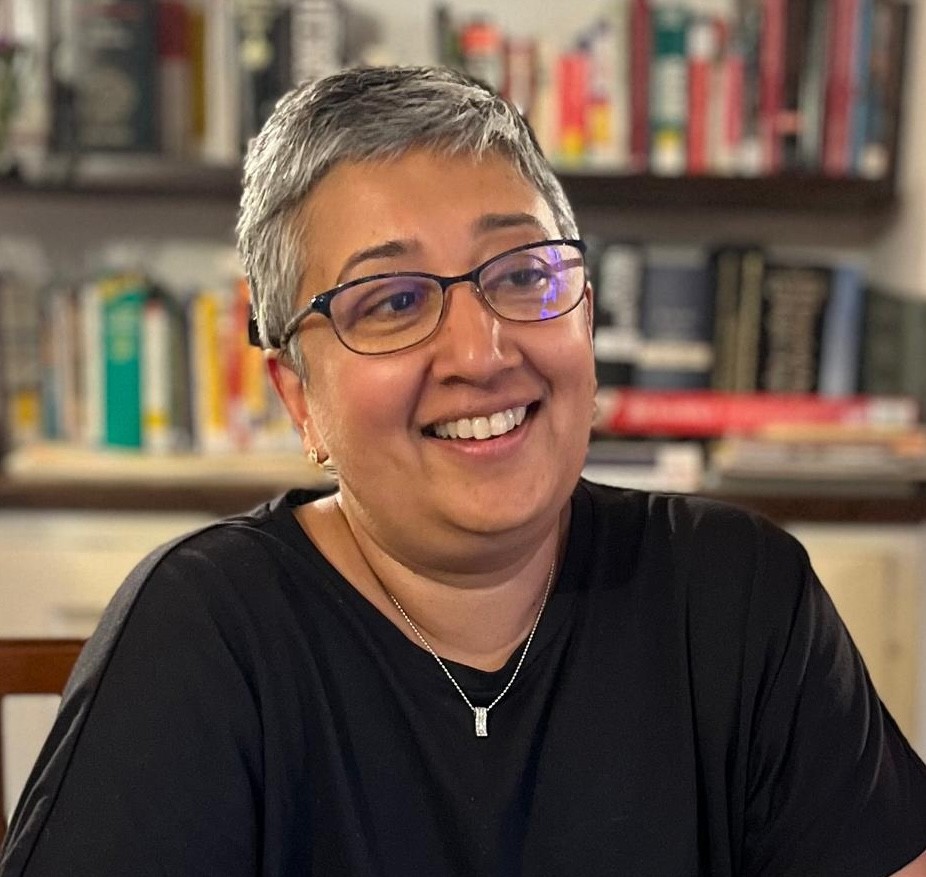
Staff reader Meera Vijayann talks with NER 47.1 author Hasanthika Sirisena about rethinking relationships, the differences between public and private sex, and the research that led to her essay “Castaway.”
Meera Vijayann: When we talk about sex shops, the images that come to mind are seedy and dangerous places that primarily cater to men. So it’s fascinating that when you enter a sex shop on US Route 11/15, you are dressed in hot pink and expensive gold jewelry. How did people in that space react to your curiosity as a writer? How did you feel visiting a sex shop in middle age compared to your youth? In the beginning, you say a man slunk away as if “you represent something wrong”—
Hasanthika Sirisena: The sex shops I visited are small businesses and they are clean and well-organized—like a grocery store, really. But grocery stores advertise themselves, and these shops take great pains to not make what they sell immediately apparent. That’s not about seediness but about cultural barricades.
And that’s a great question about visiting a sex shop in middle age. When I was in my twenties, I didn’t know anything. I had no language. And sex seemed an experience that I was supposed to have, but there also existed these multiple, invisible constraints around the who, when, and where. I was supposed to simultaneously manage this all with the utmost respectability and also enjoy it hedonistically. I had no idea how all this was supposed to happen. Sex shops were my first encounter with sex in its variations as a very public act.
What strikes me now about reentering these shops is how mundane everything is. It’s these barren storefronts, these giant, opaque facades, that make anything inside actually salacious. How many stores do we encounter in a day that appear to actively keep us outside? Once inside, though, I felt tremendously aware of the number of workers engaged in boring, meaningless, repetitive labor—the production lines, the merchandising, the bookkeeping—that goes into producing this aura of private pleasure and transgression.
And that’s how I dress, typically. There’s a lot to be unpacked right there, but we don’t have the time or space.
MV: Class is a theme that I identified throughout “Castaway.” You talk about the history of sex shops, our cultural landscape, and the invisible labor that goes behind meeting the demands of people. What did the “unofficial organizing” of sex shops in urban and rural America teach you about our larger discourse around sexuality and class today?
HS: A lot. My fear for our culture is that income inequality is sorting people into those who can afford to participate in institutions like marriage and domestic partnership and therefore can afford sex and, frankly, can afford to be touched and those who can’t. Even as I write that, I recognize that statement can easily read as patently silly. There are plenty of married people (and I use the word married here not to privilege marriage but just to indicate one social institution) who are having frequent, pleasurable sex and some married people who barely touch. For me, this is why the distinction between public and private sex is so important. There’s private, intimate sex that’s about individual choice and individual experience, and there exists public institutions that allow for sex, in many iterations and variations, to be readily available to everyone and anyone who wants and needs. I worry that when we place sex behind a huge concrete wall with no map and no signage, we exclude so many. Only the savvy and the able-bodied and the privileged and protected—which in this culture is often those who can monetarily afford privilege and protection—can access sex.
And this isn’t just a queer issue for me. I also am worried to the extent that this sorting process is impacting straight men.
I think almost every day about Amia Srinivasan’s The Right to Sex. The book is so clear-eyed, and the language is one of questioning and examining but always with compassion. I think we were having an interesting and important discourse about sex at the time her book was published. I think we aren’t currently, or that conversation has become very siloed. I’m hopeful things will change and that we return to a kind and inclusive discourse, soon.
MV: There is an undertone of sorrow when you write about Samuel R. Delany’s Times Square Red, Times Square Blue, and how our culture privileges certain kinds of relationships and hierarchies. Is there one thing you hope your essay can change people’s minds about?
HS: I urge us all of us to rethink what love and a relationship looks like. The other day, I came across an advice column where the letter writer described herself as a cancer survivor in her early seventies, bald, and worried that no one wants to date her. The advice columnist’s response was kind but amounted to “Get out there. You haven’t connected with the right people yet.”
Many assumptions nestle within this statement. That a person who has undergone cancer treatment can even “get out there.” Or what it means to connect when your body has managed and survived illness. I felt the word “bald” was almost a metonym for everything this woman had lived through and everything she felt the world didn’t want to accommodate about her. Her loneliness was real and palpable and stays with me now. I understand we have a barely functioning health care system so it’s probably a big ask to wish for public institutions that offered real, physical, tangible companionship and care for someone like her, but what we offer now feels like a terrible cruelty—damage on damage.
I don’t want to change anyone’s mind because that’s not what an essay should seek to do. I do wish each of us would ask of ourselves two questions: How far am I really from being that letter writer—an illness, a divorce, a couple of missed paychecks? What might each of us gain from a set of institutions that have an expansive vision of sex as care that everyone deserves and should be allowed access to if we choose?
MV: How did you prepare to research and write this piece? What was your process?
HS: I’ve had the great privilege of teaching queer literature and the literature of disability. I have been immersed in the work of people who theorized about this at great personal threat to themselves—even now. Theorists like Eve Kosofsky Sedgwick, José Esteban Muñoz, Sara Ahmed, Jack Halberstam. My essay owes a debt to Lauren Berlant and Michael Warner’s “Sex in Public.”
I started with that base of knowledge. I visited the shops and talked to the people who worked in them. I did archival research. As I mention in the essay, this corridor of sex shops received a lot of attention from the local news media when it first appeared. And, I lived in the area for almost a decade, so I talked to many people who had opinions about why these shops existed and who they served.
MV: What are you reading right now?
HS: I am reading Johnathan Gleason’s A Field Guide to Falling Ill.* I’m in awe. He weaves together themes of queerness, the body, who our culture designates as worthy of treatment—and not—by weaving together the personal, the reported, and the deeply researched. It’s a remarkable work and deserving of a wide audience.
Hasanthika Sirisena’s essay collection, Dark Tourist (Mad Creek Books/The Ohio State Press, 2021), won the Gournay Prize and was a finalist for a Lambda Literary Award.
Meera Vijayann, a nonfiction reader for NER, is an essayist and writer based in Seattle, Washington. She is currently working on her debut novel.
* See Jonathan Gleason’s essay “Exit Wounds” in NER 42.4 (2021).