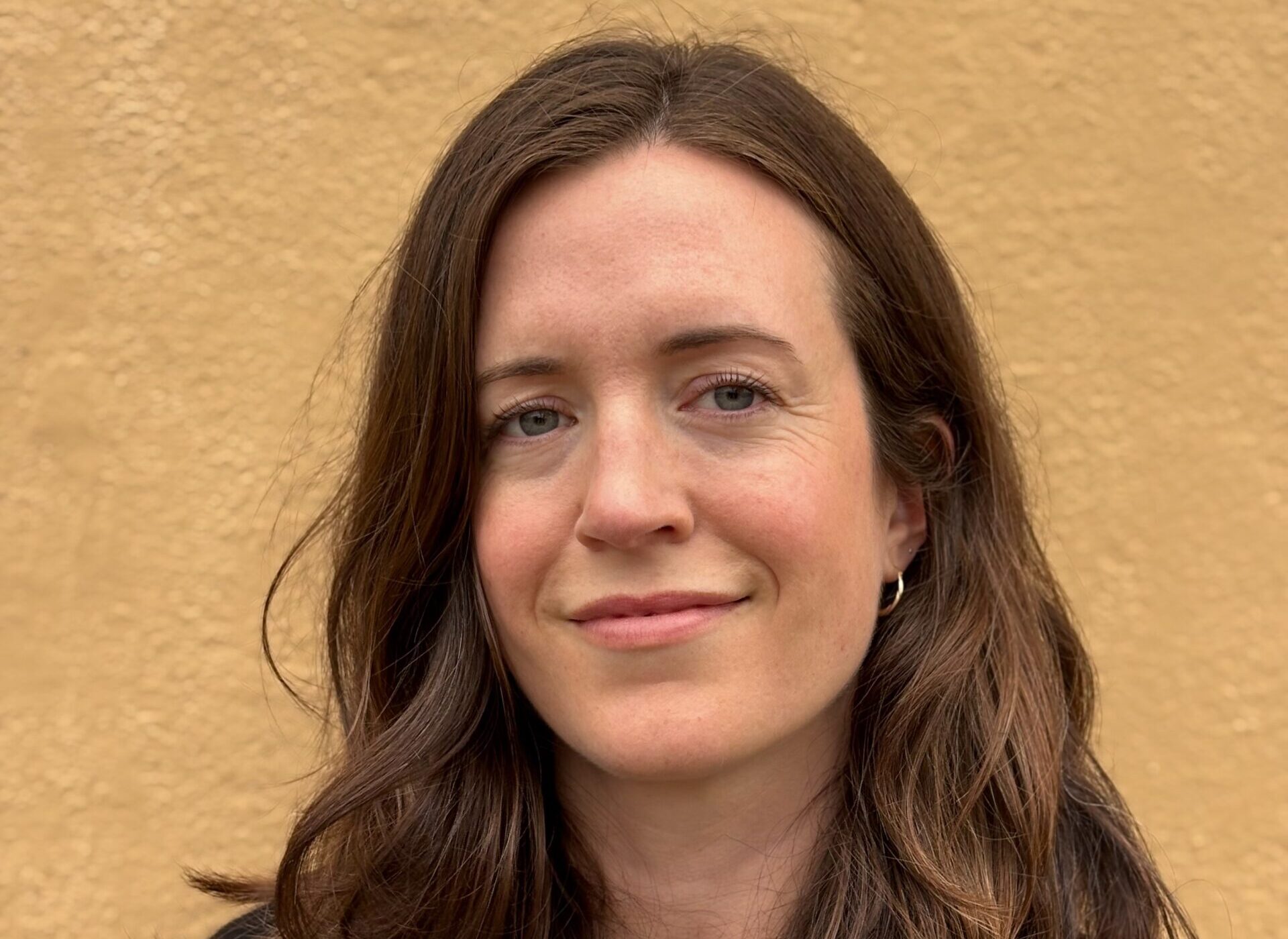
Staff reader Anna Chung talks with Liz DeWolf about how language and place inflect her characters and how her own experiences learning multiple languages shaped her short story “Lingua Franca” from NER 47.3.
Anna Chung: “Lingua Franca” begins by immediately characterizing both the narrator and Su as foreigners. However, we never learn where they’re from or where they are now. Was this intentionally left ambiguous? In lieu of this knowledge, what did you want readers to focus on in the story or in their relationship?
Liz DeWolf: What I was most interested in while writing this story was the absurdity of trying to genuinely connect with another person in a language neither of you knows particularly well. The fact that Su and the narrator don’t have much knowledge of each other’s native language or culture makes it more difficult than it otherwise would be for them to bridge that gap using preexisting knowledge or assumptions. Not naming specific places or languages allowed me, as the writer, and hopefully also allows the reader, to stay narrowly focused on this sense of being constrained. I hope it also heightens the satisfaction of moments when the characters manage to get around it.
AC: The conversations between the narrator and Su so aptly capture the awkward rhythm (and unintentional humor) of trying to find the right words in a new language. I’m curious about your process of writing dialogue, and in particular this kind of purposefully stilted dialogue. What is your own experience with language and translation? Did you have a language in mind that you were translating to or from?
LD: I wasn’t translating from a specific language, but I did look to my experiences learning Spanish, French, and Turkish at different points in my life. The dialogue particularly draws on conversations I had with other students in my French classes in Paris and my Turkish classes in Istanbul. My experience with Turkish probably had the most influence here because, of the languages I’ve studied, it has the least in common with English. It’s important to the story that the language Su and the narrator are learning is very different from either of their native languages, which are in turn very different from each other. This creates a linguistic triangle, where neither character has an advantage over the other. They meet at an equidistant point.
AC: In the story, the act of translation is presented more than once as something “laborious,” and it becomes clear that translation can create more opportunity for misunderstanding and misconstrual (whether deliberate or unintentional). Yet a lack of fluency also allows for unexpected clarity or truth. I am thinking, for example, of when the narrator says that her “open life is now closed” (a phrase that I loved). Was this tension something you always wanted to explore?
LD: Yes! Thank you for reading the dialogue so attentively and for articulating this tension, which was definitely central to my interest in writing this story. I’m fascinated by the ways we manage to express abstract or complex ideas when our knowledge of a particular language is limited. It’s excruciatingly hard but immensely satisfying if you can find a way to do it. And, like you said, sometimes being forced to work from a simpler palette can lead to surprising profundity. At the same time, because you’re operating within both your own limits and those of the person you’re speaking to, there’s always the chance the other person won’t understand what you mean. There’s no real way to confirm or deny understanding without a third party of some kind, whether that’s a translation app or another person who knows both languages. This ambiguity is unavoidable, but it’s not necessarily a loss. There are moments in the story when accepting ambiguity is an act of kindness or mutual respect.
AC: Despite the lack of specifics in the story, language, place, and identity seem to be fundamentally intertwined. Given that the shape of these characters is so influenced by the language they are speaking or the people they are around, I’m curious how you first encountered them, and how they may have developed during the process of writing this story.
LD: In early drafts of the story, Su was the character I knew most about because I was following the narrator’s process of trying to understand her. This meant that, at first, the narrator was only observing and interpreting. Many of my stories end up at least partly taking the shape of what Lawrence Buell calls the “observer-hero narrative,” in that they tend to be structured around a significant relationship or encounter that the narrator or filtering perspective (the observer) has with someone they find particularly compelling (the hero). In all first-person stories, the narrator’s perspective limits how developed other characters can be, and this is even more restricted in observer-hero stories due to the narrator’s intent gaze on the “hero.” In this story in particular, the narrator’s gaze on Su is further warped by linguistic constraints. It took several drafts for me to understand more about the narrator herself and why she might be so drawn to a friendship in which it’s harder to articulate what she thinks and feels.
AC: Ren and Zed are able to speak with Su and the narrator in their native languages, in which they are seemingly more comfortable and able to be themselves. Yet the characters who share a language seem to be driven further apart by this rather than closer together. What role did you envision these secondary characters playing in the story?
LD: Just as I was interested in how linguistic constraints can lead to surprising moments of clarity and intimacy, I also wanted to explore ways in which unlimited access to language might actually hinder connection. Because the narrator is actively trying to get a grip on her own state of mind, she’s threatened by the fluid conversation she’s able to have with Ren. She fears she might accidentally share things about herself that she hasn’t yet come to terms with, or that she could be more readily judged. In a way, she feels she has less control in her native language than she does in her second one.
Though we don’t have access to Su’s perspective, it’s suggested that living in her second language affords her the level of privacy or anonymity she craves. Zed is the only character who can communicate easily with both Su and the narrator. From this perspective, his presence is dangerous for Su.
AC: There is a sense that Su and the narrator are always being perceived by strangers (the old woman on the bus, the child with gummy fingers), who may also be filling in the gaps of what they think they understand about each other.
LD: The language that Su and the narrator speak together is not a common one for people to learn in adulthood. And by being each other’s primary conversation partners, they’re almost developing their own version of that language, reinforcing each other’s idiosyncratic usage, which naturally makes native speakers curious. Sometimes they stare. This creates a barrier around the two of them, estranging them from where they are while intensifying their bond within it. But their bond is also tenuous; they have to work very hard to sustain a shared sense of understanding.
AC: At its heart, the story seems to be asking what it really means to know someone: It becomes clear that more language or information does not always translate to more understanding. It also interrogates how we are shaped by our past and how we simultaneously try to escape it. Are these questions that you have always been interested in exploring? How does this fit into your work more broadly?
LD: A friend once told me that I “seemed different” depending on which language I was speaking, not just in my word choice or accent but in my demeanor. I was unsettled by his comment at the time—was I less “myself” in one language than another?—and it’s stuck with me because I’ve always been intrigued by the idea that a new language, or a new place, can be an opportunity for reinvention, to start over with a clean slate. At the same time, that expression “wherever you go, there you are” has become a cliché because many of us are constantly relearning that lesson. As someone who has moved a lot since childhood, I’ve always wondered how much of our lives is shaped by the place (or language) we currently exist in, and how much we take with us wherever we go—what, in other words, is inescapable. A lot of my writing is concerned with the instability of self-knowledge and how this bears on our relationships with other people.
AC: Finally, what are you reading, thinking about, or working on now?
LD: I’m actually working on a novel based on “Lingua Franca,” which allows me to explore the story’s cross-lingual dynamics over a longer span of time. Giving the narrative more room to breathe has opened up so many exciting possibilities while also posing daunting questions: How might the characters’ relationships shift as their linguistic knowledge develops and as their pasts increasingly demand to be dealt with? A novel I’ve been returning to while I work on my own is My Phantoms by Gwendoline Riley, which follows a confounding mother-daughter relationship from the daughter’s perspective. This dynamic obviously has very little in common with the one I’m exploring, but I’m learning so much from how Riley calibrates intimacy and distance between her characters over time. The prose, especially the dialogue, is so sharp, and the story is just as funny as it is distressing. Reading a chapter always shakes something loose for me.
Liz DeWolf is a writer and editor based in Los Angeles. Her fiction has appeared in The Missouri Review, The Common, and elsewhere. She is at work on a novel and a collection of short stories.
Anna Chung is a writer from Virginia living in Brooklyn. She is a staff reader for NER and her fiction has previously appeared in The Kenyon Review.