Welcome to NER Books, New England Review’s brand-new quarterly book review column. This fall we’re delighted to bring four new and recent works of fiction to the attention of our readers. We conceived the column as a way to celebrate new works in the genres published in the magazine—fiction, poetry, and creative nonfiction, of course, but also novellas, cultural criticism, flash fiction, drama, and all genres of work in translation. We’re especially eager to highlight books from small and independent presses because we observe a disconnect between the vitality of the nonprofit and indie publishing scene and the contraction of books and arts coverage in mainstream media. We plan for authorship of this column to rotate so a range of critics can have access to this platform. We are dedicated to seeking out work by writers from diverse backgrounds and perspectives.
NER Books will go beyond “recommended reading” and engage critically with the selected publications. We do, however, intend to focus on new and recent books we think are artistically valuable and worth our readers’ time. Fortunately, there is no shortage of those. Thanks for being here for our inaugural column. We’re so excited to share this new feature with you.
Publishers, writers, and critics interested in contributing to the column can send ARCs and queries to Emily Mitchell NERbooks@middlebury.edu.
—Emily Mitchell, contributing editor
Four New Fictions
The Red Dress by Frank Huyler, Red Ants by Kimberly Blaeser, A Good Haunting by Carol Mitchell, and Necronauts by Ryan Habermeyer, reviewed by Emily Mitchell.


The Red Dress by Frank Huyler & Red Ants by Kimberly Blaeser
Frank Huyler’s eerie, extraordinary jewel of a novel, The Red Dress (Bellevue Literary Press), provokes sensations that will be familiar to readers of Sara Wynn Williams’s memoir Careless People, about her time working for Facebook. The narrator of Huyler’s story, Nick, is a divorcé and captain of a yacht that wealthy clients charter for day trips on the Mediterranean. He is invited by an associate to staff the vacation of a tech mogul and his family on a private island in the south Indian Ocean. Nick brings with him his seven-year-old daughter, Natalie, whom he rarely sees and with whom he hopes to reconnect during this time. But when father and daughter arrive at the island, Nick learns that they, along with all the other staff, will be required to wear electronic glasses that distort the faces of the people they are working for, masking their identities. Whenever the family is present, the glasses are required to be worn.
What follows is a subtle and astonishing exploration of the experience of inequality, surveillance, and power. What Huyler has identified brilliantly, the source of much of the tension in the novel, is the disconnection between the hollowed-out language and rituals of fairness, still our contemporary default, and the reality of insurmountable disparity. When Nick notices and comments on the fact that all the staff are white, the man who hired him explains that the family wanted to avoid looking like the colonial overlords from decades past, an absurdity that Huyler has the good sense to let stand without comment. And when Natalie is invited to befriend the mogul’s daughters, Nick watches anxiously, knowing she could be discarded or mistreated by her new playmates and there is not much he can do about it.
The children’s friendship forms the heartbreaking center of the story and the grounds on which Nick must resist his own servitude. The novel doesn’t offer any easy solace. It is diagnostic and analytical rather than prescriptive. Indeed, it shows how deep the rot has gone: There’s an excruciating but pitch-perfect scene where Nick discusses the cruel behavior of the mogul’s elder daughter with her psychologist, an evidently intelligent professional who cannot bring herself to acknowledge that the child has done anything wrong. Ultimately, though, there is a suggestion that hope might be found in new, tentative forms of solidarity, especially by reaching beyond the ideal of the intact, nuclear family, as well as in Natalie’s surprising innate resilience. A startling work, gorgeously written, mesmerizing and essential for our times.
Also exploring themes of characters facing power beyond their control is Kimberly Blaeser’s collection of short fiction, Red Ants (Counterpoint). These stories are the prose debut of a highly accomplished poet and have all the strengths their author’s background might imply. Their language is stunning and playful, vividly evoking the northern Minnesota forests where the tales are set. The natural world is intensely present on the page, whether through lyrical description, scientific detail, or the Anishinaabe cosmology that Blaeser weaves throughout, showing a landscape that is full of agency and memory in contrast to the extractive utilitarianism of an intrusive, broader US culture. The stories are also subtly bilingual. Anishinaabe terms connect the reader to an indigenous experience of the landscape and the lives of Blaeser’s characters. Sometimes these are explained for the benefit of the non-native reader. Sometimes they are left untranslated. The effect altogether is absorbing and captivating.
The sentences alone would make this book worthwhile, but there are also other kinds of literary pleasures to be had here. Blaeser has a keen sense of plotting and suspense, as in the opening story, “River Dreams,” in which a young law school graduate returns to the reservation where she grew up, animated by a desire to get to the bottom of her uncle’s mysterious death two years earlier. What follows has the lineaments of a thriller: a brave (or foolhardy) investigator, corporate malfeasance, snappy dialogue, intensifying threat. Blaeser is also adept at handling complex background information gracefully. In the title story, the narrator gets into the knotty details of both ant life cycles and tribal politics, tying them together in surprising and illuminating ways. And there is a wry sense of humor running through many of her stories, most clearly in “Fancy Dog Contest,” about a canine pageant that gets out of hand, and the shorter “Translation for Dummies.”
There are a few stories in the book that feel less fully realized than the rest, like “Waiting: A Quintet,” which disperses its energy too broadly through its use of multiple narrators. But with its emotional range, moving seamlessly from some of the darkest and most difficult subject matter imaginable—the ravages of addiction and climate change, corporate predation, and accidental violence—to lighter, funnier, more joyful terrain, and dipping into the fantastic and the speculative when it is so inclined, this collection does the work of a novel in bringing the reader into a fully and richly imagined world, allowing us to stay and, if we are paying attention, to understand.
A Good Haunting by Carol Mitchell & Necronauts by Ryan Habermeyer
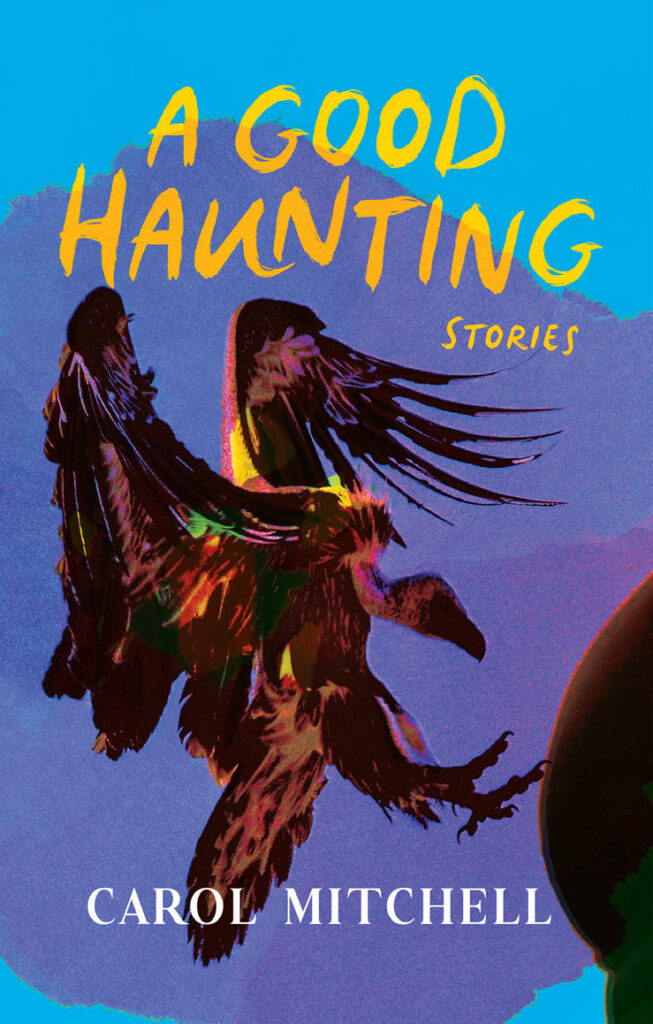
Meanwhile, Carol Mitchell’s first story collection, A Good Haunting (Akashic Books), is delightfully readable. It’s her second book for adults after a prolific career writing for children and young adults. Maybe this has influenced her clear, spare, and empathetic prose style, as well as her basic orientation of warmth toward her characters. Her narrators and protagonists, Caribbean people of both African and Asian ancestry from the present, past, and future, carry with them complex legacies of migration, enslavement, family conflict, and gender bias, which they aren’t always able to triumph over. In “Transformation,” the opening story, a woman caught in an unhappy marriage dreams of asserting her independence. Whether she does this or not is ultimately left open to interpretation, a wise choice that avoids easy affirmation in favor of something more nuanced.
The worlds of Mitchell’s stories are woven through with the magical practices and supernatural traditions of Africa and the Caribbean. These forces (as the title might suggest) don’t always align neatly with good or evil, but are powerful, mysterious, and ambiguous. In the funny, moving title story, the husband of a math professor killed in a car accident is pressured by her family to perform a traditional burial ritual he doesn’t believe in. As the ceremony proceeds, he begins to suspect he might be haunted by her ghost, a possibility he views first with longing, then with more ambivalence, as certain mysteries about his late wife emerge after her passing. In “Motherhood Imposed,” which draws on the figure of the jumbie from Caribbean folklore, the malign enchantment at work is shown as the result of overpowering maternal love, the same force which may also have the potential to put the long-running curse to rest. Mitchell’s magical conceits, which are elegant and intriguing, work beautifully to illuminate the human dilemmas at the heart of her stories. The one exception is the long penultimate story, “The Way of the Volt,” in which the rules of magic are complicated and difficult to grasp, distracting from the ambitious investigation of enslavement, culpability, and fatedness the story undertakes. Overall these tales are a real, satisfying pleasure, smart, fun, and thought-provoking all at once, showing how being haunted can be useful and even at times necessary.
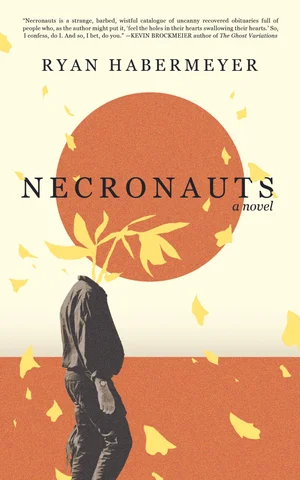
Finally, Ryan Habermeyer’s novel Necronauts (Stillhouse Press) is a wild, dismantled narrative, by turns hilarious, strange, grotesque, and poignant. It takes the form of a series of obituaries and other articles supposedly written by the author’s estranged father in the mid-1980s for his local newspaper in the fictional town of Calypsee, Utah, and discovered in his attic upon his death. These short pieces detail the lives and ultimate demises of Calypsee’s residents as well as the bizarre happenings and figures in the little town, such as the annual Marx jubilee, commemorating Karl Marx’s brief 1875 visit; the butcher boy, who wears his father’s WWII parachute every day and listens to the ground to hear news of the future; and les trois sœurs, spectral sisters who only appear when it snows, looking for the family they never had.
Linking these disparate peculiarities are the recurring figures of the cosmonaut boy, a child who never removes his space helmet and who may or may not be an alien, and the sad dentist who (sort of) adopts him. The cosmonaut boy speaks only with his fingers in a language no one understands. He loves baseball and old science-fiction movies and becomes addicted to ketamine, which he and the dentist take in abundance while they construct an enormous catapult out in the desert, the purpose of which only slowly becomes clear. Between all the vignettes that compose the text, old black-and-white photographs appear, reproduced with varying degrees of clarity and saturation, blurred at the edges or with the faces scribbled out.
This book demands that you slow down to fully take in its startling images, abrupt digressions, and intriguing juxtapositions. Its meanings accumulate as you read to become a reflection on the weird history and reality of the place it abstracts: Utah and the Europeans who settled it, among whom were the author’s own forebears, but also the American West during the Cold War and the late twentieth century. There were moments where I longed for more threads to tie the narrative together, and yet the novel’s wandering feels apt for a book about a world that we can’t make coherent and have to live in anyway. In the end, Necronauts amply rewards the reader who brings the patience and curiosity to properly explore it.
Emily Mitchell is the author of three works of fiction: The Last Summer of the World, a novel (W. W. Norton, 2007); Viral, stories (W. W. Norton, 2015) and The Church of Divine Electricity, stories (University of Wisconsin Press, 2025). Her short stories have appeared in Harper‘s, The Sun, Alaska Quarterly Review, The Southern Review, The Missouri Review, Prairie Schooner, and elsewhere. She teaches at the University of Maryland. Her second novel, Far Ocean, about eighteenth-century century botanist and explorer Jeanne Baret, won the 2025 Big Moose Prize and is forthcoming from Black Lawrence Press in 2027. A former fiction editor at NER, Mitchell now serves as a contributing editor and editor of NER Books.