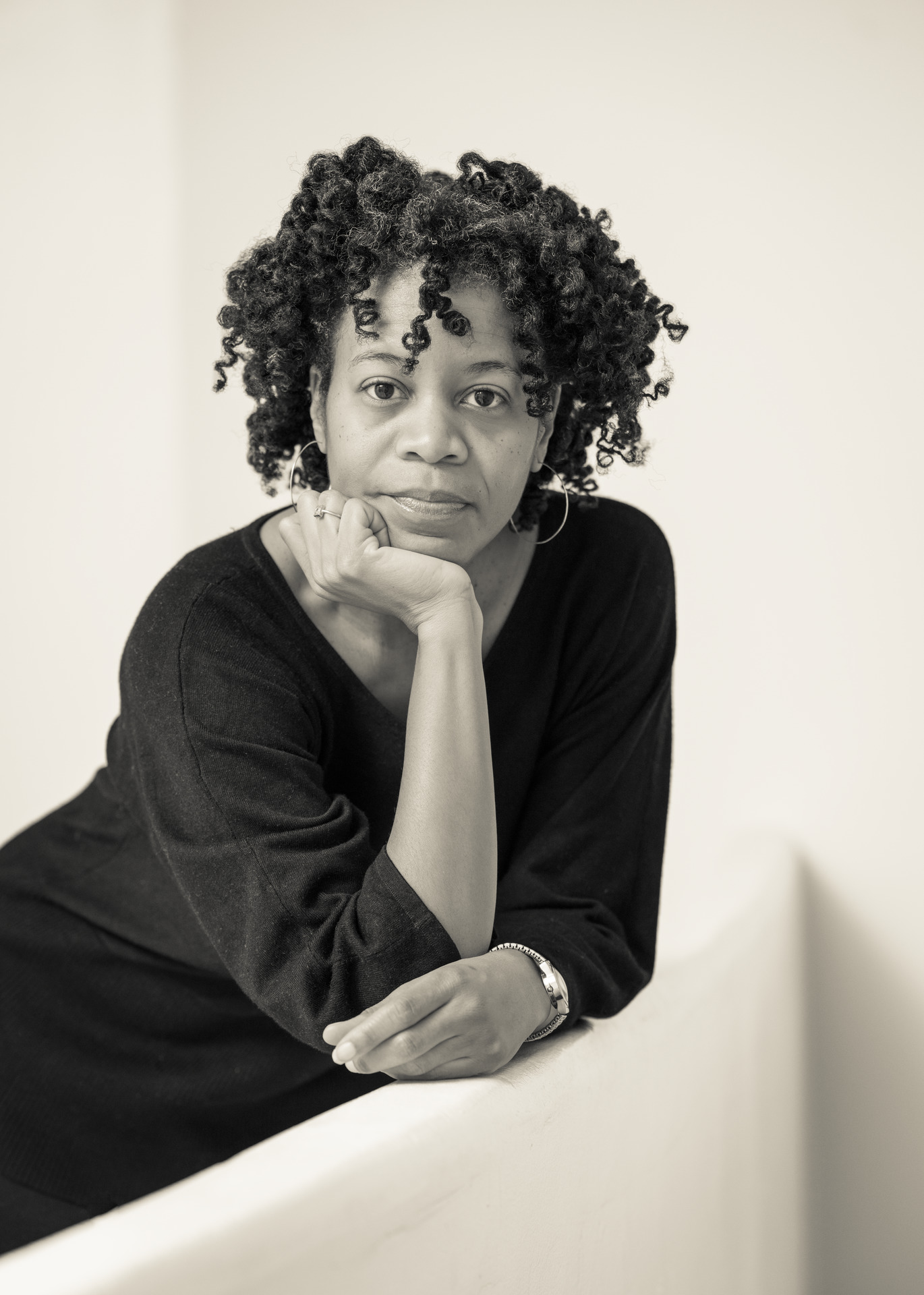
Staff reader Thomas Nath talks with poet Ama Codjoe about intimacy, the potency of childhood, and the uses of memory in her sonnet sequence from NER 47.1.
Thomas Nath: On a broad level, I’d love to hear how you see these four poems speaking to each other. Were there similar emotions or inspirations at play in their creation, or are there specific strands between one or more that were very present for you? Are they part of a larger project?
Ama Codjoe: These four sonnets are a part of a larger project that uses taste as a sensory doorway into poems mainly about childhood. Sometimes the poems stray from literal taste into the realm of predilections, or, as in the case of “[How hard to be extremely sensitive and male],” I was thinking of the taste of tears. I think these particular sonnets are communicating to each other about childhood, patriarchy, and the nuclear family.
Writing them, I was taken back to specific sites of my childhood: the Giant Eagle grocery store; meals at the dinner table, at lunch, or out to eat; the TV room in my childhood home. I went where my memories led me and was surprised by how the themes emerged and cohered across the sonnets. But once I’d finished writing them, it was easy to see how they were singing to each other.
TN: Each of these poems brought me back to that heightened emotional state of childhood, and all seemed to revel in that sense of just how powerful new experiences and sensations can feel when you’re younger. It might just be that I read them in tandem, but I sensed that the same speaker was relating all four poems. Do you see each of these poems as having different speakers, or is there something of a shared voice behind them?
AC: I definitely think of all of these poems as having the same speaker. And I love what you mentioned about the potency of childhood. I think that thus far in my work there has always been an autobiographical impulse—even in persona poems—but in these poems, I was interested in exploring sonnets that also had a memoiristic tone. Taste is so evocative that it made the perfect doorway to enter into an examination of memory and place. Before these poems I hadn’t written much about my childhood—but I, of course, had written about what rippled from childhood into adulthood, the inheritance I received from my family of origin. Writing these particular sonnets felt like taking hold of a thread and walking further and further backwards in time.
TN: I’m really curious about how you see these poems in relation to form, particularly to the sonnet. I loved when these poems dipped into fairly strict iambic pentameter (e.g., “what shock the crossing of those wires makes / inside the patriarch’s bare, beaten chest”). How did you think about the sonnet when composing these poems?
AC: When I turned thirty-three, a friend I‘d known as a teenager reminded me that, as young readers, we’d adored Julia Alvarez’s sonnets in her poetry collection Homecoming. Alvarez wrote thirty-three sonnets to mark her thirty-third year on earth. Recalling Alvarez’s project, I decided to write thirty-three sonnets of my own. As an emerging poet new to received forms, I learned a lot about the sonnet, writing many more than thirty-three poems in the process. I think this kind of focused work tuned my ear to slant rhyme and meter in ways that have influenced all the poems I’ve written since. Now, returning to the form after a long hiatus, I think I have an internal sense of the musicality and logic of a sonnet—or, at least, of a sonnet in my hands. I was also thinking about Wanda Coleman, Terrance Hayes, and especially Diane Seuss when approaching this grouping of poems, which consists of fifteen sonnets in total. It’s been over a decade since I first waded into the waters of the sonnet. At this point, I feel like I’ve internalized the form.
TN: I was really moved by the multiple (and sometimes conflicting) ways in which family functions for the speaker. How does family function for you as a source of material?
AC: In my poems and in my prose, I am often concerned with intimacy. It is a through line in my work. Intimate relationships, including those with my family of origin, are the “stuff of me.” I don’t think of this as source material, but as a part of who I am. Put another way, intimacy is a theme in my work because it is such an integral part of (my) life. I am currently writing a “poetic memoir” about how a year of travel transformed my life, and I find myself much more concerned in prose about how family shows up in the work. The more I write personal nonfiction, the more I understand how freeing poems are: their fictive elements are assumed. I love that my poems about family are not taken as a record or as “the truth” but simply as art. I revel in that freedom in these sonnets and elsewhere.
TN: I read these poems with a sense that the speaker was returning to specific memories in order to glean further knowledge or understanding—about themselves, their family, and/or the broader world. How do you think about returning to memory as a source of knowledge? What sort of truths can we take away from memory?
AC: Mostly, I want to answer this question by expressing the gratitude I feel to be a writer. Writing is a place where I can dialogue, through the excavation of memory, with various aspects of myself. In some ways writing is a process not only of self-discovery, but self-making, and for me the reflection you are pointing to here is key. I didn’t set out to return to a set of specific memories, but as I wrote and daydreamed and stared out of the window, memories returned to me—some of which I’d turned over again and again and some of which I hadn’t thought about in decades. Poems allowed these memories to return and invited me to reflect on them from my current vantage point. This is what I mean about the gift of writing. I learn so much about myself, my family, and the larger world. I bring that knowledge into my relationships with myself, my family, and the larger world. Isn’t that a wonder?
TN: There’s also this sense of the speaker having greater understanding now about specific family members, as when the speaker “soften[s] now” towards her brother, or “understand[ing] [her] father’s appetite.” What role do you see for memory in allowing us to become more understanding, more empathetic?
AC: You’re right, this is a great example of what I mean. Part of my job as an artist, as a poet, is to reflect. Whether while on a walk, talking to a friend, or folding the laundry, I am invested in the task of reflection. This to me is a critical component of art-making. It is this reflection that allows the kind of empathy and understanding you are pointing to. And, in my experience, the “by-product” of that reflection is not only the writing but the living of one’s life. I suppose, too, it works in the other direction—that the ways we grow and mature as human beings can be evidenced in our work as poets, that the ways in which life tests, nurtures, and grows us shows up in the work. I am grateful for the back and forth; it is a beautiful kind of giving.
Ama Codjoe is the author of Bluest Nude (Milkweed Editions, 2022), winner of the Lenore Marshall Poetry Prize and finalist for the NAACP Image Award for Outstanding Poetry, the Kate Tufts Discovery Award, and the Paterson Poetry Prize. She is the winner of a 2023 Whiting Award and a recipient of a 2024 Arts and Letters Award in Literature from the American Academy of Arts and Letters. Currently, she is the 2025–2027 Bonderman Assistant Professor of the Practice in Literary Arts at Brown University in Providence, Rhode Island.
Thomas Nath is a Trini-American writer, researcher, and inartificial intelligence. His work has appeared in the Brooklyn Review and the journal Regulation & Governance. He recently graduated with an MFA from the Iowa Writers’ Workshop and is finalizing his first novel.