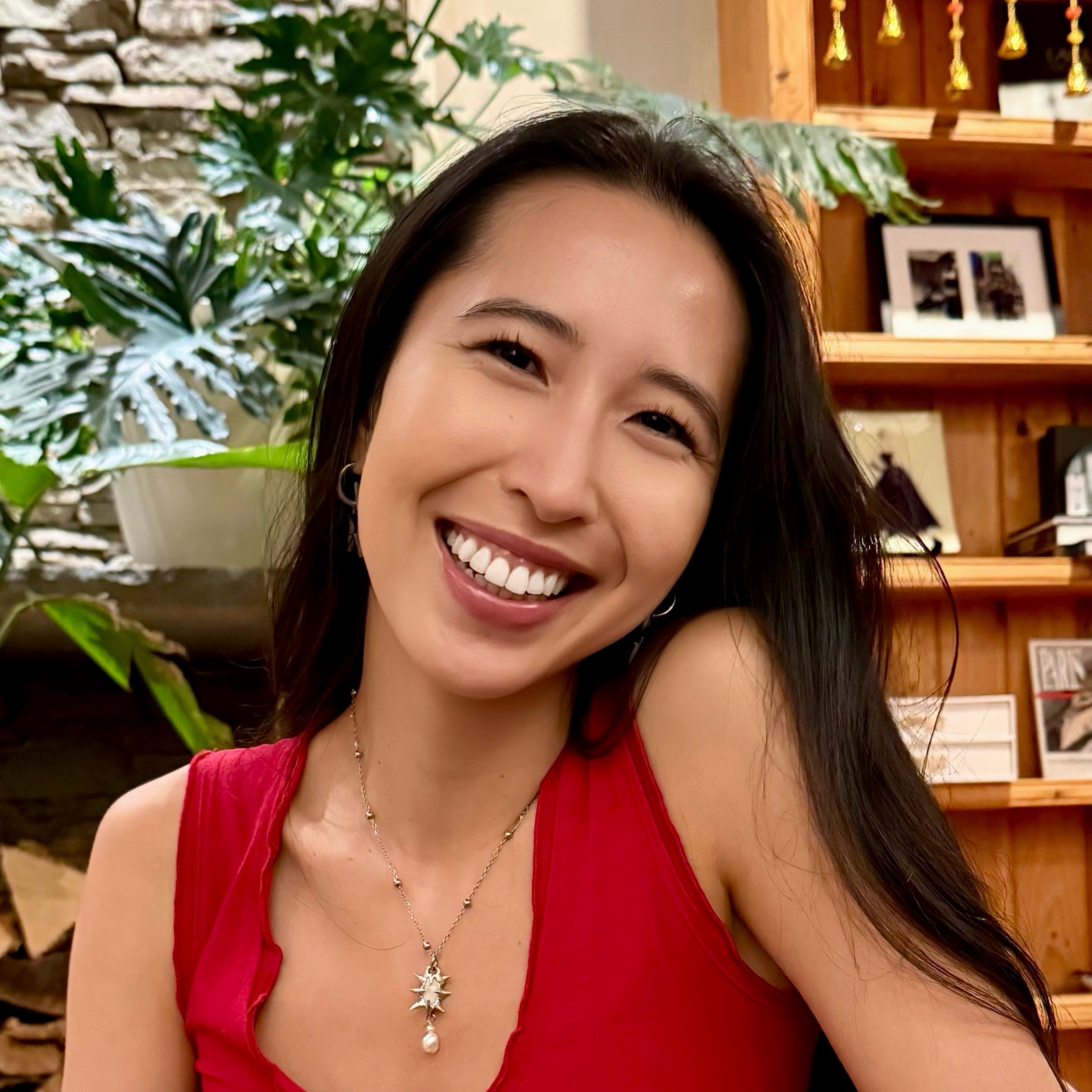
NER 46.3-4 contributor Jessie Li talks with staff reader Dana Lynch about infinite universes, writing in first-person plural, and the function of misunderstanding in her short story “How We Met Our Father.”
Dana Lynch: Where are you in the world and what does your writing life look like right now?
Jessie Li: Every writer has a different process, but I spend a lot of energy gathering ideas, images, and fragments of dialogue before I really begin a story. I also read obsessively. I return often to Alice Munro and John Cheever when I’m stuck. Although “How We Met Our Father” is a very short story, many of my favorite works of fiction are long novels. I particularly admire Leo Tolstoy’s Anna Karenina, George Eliot’s Middlemarch, Vikram Seth’s A Suitable Boy, Norman Rush’s Mating, and Madeleine Thien’s Do Not Say We Have Nothing.
I like what the filmmaker Andrei Tarkovsky says: “To be faithful to life, intrinsically truthful, a work has for me to be at once an exact factual account and a true communication of feelings.” I aspire to such a level of precision that every word I write in a story is indispensable and true. I try to be free in writing but ruthless in editing—I’m not afraid to cut half of a story if that is what is needed.
I’m currently pursuing an MFA in fiction at the Michener Center for Writers, so my attention is entirely focused on reading and writing. This is actually the first story I wrote when I started graduate school. The initial draft came out very quickly, during my first two weeks in the program. So in a way, this is the story that marks the beginning of my current life.
DL: Congratulations again on the publication of “How We Met Our Father.” Dialogue is a huge part of this story, and it kept me eager and as excited as the sisters in the piece. I felt as though I was a part of the “we” right away. What was it like to approach and craft this story?
JL: This story started with dialogue, with the sound of these daughters’ voices in my head. In an early burst, I wrote down many lines of speech without attributing them to individual characters. At the outset, there was a sense of communion among the sisters, a clear us versus the parents dynamic; but of course, as the story moves along, there is a fracturing, and the three sisters begin to be differentiated. It’s funny to look back at my notes because the story is all there, although I didn’t know it then: the Time Machine game, the father’s revelation, the questioning of stories against reality.
I was thinking of the joy of family conversations and how the spark of a conversation can be carried from person to person. But I had never written a first-person plural narrative before, and I sometimes view such narratives as gimmicky. However, there are also great examples of the form: William Faulkner’s “A Rose for Emily” and Jeffrey Eugenides’s The Virgin Suicides come to mind. When I started writing “How We Met Our Father,” it quickly became apparent that there was no other way to tell this story. That’s when I knew the “we” was right.
DL: You mention the joy of family conversation and writing the short story in notes: Did you have any false leads while you were writing this? Perhaps a different reveal or other sections you were toying with before you settled on the final draft?
JL: I didn’t have any false starts, but I did rewrite the ending a few times. I knew that the final scene would be set in the daughters’ bedroom. However, I thought I’d simply end with an image: the freight train running through their town and the ghostly parallel between that train and the train their father once rode in China. But when I read through that draft it felt incomplete, unsatisfying. That was how, through several revisions, I finally landed on the current ending. (I hesitate to share this because I often think of a wonderfully scathing remark by Nabokov on the dangers of revealing drafts: “Only ambitious non-entities and hearty mediocrities exhibit their rough drafts. It is like passing around samples of one’s sputum.”)
Since the story’s publication, I’ve had friends tell me that they wish the story was longer. And I could definitely envision a sequel to the story. In fact, a parallel or extended narrative feels built in, because at the heart of it is an examination of what it means for a story you always believed to be true (in this case, the daughters’ story of their father’s life) to be upended. Within the daughters’ final prayer for “the persistence of this universe” is an implicit acknowledgement of reality: there are many universes. Even more, in fiction, infinite universes can exist. A story narrows those possibilities into one telling. But a sequel to the story could look at alternate paths or endings, just as the family’s Time Machine game dances around those possibilities.
DL: There’s a point in the story in which the girls struggle to remember a Chinese word their father uses. I remember highlighting Celine’s words: “I don’t think this is the right term. Remember? It was something about values. Your perspective on life.” Until that point, I took notes on the Chinese in the story and kept thinking about the limits of the English language. Translation can feel impossible if you’re examining a term or phrase that’s only used in another culture, and sometimes English just doesn’t have an equivalent word for a certain emotion or concept. How did you incorporate both languages into this story and were there any “untranslatable” moments?
JL: When I was a child I was very fixated on the notion of dreaming in another language. In my mind, a person’s real, or at least primal, language would be the one they couldn’t control in dreams. Of course, for as long as I can remember, I’ve dreamt in English. Similarly, the daughters in this story operate in English, but their father has lived an entire life before they knew him, in a different country and language. The few times he mentions something in Chinese, he has to define it. Is it possible that something is lost in translation? Certainly.
When I mentioned 三观 (sān guān) to a friend who is a native Chinese speaker, he immediately understood the idiom, but the daughters in the story can only understand the term to the extent that their father explains it to them. As a result, Chinese is a source of misunderstanding in the story. The daughters admit that they struggle even to complete their homework for Chinese School. And they later mistake the term their father uses, finding 三光 (sān guāng) instead of 三观 (sān guān) in the dictionary. This linguistic misunderstanding perhaps demonstrates their contradictory desires: they wish to know their father as a person, but after a certain point, they want him “to accept the limits of our knowledge,” and to pin him in place as he is now.
DL: Your work has a magical undertone that kept propelling me forward. Not just with the Time Machine game, but also with the family dynamic and your approach to storytelling. How did you fit so much subtext into such a short piece? Do you have any advice for writers who may want to try the short story as a medium instead of focusing on a longer work?
JL: I love that you call it a “magical undertone.” I agree that the story does not operate within a strictly realist setting; as soon as the family crosses into the territory of memory, time, and language, something else takes over. Normally I love narrative exposition, but in this instance I had to trust that the dialogue would carry the story, and that the meanings would layer over each other as the story progressed. Part of the intensity comes from the collision between what the family members say versus what they remember versus what they believe or hope to be true. As in life, there are elisions and simplifications—as well as those misunderstandings we discussed—that happen in conversations even between the closest of people.
One of the fundamental questions the story tries to ask is whether you can truly know another person. That attempt to understand another person, even if it is futile, is a key part of literature. Some of my favorite authors manage to portray every character—however careless or even evil—with compassion and clarity. I mentioned Eliot and Tolstoy, but in contemporary short fiction I think of Elizabeth Strout as a writer who does that well, especially in Olive Kitteridge and in her Lucy Barton series. And speaking of a magical undertone, I also love Jamil Jan Kochai’s work; several of the stories in The Haunting of Hajji Hotak enter an otherworldly realm.
I still consider myself to be a novice short story writer, and I’m continually studying great short stories in order to improve. You can diagram and dissect a story to try to understand how it works, which is what George Saunders does with seven Russian stories in A Swim in a Pond in the Rain. That book is my immediate recommendation for anyone who wants to write a short story. It’s a wonderful guide to both reading and writing creatively, and I return to it regularly. One idea he emphasizes is how each sentence in a short story must be good enough for a reader to want to read the next one. I take this advice to heart while writing. If I’m bored, the reader probably will be too.
DL: My final question pertains to what’s next. What are you working on? Are you reading anything else that you’d like to recommend? Thank you again for a wonderful discussion.
JL: Thank you so much for this conversation—it means a lot to me to have my story read so closely! I’m currently working on finishing a story collection, which will include “How We Met Our Father.” I’m in the early stages of working on a novel too. And of course, I’m reading a dozen things at once. I just finished Charles Dickens’s Bleak House, which I loved. In my edition’s introduction, G. K. Chesterton writes that it is perhaps Dickens’s best novel, and I agree; the novel demonstrates Dickens writing his most expansive and human characters. On a plane recently, I read Eurotrash, a short, sharp, and funny novel by Christian Kracht. And I’ve also enjoyed A. S. Byatt’s novel Possession, a brilliant literary romance, along with poetry by Theodore Roethke and Zaffar Kunial.
Some writers need a blank slate in order to write; I need to saturate myself in the words of others. Zadie Smith described this tendency—or affliction!—well in her lecture “That Crafty Feeling”: “Some writers are the kind of solo violinists who need complete silence to tune their instruments. I want to hear every member of the orchestra—I’ll take a cue from a clarinet, from an oboe, even. My writing desk is covered in open novels.” Like Smith, I hope it will all come together in what I write next.
Jessie Li was born in Hong Kong. Her writing has appeared or is forthcoming in The New Yorker, The Atlantic, and StoryQuarterly, and has received the 2025 PEN/Robert J. Dau Short Story Prize for Emerging Writers. She is currently a Fiction Fellow at the Michener Center for Writers, where she is at work on her first book.
Dana Lynch is an MFA writing candidate at Columbia University. She is an avid writer of both nonfiction and fiction, focusing on her biracial Korean American identity. Alongside her studies, she is a staff reader for NER. For now, you can find her buried underneath writing submissions at a NYC local coffee shop near you.