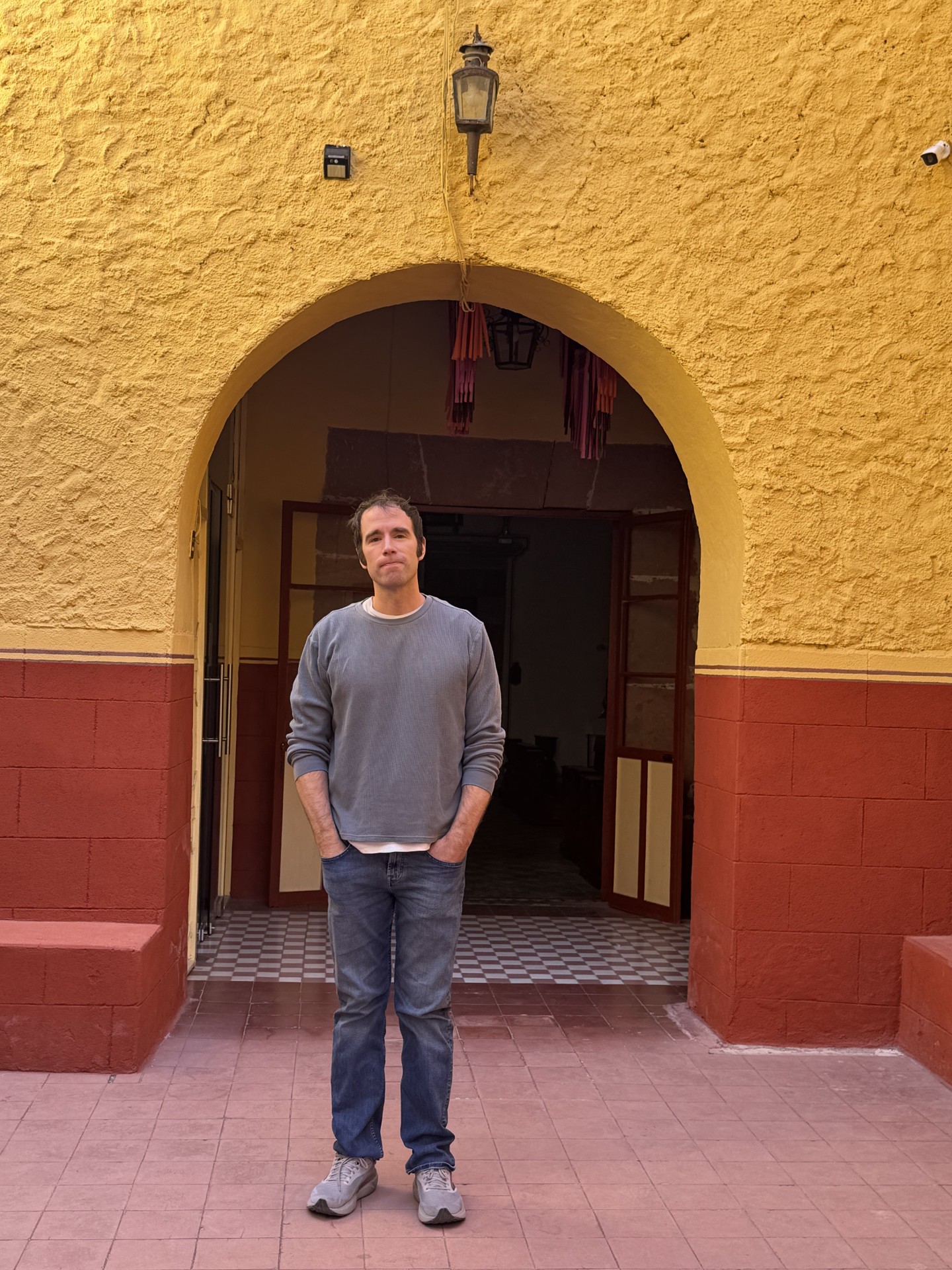
Staff reader Simone Kraus talks with NER 46.3-4 contributor Michael Carson about the significance of writing letters, Kafka and Lawrence, and the relationship between war and writing.
Simone Kraus: When we began our conversation about your NER essay, we discovered our shared interest in letter writing as a form of exploring life and language with another person. Our interview turned into an exchange of thoughts which lasted for several weeks. To have your perspective on things through your letters came as an unexpected gift. I realized how much joy there is in “opening” a new letter.
Michael Carson: I’ve enjoyed this very much too! It’s odd the way that letters arrive in our lives. They originate from afar and move and persist past the present moment. I’ve been thinking a lot about time recently and how it can work over different kinds of space. Letters tap into this more than anything else I’ve come across, a way of keeping far things near and near things far. Tremulous, passing, but real enough, and proof that we think.
They are kind of a lost art now, and maybe one of the through lines of my NER essay. In many ways I’m responding to Kafka’s and Lawrence’s letters, which are astonishing and about as good as it gets when it comes to trying to communicate with someone else across time and space. I find myself turning to their correspondence much more often than their novels.
Social media works on patterns and algorithms and we see the world a certain way through it, but it is never individual or precise like a letter tries to be. On social media, there’s no responding with that “slow patience of life” I mentioned in an earlier letter. WhatsApp has its uses and there is meaning in a text exchange, but I feel it lacks a certain unfoldingness through time.
Likely it has something to do with the physical, the fact you can go back to the physical, over letters, maybe even stored emails. But few would ever go back over a WhatsApp exchange or even a TikTok from last year. At least I don’t think they would?
SK: While thinking about your piece in NER 46.3-4, I got lost in your earlier essays that detail your experience as a soldier in the US Army. I think the reader can find references to that time in “Only Life Has a Way Out.” They are not memories, not shadows, but a kind of presence. Is writing something that came after you left the army? Or has it always been an important part of your life?
MC: I’ve read obsessively my whole life but only started writing after Iraq. I had this moment in Georgia a few months after deployment where I told myself, “you either do this or you are not going to make it.” My phrasing felt extreme and grandiose, and I’m still not sure which “you” was here: the me before the war, the me after, some of the people I had lost, or the people who had lost their lives because of my and my country’s choices. Or maybe the whole decade, the years we all lived, cause and effect, history and history and history.
I’m glad you had a chance to read my War Horse essays. They feel a little different to me now after seven years. They’re still very angry and fighting with that historical abstraction we have been discussing: the “how” of writing about something like war, maybe in a good and bad ways.
But you’re right. Unlike my earlier essays, this NER essay is part of the memoir I’ve recently completed, a pilgrimage of sorts through the human brain, history’s graveyards, and Mosul, a city that has been destroyed and rebuilt many times since Jonah showed up after the whale. The project tries to move through this memory space into some kind of presence.
SK: In our letters we discussed your interest in twentieth-century Europe. Could you elaborate a little more on this?
MC: I’ve been drawn to European history for as long as I can remember. It might have something to do with nostalgia and being a third-generation Irish American, but also a deeper nostalgia about meaning and origin. I try to trace this in the NER essay, how a certain kind of history bends toward and away from itself.
I spend a lot of my time off in Europe, enjoying the sounds of languages I mostly can’t understand and being lost, like we talked about in the first letter. You start to hear language as pure sound and realize how much we speak almost as if not to speak. That too is bound up with the otherness at the heart of Western civilization which, having sprawled outside itself all through the world, has never quite fathomed, or maybe even begun to fathom, what it doesn’t know.
As I said earlier, I don’t often read Kafka’s or Lawrence’s novels. There are certain writers who do their best thinking as they think. Journals, parables, letters, and poems can do that. It does seem to run against the thread of the canon as history, of accomplished form, and speak to something that is important in the twentieth and twenty-first century. Not the death of the novel or anything, but this sudden new freedom of thought and life that these writers tap into.
SK: Kafka’s diary entry “Germany has declared war on Russia—swimming in the afternoon” serves as the epigraph to “Only Life Has a Way Out.” While many have argued these words stand for the indifferent, absurd world(s) that Kafka creates in his works, I think this quote corresponds with what Milena Jesenská said in the obituary she wrote for him. She described Kafka as someone who can recognize others immediately in the slightest movement of their eyes, almost like a prophet. To her, his knowledge of the world was extraordinary and deep. Why did you select this particular quote from Kafka’s diary?
MC: History is the supposed answer. The cause and effect. It claims authority and knowledge of reality, a kind of coherence and map of time usually organized by dates of wars and violence and rebellion, but is in my experience often overwhelmed by the torturous circumnavigations of memory and an all-consuming nostalgia for what is not history. But to complicate things further, we also have a double nostalgia—for history, for event—that often twists us back to some vague, first human memory.
So, I think this is why I like Kafka so much. This is everywhere in his writing. And that quote, “Germany has declared war on Russia—swimming lessons in the afternoon,” captures this as cleanly as one can, at least from a historical perspective. A war that will kill 20 million people has begun, followed by another that will kill 50 million (including many of Kafka’s relatives and lovers), and you have the incommensurate set against it, “swimming lessons,” days divided into lazy summer afternoons.
Kafka did swim. It was an alternative, a different kind of un-mechanical movement that provided an undercurrent to his trapped mechanistic thinking. But I wouldn’t set them in opposition, consciousness versus unconsciousness. It swirls about inside and through him and saves him and he knows it saves him and he is therefore scared of it because he knows that salvation could damn him. I think this is tied to love too, of course, and this delightfully strange correspondence with Milena, which is really and truly correspondence, right?
SK: In the first part of your essay you explain that the waves of the beach you visit in Finisterre understood that they symbolized for you “the end-of-the world waves.” You write, “We were in accordance.” In what ways? And what was your process for writing this essay?
MC: I think this is what I meant by the title, “Only Life Has a Way Out.” It comes from one of Lawrence’s poems, but it’s another way of phrasing the problem Lawrence and Kafka grasped like drowning men or sailors at the helm, depending on the day or sentence. This image or vision of the thing behind the thing that we call life is the process of journeying into the unknown: watching ourselves and the world around us patiently and never closing off the world because, like you suggested, closure is force, and no kind of life.
The waves themselves are a reflection of our attitude toward them. It’s not pathetic fallacy but the dangerous overwhelming power of the human mind. But it scares us, and we often turn away from the accordance just as we break off correspondence. It’s too much. We can only handle it in small doses, just as one can only swim underwater for a short period of time.
I’m not sure if this answers your question about process, but it’s how I set out to write the piece. I wanted to be in the places—touch the ground or swim through where history happened and also where it did not happen—and the sea has always been my favorite place for that kind of thing. Well, the shore, I mean. I could stare at it forever, the way it is neither one thing or another and yet it is always changing. The world feels truly and supremely vivid, as if nature were in the process of creating as we watch on. We are immersed in art and the spectacle of beingness, everything about “to be” as well as the memory of our coming into being.
I should say something about waves too. They roll and crash. There have been a lot of waves since the beginning of the earth. And yet we don’t know where an individual one will fall. It’s also important to emphasize that there is a difference between swimming in a pool—which Kafka mostly did—and the ocean, and the ocean at the end of the world is going to have waves that refuse even an approximation of what we knew to be of this world.
That’s my hope at the beginning of the essay, anyway.
SK: Later you describe a scene at the Cimetière du Centre à Vence in France. This passage is linked to Lawrence, a writer that you explore in combination with Kafka. Or vice versa.
MC: There’s a line from Lawrence I came across recently where he says, “it is a struggle between the endless patience of life and the endless triumph of force.” This is lovely and true to me, and maybe why I feel that Kafka and Lawrence go together, even if they have nothing in common aside from slowly dying of tuberculosis around the same time in history. I’m never really sure where “force” or “life” is in any given sentence of theirs, but I’m sure that neither writer considers them to be the same thing, and I like how this sets them apart from many other writers and thinkers and almost every tech/LLM enthusiast today.
The more I think of this the more I’m realizing that many of the essays I’ve written over the last few years involve graveyards in some way, and maybe it has something to do with them being living spaces until people stop visiting them. My favorite graveyard memory might be the one I went to in Geneva, where all the local office workers spread out blankets and were having lunch. I think that’s how it should be.
It also makes me think of an essay I wrote this last summer on Jean Améry. I traveled to two seemingly opposed “memorial” places, the Salzburg hotel where Améry took his life and his resting place in Vienna, and tried to figure out the thread in a life and in writing when it comes to the experience of violence (in his case torture by his former countrymen), how you live with and after it, and how thinking about the event can only get you so far.
It’s something I’ve struggled with in relation to my own experiences, having been caught up in one of those historical moments we talked about. Suddenly, everyone is divorcing themselves from their role in these events by appealing to historical necessity and euphemisms like “lethality” and “mission readiness” and “War on Terror.” The reality is that we are all people making choices, and when someone invades a country or lobs missiles at boats or houses, human beings die.
SK: Could you talk more about your work-in-progress? You are working on an essay about your “uneasy” (your word) relationship with the 1920 German novel Storm of Steel (In Stahlgewittern) written by Ernst Jünger.
MC: “Unease” is probably not a strong enough word. Jünger is unapologetically in love with war and not just war in the abstract—battles and generals and things—but his gruesome, frontline experience of it, the trenches during World War I. He aestheticizes the experience as an impressionist painter or symbolist French poet might (two forms of art I really enjoy), but it really offends me when applied to the moral wreckage that is war.
His later writing can be thoughtful and meaningful, though. There’s the image of him reading the Old Testament in occupied Paris during the Second World War that I think about a lot. And he later loses his son to Hitler. I’ve written an essay on him that fits into my larger memoir. I’m trying to figure him out, get as close as you can to a mind like that. I don’t get very close, but it does get at my return to World War I trenches throughout my adult life, measuring my own need to see them with his desire to die in them.
He was also obsessed with insects. I think that’s important. He could get this enormous distance from experience that both annoys me and feels important to understanding whatever it is that humans think and do and try to be. Maybe the memoir I’m working on is an attempt to out-do him in some way. To move away from the intensity of the experience of violence, which he cherished as the ultimate reality, and toward some deeper, truer language and way of being human.
Michael Carson deployed to Mosul, Iraq, in 2006 with the US Army and now teaches community college in Baytown, Texas. His recent writing can be found in The Hudson Review, The Threepenny Review, Chautauqua, and Another Chicago Magazine.
Simone Kraus, a nonfiction reader for NER, is a translator and writer with research interests in American literature and translation studies. She is the author of Prag in der amerikanischen Literatur: Cynthia Ozick und Philip Roth (Peter Lang, 2016), a book focusing on the literary representation of Prague in the works of Cynthia Ozick and Philip Roth.