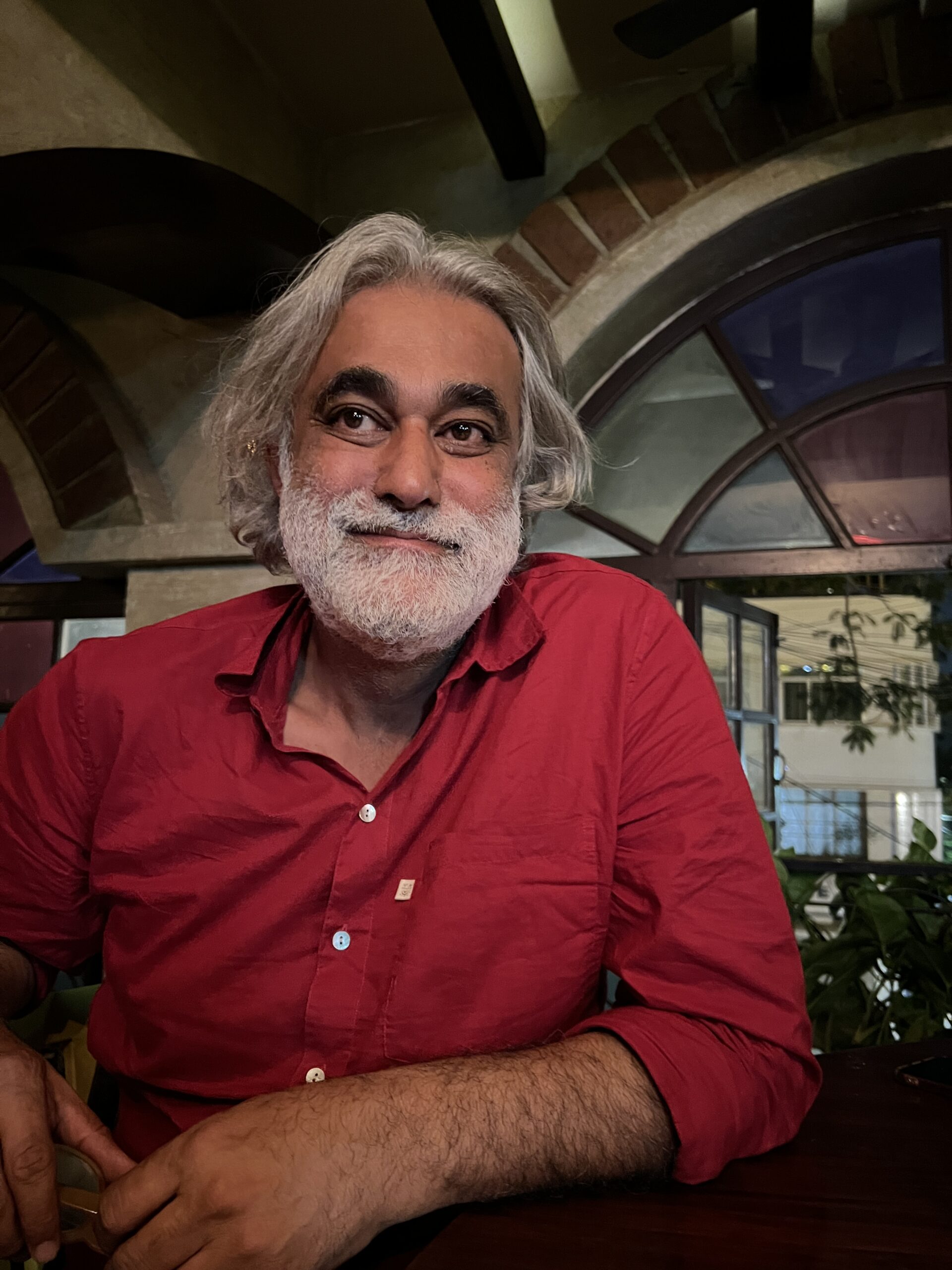
Staff reader Autumn Mitchell talks with NER 47.1 author Ranbir Sidhu about subjectivity, the racial politics of failure, and rejecting self-commodification in his essay “The Art of Failure.”
Autumn Mitchell: In “The Art of Failure,” you describe your writing process as a “discovery, the blank page an invitation to take a journey to unknown places.” Could you tell us more about your writing process?
Ranbir Sidhu: For me, that sense of discovery is related to a sense of life on the page—it’s either there or it’s not, and you feel it in your body when you read it back, sometimes even when you write it. I can’t imagine plotting a story beforehand. The characters would be dead before I wrote the first word. In a sense, the process of writing is bringing them to life, sentence by sentence.
AM: How do you know when a piece, especially a personal essay, is finished?
RS: Of course, life goes on after the essay ends! I don’t think of the ending as having exhausted the subject, but as a place where the essay now returns me, the writer, and hopefully the reader, back into the world. You’ve traveled somewhere, you’ve explored a bit, you know there’s more to explore, but now it’s time to go somewhere else.
AM: Your essay connects events that take place across the mid-1970s and the mid-2000s. What inspired you to write about these connections in 2026?
RS: I’m not sure if I was inspired so much as carried along. I paused and allowed the essay to make the connections for me, or I gave it the space to search for the connections it needed. This sounds slightly woo-woo, I know, but it goes back to how I write fiction, which is simply to follow the words, and trust that they will take you where you want to go. In this case, they took me back to the 1970s.
AM: Has your writing process changed since the 1990s and mid-2000s? Or do you still allow the words to “surprise” you?
RS: I couldn’t write without that sense of surprise. However, when I set out to write this essay, I was searching for a new way to approach the essay form. I’d become seriously bored with the essays I’d written. They’d begun to feel programmatic, obvious. I wanted to free myself from the weight of that history. I turned down any commissions for essays and set out to reimagine that relationship. Among the writers whose work I turned to for form and inspiration are Maria Tumarkin and Peter Handke.
In Axiomatic, Maria Tumarkin’s amazing collection, she takes apart the essay form and puts it all back together in a wonderfully novel way. I think her willingness to challenge linearity, structure, and so many of the aspects that we expect from the essay—that we are about to be sat down and told a story about something real—allowed me to think about how to break up my writing, zip across time, and make those connections in a more subjective way. Without her influence, I think I might have been more tentative about pursuing these decisions.
Peter Handke’s essays are masterclasses in allowing form to take the leave and not have the author be beholden to the subject. In “Essay on the Jukebox” for example, which is almost as long as a novella, we don’t get to the supposed subject until well over halfway through the piece. It’s a small masterpiece that shows a mind allowing itself to explore the territory of language and place, going wherever it wants to, like a wanderer in a strange landscape. Handke gave me permission to relax, take a deep breath, and follow the words without worrying about the so-called subject at hand. With both these writers, it’s their reliance on the subjectivity of experience that inspired me and gave me a kind of wonky map to think about how to proceed.
AM: You end the second section of the essay with the line “It felt at times as if failure was written into my body, into my skin, into my being.” Could you elaborate on this sensation?
RS: I can’t speak for someone who is white or how the experience of failure (or any experience) becomes coded into their sense of skin color, but for me, that sense of not being white, of always being seen as someone “other,” became fundamental to how I experienced the world. It introduced a continual sense of unease, because often you could never be entirely certain whether something happening to you would have happened to anyone, or if it was happening because of your skin color and how that color was perceived. And so with failure, which becomes encoded with the question of skin color, and thus the body, but all in a deeply destabilizing way. Speaking for myself, as a brown body moving in predominantly white societies, I encounter a world of ambiguities, where I’m never certain what actually is happening. It can really feel like a hall of mirrors.
AM: When you reflect on the meeting with S and the Three Stooges, you conclude that “What they wanted was color, a few brown skins on their stage to set off the white ones, to highlight them, a little brown seasoning in the pot to give it that added umph.” Could you speak more about the idea of “commodifying that self for easy consumption” and how it relates to your experiences with the physical and artistic gentrification you witnessed in New York?
RS: I know, it’s awfully depressing, isn’t it? Since then, despite a sense of spaces being opened up to people with more diverse backgrounds, I feel they’ve closed down considerably more in other senses. The commodification of self that most writers and artists have to accomplish today to simply be “seen” or “heard” is soul-crushing, and the work suffers as a result. Unless you’re very, very lucky, to escape it is to intentionally make yourself disappear and vanish from the larger cultural conversation.
AM: Since the meeting with the Three Stooges, has your play “True East” been realized on the stage or published in print?
RS: No, sadly. When I walked out of S’s office that day, I knew any chance of being a serious playwright in New York was pretty much over. You only get so many chances and that one was gone. Rather than pour more energy into chasing that dream, what I really wanted was to return to my first love, fiction. It’s a pity, because I felt a great sense of sympatico with the play form and with working with actors and a director and all of that. I’d grab the opportunity to write for a theater again. It’s also unfortunate because I’m equally sure that the play I wrote for them is even more relevant today than it was then.
AM: Towards the end of “The Art of Failure,” you write: “So what else is failure if not a path through the dark forest of life, unlit and halting, an endless grasping at possibilities that almost always disappear the moment you take hold? What else is failure but the daily task of living?” Does this revelation still ring true to you?
RS: I’ve thought a great deal about that since finishing the essay, and today I think I’d go a little further: Failure is living. It’s simply who we are and what we do, and to separate it from ideas of success misses the point. Stating that we fail in order to succeed also misses the point. The sense of failure that I write about here, that hung over my shoulders for years, was and is very real, but I think about it very differently now. When I write about wanting to celebrate it, I mean that quite concretely, not just as a literary flourish. It’s still not easy to fail, to get a rejection, or feel a story or essay is simply not working—or more recently for me, being overwhelmed by a few simple tasks, something that can at times leave me semi-catatonic in bed for half the day. But I no longer find it possible to separate such failures. Instead, I’d like to uncouple ideas such as success and failure from the differing moral weight that each carries, and argue that success is no more important, no more meaningful, ultimately, than failure, nor are they contingent on each other. Each is simply a part of a whole.
Ranbir Sidhu’s memoir No one gets out of here alive (HarperCollins India) will appear in 2026, along with a reissue of his first two books. He is a recipient of a Pushcart Prize and a NYFA Fellowship and is the author of six books, including most recently Night in Delhi (Westland/Context, 2024) and Dark Star (Westland/Context, 2022). His work appears in The Baffler, Conjunctions, The Georgia Review, Fence, Zyzzyva, Missouri Review, Alaska Quarterly Review, Other Voices, The Literary Review, Salon, Los Angeles Review of Books, and Vice. He lives in Athens, Greece.
Autumn Mitchell is a first-year BA/MA student concentrating in fiction. As an IUG student, she currently majors in English, minors in technical writing, and concentrates in creative writing. Outside of class, Autumn serves as the 2025-2026 fiction editor for Kalliope (Penn State’s undergraduate literary journal) and nonfiction literary publication intern for the New England Review. She takes inspiration from the natural world of Brookville, PA, and utilizes symbolism and metaphor to create unique, layered pieces. Her work has been published in Kalliope, Folio, and KLIO. After graduation, she intends to lecture at Penn State and apply to MFA programs.