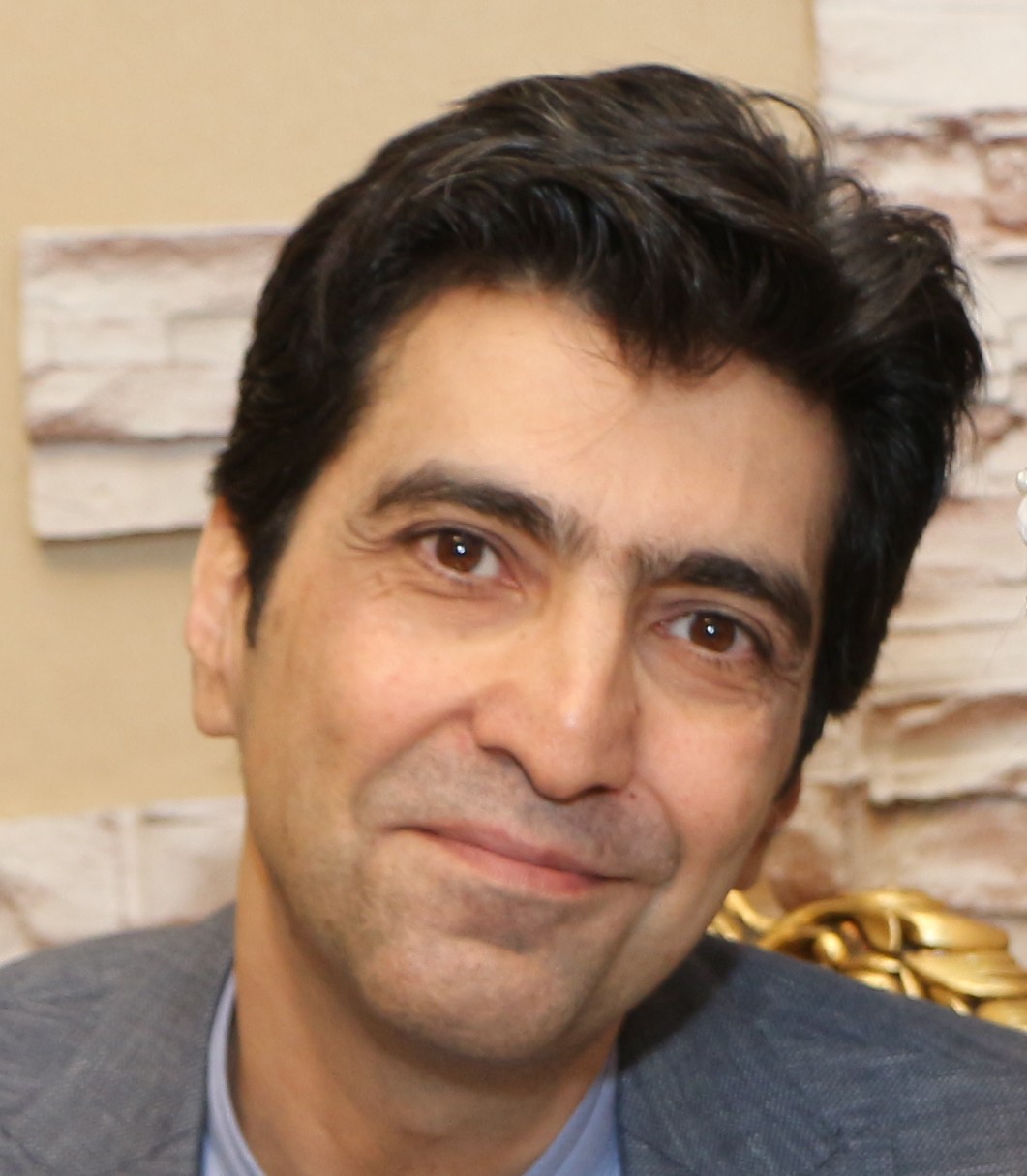
NER office manager Mary Heather Noble talks with writer, poet, & translator Kaveh Bassiri about love, the afterlife of language, & conveying the unknown in his essay “Tarjoma” from NER 46.3-4.
Mary Heather Noble: You open the essay with a scene in which you and your siblings are circled around the ICU bed, holding vigil for your dying father. The description really grounds the circumstances of death and dying in the context of an immigrant family, which is to say that the reader senses a tension not only between the keeping-alive and letting-go but between the different expectations and cultural traditions around family and death. Can you speak about how the impulse to “do right by” a dying parent might be more nuanced for an immigrant family?
Kaveh Bassiri: It’s always challenging to do the right thing for your parents, no matter who you are. But to your question, I think about three things that relate.
First, there’s the challenge of whether you know what your parents want. I always knew, for example, what my mother wanted regarding life-sustaining support, but I didn’t know what my father thought about it. We tried to talk to him about it, and at first he was open to discussing it. But then he suddenly changed his mind and didn’t want to talk about it anymore. I was never sure what he wanted or what he would have prescribed for himself.
The next difficulty is when you might know what a person wants but are unsure if you want to follow through with their wishes. What if you think something they want is wrong, like a prejudice they might have? That was my challenge. For example, I don’t believe my father wished for my ex-partner to be at his funeral. But I concluded that when a person dies, they don’t carry their prejudices with them, that they somehow become wiser and can see through things. Of course, that means I think I know better—which presents another complex layer. Ultimately, for me, if it’s leaning toward love, kindness, and inclusivity, I’m willing to make the leap.
The third complication was that, as first-generation immigrants, we were not familiar with all the customs and rituals of our parents’ culture. I was young when I came to the U.S.; I went to high school here and never saw a Muslim funeral. I knew my father wanted a Muslim funeral, but I didn’t know what that entailed. We ended up having to Google where the mosques were and how to find an imam. My dad believed in Islam, but he didn’t have an affiliation with any mosque. He thought spirituality was a personal thing and never imposed it on us.
MHN: It must have been hard to help your father land softly in his tradition with no roadmap to get there.
KB: My brother was able to guide us. As a scholar of Islamic studies, he could access the prayers and ask colleagues for help on the rituals, so he was able to help bridge the gap. There were still challenges: In the piece, I talk about a Sunni imam refusing to perform the proper rituals because my Shia father wanted to be wrapped in a kafan decorated with prayers of mercy—the imam regarded this as blasphemous. He thought the kafan should be plain. We just wanted to please our father, so we looked for another imam. My father’s sense of religion was that you have to come to it yourself, and I think we actually got closer to that understanding through this process.
MHN: I think it’s a gift to be given the room to explore and come to spirituality out of your own curiosity. It’s actually quite beautiful.
Your piece is titled “Tarjoma,” or “translation” in Arabic and Persian, which you note can also mean “a biography, the narrative manufactured from our lives.” I love the layered meaning of this title, in that tarjoma can refer to the transition from life to death, but there is also a distillation—similar to what can happen with the translation of language—in which the essence of a person after death is not necessarily the same as who they were when living. How did your understanding of your father’s duality, that tension between love-and-nothing-more versus valuing accomplishment and achievement, influence how you approached this essay?
KB: The transition from the pressure of my father’s high expectations to seeing love as the most important thing to him was unexpected. All of us were surprised when he repeated the couplet by Mohammad-Taqi Bahar. We couldn’t remember him saying the poem before, and all of a sudden, out of nowhere, it came: teach my children love and nothing more. This wasn’t like the other poems he recited and was more meaningful than the kind of thing he usually wanted to say when the oxygen mask was off. It brought a tenderness and kindness that I try to tap into in my writing about him as well.
Translation actually played a big role in how the essay came together. I was thinking of movement from one place or form to another, of how translation refers to the removal of a saint’s body or to a carrying across. I also thought of translation as “afterlife,” as Walter Benjamin says, and the afterlife of people in language.
In the essay, I hoped to translate two things: the experience of watching my father pass away and the need to capture and keep a portrait of him. But how can you capture a person in a short essay? All I had were my thoughts and memories and a few items of his, so I was trying to figure out how to translate them into a story I could understand.
I did an exhibition in Tulsa, in which I asked my brothers and sisters for any items they had of my dad’s, and I organized them like a museum archive: legal documents, certificates, work-related items, things he collected like stamps, and personal items like shoes, glasses, and combs. These items are not him, right? But there’s a story that he tells by what he brought across as an immigrant, what he kept. And each of us is telling our own stories by holding on to certain things of his—that’s also our translations.
MHN: It seems like accompanying your father through his death allowed you to learn more about him than just experiencing him as a son. How is this like translation in language? Do you find as a translator that you become more intimate with a work through the effort of translating versus just reading it and contemplating it in your native language?
KB: I always say in my classes that I think the closest reader you could possibly have is your translator—the person who gets so intimate with your work that they may see things even you don’t. In translation, I want to be faithful to the original, so I have to understand the piece very well. If I don’t understand it, it’s very hard to translate.
With my father’s death, I knew that a literal translation wasn’t possible. How can one translate death? No one really knows what the experience is like. The only way is to embrace death and loss as unknowable, untranslatable—which made it easier to accept it and capture the sense of it on my own terms. Like an intersemiotic translation, or an adaptation.
MHN: This makes me think of when one art form influences or interprets another art form and creates a derivative work. Is that what you mean?
KB: Yes, that’s more like it. Like cross-medium. I think it’s a form of translation, but different. Like an exercise from one of my mentors where he puts a rock on a table and says, “Translate this.” And the students are free to decide what part of this thing they want to translate and in what way. Some people look at the size, some people look at the color, some will consider the weight of it, some people make something completely different. It’s kind of open. The possibility of translation is not just the literal; it’s more.
MHN: Your work as a poet and translator is evident throughout the piece, especially the way in which the etymology of words like translation, patient, pain, and others are explored. I think grief is one of those times when we bump up against the limitations of language. In this and other work, how do you determine which words or concepts to translate and which to leave for the reader to infer?
KB: If it’s a literary translation, then I’m going to try to see how much I can put in. But in some pieces, the craft is in the sound or multiple meanings of the original word, so I just can’t translate it. When I’m writing my own work, I like to hold the possibilities of the words, know their history, their etymology. I used to say that I want to write like an archeologist discovers, pulling words up and putting them together. Then you come to the poem like an exhibition, see the bones and recognize the whole dinosaur.
I also like allowing silences around a thing that invite the reader to create the world of the poem for themselves. Especially in this essay about death and loss, I want to leave silences and possibilities around the words, to let absence be present. All I know of death is what I witness. I don’t know what I don’t know. Nobody died and came back and told me what it was like. So I need to convey that sense of unknowing. But it’s not unfathomable because I know I’m going to die someday, too. I know it will happen to me because I saw it happen to my father. So it’s in between knowing and unknowing. I love that kind of writing, writing that really invites me in but leaves me mysteriously in that space. My writing isn’t composed of randomness, though. Everything belongs. They’re like the items of my father.
MHN: As you describe your father’s progression toward his final moments, you point out the distinction between pain and dard, the Persian word for “pain.” You note they are not the same, that pain “is rooted in punishment and retribution.” Can you elaborate on the distinction in the context of the narrator’s pain—the pain of grief?
KB: I was fascinated with the origin of pain. It comes from the Latin and Greek words that mean retribution and punishment, related to crime and “penal.” I was like, wow, that’s really different, because the Persian word doesn’t have that. So I thought, how can I liberate and accept pain and not have the punishment and retribution attached to it? To do that, I had to go back to the Persian word that doesn’t have the judgment, just the grief.
MHN: Like trying to distill the pain down to just missing a person that you’re deeply connected to, versus the pain of regret or guilt or all those other emotions?
KB: Right. Or the pain of judgment, like the weight of his ideas about me. You know what I mean?
But I also was thinking about Elaine Scarry’s philosophical sense of pain having no object and only referring to itself or about Ludwig Wittgenstein’s thoughts on private language and his belief that the only way we understand pain, a private experience, is through the public language. Writing as a way of unmaking pain, by making the private and personal into something public and communal. These were the ideas in the more philosophical, original version of the piece, where I was avoiding a personal exploration of pain.
MHN: Given your accomplishments as a poet and translator, I’m curious how your work in those areas influences your approach to writing nonfiction. How does it influence structure? What are the factors that make you start a piece as a poem instead of an essay?
KB: Poetry makes me slow down, and it opens up the world in new ways. It allows me to spend time with each word, playing with all of its possibilities. But when I got my MFA, I realized I could not possibly spend all the time writing poems, so I pursued translation as a way to sustain my poetry. Translation allowed me to enter a different poetic world. It made me read differently and inspired me to think in new ways about how words shape our experiences.
I’ve written academic essays and prose poems, but until recently, I didn’t seriously write lyric essays. This is a new thing for me, and it’s very exciting because I’m learning and exploring as I write. I’m inspired by many great writers who do that, like Claudia Rankine, Eula Biss, W. G. Sebald, and Maggie Nelson. It also reminds me of documentary poetry. It is a place where I can bring research and poetry together. I like the meandering nature of the lyric essay. I agonize less over a comma, or don’t spend a week worrying about one word.
Of course, it takes just as much time and is just as hard. It’s not like you have a lighter job with prose. And sometimes when I’m in a project, I’ll think: I just want to write poems! But then I’ll want to write a poem and have everything in it—which can’t be done. Essays can hold a lot more, the way series of poems do. That’s another thing that interests me about essays: You start in one place, and a few pages later, you’re deep in some other related place, and you’re not even sure how you got there. Yet you are still in the essay. It’s another type of movement from one place to another, another carrying across. I love it.
Kaveh Bassiri is the author of 99 Names of Exile (Newfound, 2019), winner of the Anzaldúa Poetry Prize, and Elementary English (Anhinga Press, 2020), winner of the Rick Campbell Chapbook Prize. His poems have been published in a number of journals and anthologies, including The Best American Poetry, Best New Poets, Essential Voices: Poetry of Iran and Its Diaspora, and Somewhere We Are Human. His translations and essays can be found in The American Poetry Review, Virginia Quarterly Review, The Kenyon Review, Guernica, International Journal of Middle East Studies, Iranian Studies, and Senses of Cinema.
Mary Heather Noble has published work in AboutPlace Journal, Barrelhouse, Creative Nonfiction, The FEM, Fourth Genre, Hippocampus Magazine, True Story, and Utne Reader, among others. Her work has been honored with the Editor’s Prize in Creative Nonfiction’s Learning from Nature issue, First Prize in Creative Nonfiction’s The Human Face of Sustainability contest, and as a finalist in Bellingham Review’s Annie Dillard Award in Creative Nonfiction. She is the office manager of the New England Review and reads nonfiction submissions for the journal.