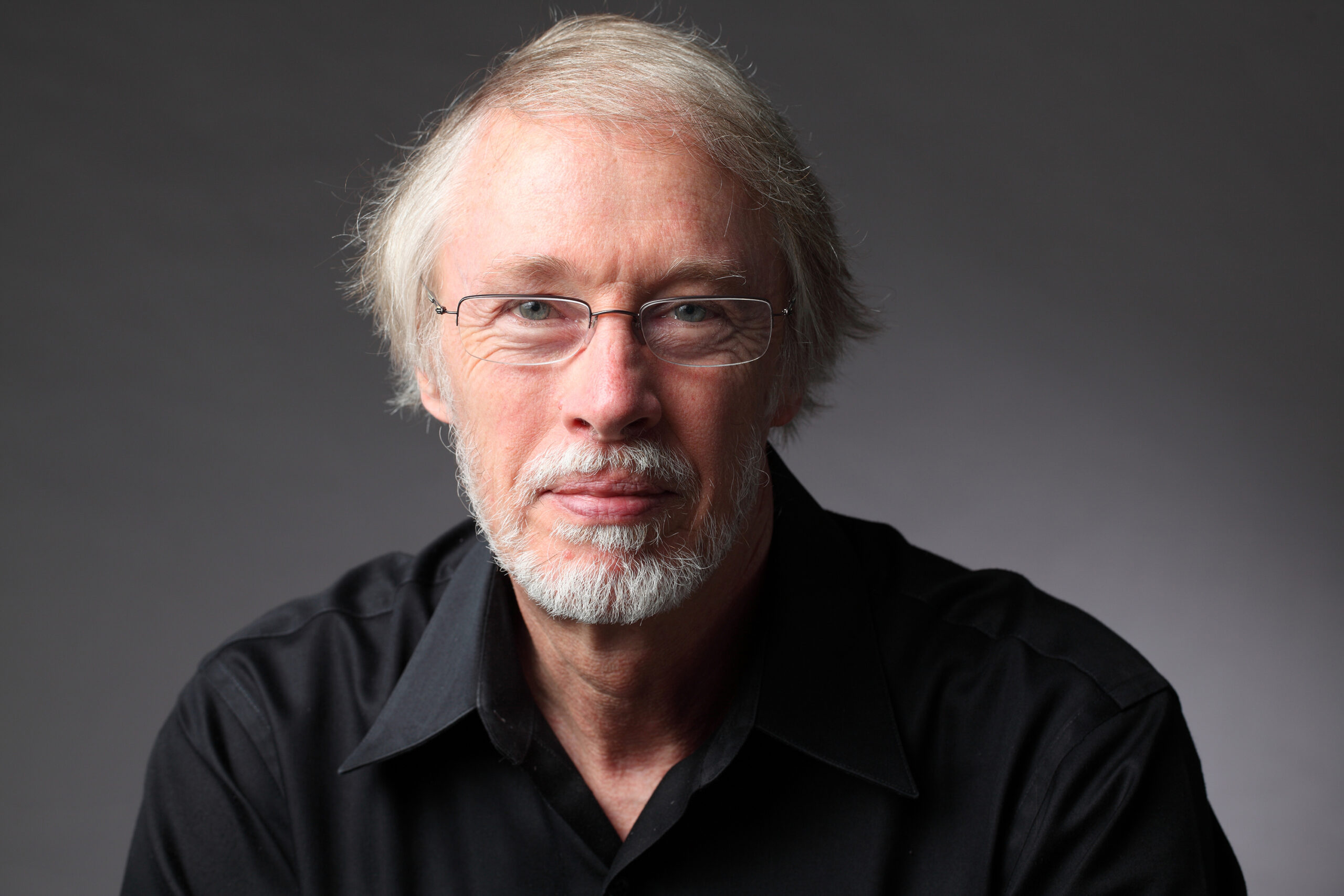
“It’s as if you’re writing on a leaf that the wind blows away as soon as you let it go,” Charles Baxter says in his conversation with staff reader Thomas Nath. Below, Baxter discusses the changes in writing that come with age, the job of the artist, and the thinkers who influenced the short pieces that comprise “Five Paper Pills” from NER 47.3.
Thomas Nath: Since there are so many topics connected over the course of “Five Paper Pills,” was there one starting place or question that served as the entry point to writing this piece?
Charles Baxter: After I showed the second piece in the series, “Economies of Scale,” to Alan Lightman, he wrote back, “These are about mortality, aren’t they?” He was right. There’s a kind of energetic writing that gets done by novelists in their youth, and then there’s the more meditative work like “Five Paper Pills” that writers like me do when they get old. The subject of mortality casts many other topics in its shadow, including our responsibility to others (“The Golem”), remorse (“Economies of Scale,” “Open Heart”), and peacefulness: the release from anxiety and attachment (“After Czesław Miłosz”).
TN: How do the themes of these pieces and some of the questions posed around religion and morality come up for you, either in your work or in your life?
CB: When a person approaches the age of eighty, it’s almost inevitable that you’re going to look back. Retrospection is forced on you. Your life is mostly in the rear-view mirror and not in the front windshield. These subjects are the ones that presented themselves to me when I sat down to write. I didn’t willfully choose them. They were just there. And it so happened that I was mulling over the great subjects that are addressed by myth and religions. I wanted to add my two cents to those ancient discussions, the million-dollar debates.
TN: I was immediately interested in the narrator’s direct address to a “you” in the first four of these pieces. Was there a specific sort of addressee you had in mind? Is there a specific conversation you imagine occurring?
CB: In English, you can’t use the pronoun “one” (it’s too formal and awkward) to stand in for an average person—one doesn’t do that—so I used “you” instead, although of course I’m addressing myself and introduced myself, the “I,” into “The Golem” halfway through. I saw that guy and felt sorry for him and sympathized with his situation, but was also frightened by him.
TN: The only section that eschews direct address is that last one, “After Czesław Miłosz,” which also has a noticeably different tone: less explicitly concerned with heady, philosophical questions; more certain; more concerned with concrete minutiae. How were you thinking about this section in relation to the first four?
CB: It’s a conclusion, a resting-place, a release, a breather. Sometimes we feel all our worldly troubles lifting themselves away from us and we feel lighter, liberated from ourselves. That piece was about that particular experience.
TN: How do you envision the five titled sections of “Five Paper Pills,” especially since the overall structure feels associative rather than strictly chronological? What marks them as disparate or unified for you? And what guided your decisions about movement and sequence? Were the five sections written in sequential order or did their ordering occur after all five were written?
CB: I’ve written over a hundred of these short pieces and fashioned them into a book tentatively titled Day for Night. They’re about the journey of a soul, and they end with the Czesław Miłosz paragraph. While I was writing them, I had no idea what sort of structure they might have, and I was determined not to worry about it. They are indeed associative and not chronological. When I began writing, I simply tried to relax and to leave my mind alone and to let the wellsprings of the unconscious collaborate with whatever came into my head that particular day.
TN: I read the title “Five Paper Pills” as a reference to the story “Paper Pills” by Sherwood Anderson, whose Collected Stories you edited. Does your piece speak to Anderson’s story?
CB: Oh, I think about Sherwood Anderson all the time: his awkwardness, his good intentions, his plain speech, the sadness of those ruined lives. I don’t write prose like his, but he’s always there, somehow. Dr. Reefy in Winesburg, Ohio writes down beginnings and ends of thoughts—whatever comes into his head—and then tosses them out. He’s not worried about posterity or eternity, and neither was I. It’s as if you’re writing on a leaf that the wind blows away as soon as you let it go.
TN: In Anderson’s story, as you noted, the titular paper pills refer to balled-up scraps of paper that the doctor stuffs into his pockets after he’s written down “the odds and ends of his thoughts.” From these thoughts, he “formed a truth that arose gigantic in his mind. The truth clouded the world. It became terrible and then faded away and the little thoughts began again.” Is there a similar, larger truth—terrible or not—that “Five Paper Pills” is forming or contending with?
CB: Yes, but it should be implicit and subtextual and not easily converted into a glib sentence or two (by me).
TN: Other writers such as Alan Lightman and Czesław Miłosz are mentioned explicitly; “After Czesław Miłosz” even expands upon text from Miłosz’s poem “Gift.” What’s your relationship to these writers?
CB: Alan Lightman is a friend, a brilliant writer and a physicist, and an authority on the life and death of the cosmos. As for Miłosz, he was one of the great writers of the twentieth century. He saw and experienced the mass movements of fascism and communism firsthand; he was there when it all happened. He knew suffering and saw its effects, and yet he was able to write the poem “Gift,” about working in the garden and feeling the burdens ease. I didn’t know him. I saw him once across a room in Ann Arbor, Michigan. That was it.
TN: I kept wondering if “Economies of Scale” and “After Czesław Miłosz” posit opposing solutions to existential angst. In the former, the reader is asked if their sins are really of great concern to a potential God of multiple universes. In the latter, the narrator finds serenity in a simple, colorless December day. How does the relationship between the very small and the very large come up for you (as a writer, and/or as a human)?
CB: When you contemplate your own mortality as you get old, you think of what you’ve done, shouldn’t have done, or should have done. If you were raised as a Protestant, as I was, you may think of a Christian form of karma—that is, whether you brought some goodness into the world or not, possibly its opposite. And then you want to get to a point of serenity when you simply don’t think about those matters anymore. You give it all—both the pride and the shame—over to whatever colossal consciousness is out there. Those two pieces are about that.
TN: I love how often these pieces remind us of the possibility that apparent hierarchies may not be what they seem: the golem can be either servant or master, Copernicus must inform the Earth that it isn’t the universe’s center, and Jesus is sacrificed for being “way, way better than we are.” How does this uncertainty play into the themes of the piece for you?
CB: We think too much about our own humanity—but what else can we do? All the same, it’s a fault, all that thinking, and we need to change our sense of perspective so that we can see our lives as tiny fragments in a universe made up of unimaginably large entities constructed in ways that we can’t penetrate fully. One job of the artist may be to adjust perspectives, to introduce uncertainty to us, and always to provide us with daydreams filled with “what if?” and “what then?” and “so what?” The great questions . . .
TN: What made you want to approach the questions and themes in this series through this more ruminative form rather than through, say, a short story? Do the techniques and processes you use for fiction change for a piece of more meditative nonfiction such as this?
CB: Again, it’s all a matter of aging: I wanted to get to the point, I wanted to omit the stuffing excelsior and extra blather of most storytelling. I’ve written short stories all my life and wanted to try another form, what some people call “flash fiction” or “flash essays,” though I’m not fond of those phrases because they seem dismissive, like first cousins of “flash in the pan” and “Captain Flash.” William Maxwell enjoyed writing fables and collected his in The Old Man at the Railroad Crossing and Other Tales, but the great danger of short pieces like mine, or his, is that they can be too point-making. When they fail, they feel like setups. I want readers to shiver with delight and not to think that I’m delivering a sermon or two. My idea is to have the reader read something of mine and then stop and stare off into space, transported, somewhere, anywhere.
Charles Baxter is the author of fifteen books of fiction and nonfiction. He lives in Minneapolis.
Thomas Nath is a writer, researcher, and inartificial intelligence. His work has appeared in the Brooklyn Review, the journal Regulation & Governance, and is forthcoming in Gulf Coast. He reads fiction submissions for NER.