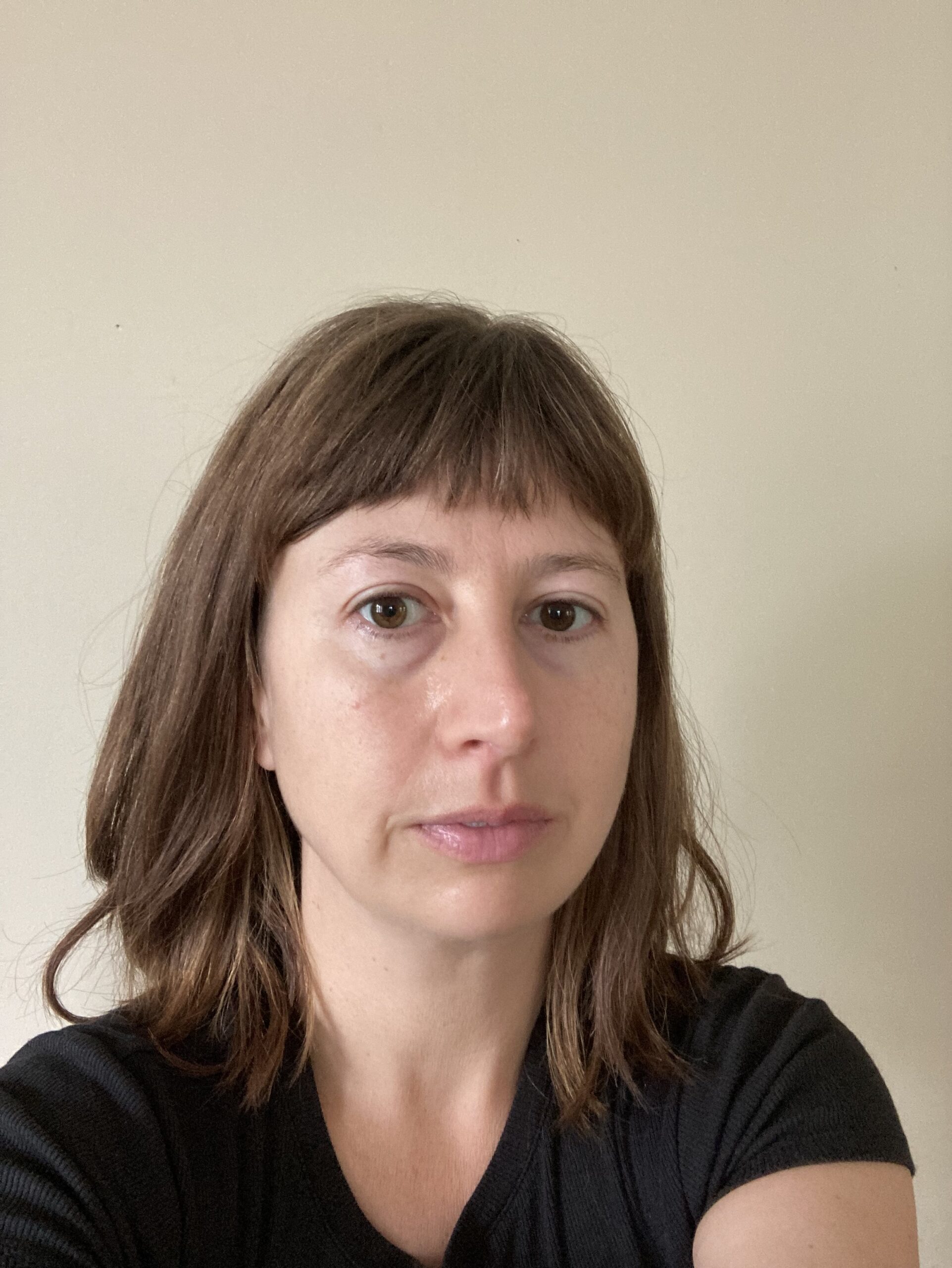
Kevin Testa talks with Gretchen Schrafft about characterization in historical fiction, writing about pain, and the role animals play in her short story “The Bastard Agrimony” from NER 47.3.
Kevin Testa: “The Bastard Agrimony” takes place in Cornwall, England, in 1671, and opens on the day before the Lammas Fair, a harvest festival that gathers the entire village. How did you arrive at this place and time?
Gretchen Schrafft: I lived in Fife, Scotland, for a year. At the end of the summer, the whole town was taken over by a thing called the Lammas Fair. The fair had modern carnival trappings, but it was nevertheless really obvious that this was an old tradition. When I needed an event to kick off this piece of historical fiction, this was the first thing that came to mind.
In terms of the timeframe and place, this story began as a way to work through and understand backstory for a novel I’ve written, which is set primarily in New England in the late 1600s. Understanding what experiences certain characters were bringing to their new lives as colonizers helped me to make my book work. But after I’d used some of what I’d created to fuel my novel, I saw there was the potential for a standalone story there.
KT: The story centers the uncertainty and violence of reproduction. What drew you to this subject?
GS: I became interested in writing historical fiction during and after having an abortion that went seriously wrong. The experience made me feel trapped by my own body, which was refusing to do what I and the kind people at Planned Parenthood were asking it to do. It made me aware of how my autonomy is limited by my biology. At the same time, it made me feel connected, in a very direct way, to earlier generations of girls, women, and pregnant people. It felt like my body, by going through this experience, had found a way for me to talk to them, and for them to talk through me.
KT: The story’s surreal elements arrive when the main character, Elizabeth, is having a miscarriage: “You devised a novel method to reach out, grasp something you hadn’t before known to exist: an unseen door . . . . And then, you were in a new world.” Why does the magic in this story arrive when it does?
GS: To experience childbirth is to experience a non-ordinary state of consciousness. To me, Elizabeth’s opening of a door into another world is a pretty smart and intuitive way of harnessing this non-ordinary state in order to navigate bodily pain that shows no sign of stopping and for which, at least at the beginning of her labor, she has no external help or support.
Another hallmark of extreme pain is that you can’t really reconstruct the memory of it after it’s over. Especially in the context of the 1600s, I think it would be natural to ask yourself after the fact, “How on earth did I make it through that?” and for “magic” to be one totally reasonable answer.
KT: I want to ask about the story’s second-person narration. As a writer, I deeply admire writers who can elevate a story by drifting away from the typical first- and third-person points of view. In your story, there’s an almost toying, playful quality to this voice, with repeated phrases and statements throughout, like when “You opened your eyes” is repeated four times in a row. These read like chants or an invocation. And then, as we learn what happens in the story, the voice takes on a much darker tone. I’m curious who you understand to be speaking.
GS: Use of the second person in fiction gets a bad rap, generally. It seems to be looked upon as a cringe-worthy choice, though I’ve never actually heard a well-thought-out argument as to why. I write in second person a lot when I am drafting because it’s weird. I feel like it frees me to do and say things it might never have occurred to me to do and say in other POVs. Maybe these are some of the voice choices you are pointing out.
I chose to keep this story in second person after I was finished drafting because I think it helps to underscore the specific type of emotional suffering Elizabeth is in. The loss of her baby, through circumstances that people at the time (including her husband) might say were her own fault, divorces her so far from her former sense of self that she doesn’t even relate to her own name. She’s only able to go on by radically narrowing her perspective and her emotions—coping mechanisms that end up costing her.
KT: Let’s talk about the animals in this story. Perhaps it’s because I’ve just read Etna by Paul Yoon, but I’ve been thinking about animals and the roles they play in our lives. In your story, we have a rooster indignant about being out-screamed, and Elizabeth’s ten-year-old daughter, Caitlin, nestling against a sheep and then running with wolf-boys. How did you see these animals operating in the story?
GS: Oh my gosh, don’t get me started! I am obsessed with the role animals play in our lives and they become much more prominent when I start writing in this historical mode because of all the labor they did for humans during this time period. So in one way, their presence in the story is just a basic function of writing about the past.
Once I started working with the animals in this story, though, they taught me a lot about central concerns of the story: shifting power dynamics, morality, how much or how little control we have over events. The rooster is supposed to “belong” to Elizabeth, the pig is supposed to go to slaughter, and yet Elizabeth finds herself in a situation where the animals have more autonomy than she does. Is it wrong for Elizabeth’s mother to ask a young Elizabeth to help autopsy a dead pregnant cow? If so, isn’t it that much more wrong that Caitlin, a child, should have to help her mother through a miscarriage and then also be blamed for the miscarriage?
I also owe the animals that populate the text for helping me realize I could make this stretch of writing into a standalone short story. When I re-read the description of the parade of people and animals leaving the village, it felt like the beginning of something.
KT: I keep reflecting on the darkness Elizabeth meets in the new world. It listens to her, possesses wit and is enthralled, doesn’t come back when she begs it to, and only returns after a tragedy late in the story. What brings the darkness back at this moment?
GS: This relates back to what I was saying before about pain, and how you can’t really reconstruct what it was like, or what your frame of mind was like while it was going on. However, there is at least one way to reencounter the version of yourself who experienced a great trauma, and that is to experience another one. Elizabeth’s ability to dialogue with the darkness again towards the end of the story is an example of this.
KT: What are you working on now, and what have you been reading you’d like to recommend?
GS: I am wrapping up the historical novel project I mentioned, which asks questions about reproductive justice in colonial New England before, during, and after the 1692 witchcraft crisis. I am also looking forward to putting the finishing touches on some short stories that take place in a more contemporary setting.
For reading recs, check out Afsheen Farhadi’s False Prophet, about an actor who gains notoriety after telling a lie about his family’s ties to the Jonestown cult. Also, Jon Hickey’s page-turning and poetic Big Chief, now in paperback. For a very fun nonfiction audiobook experience complete with music, check out High School by musicians Tegan and Sara.
Thanks so much for the chat, Kevin. It’s been fun!
Gretchen Schrafft is a fiction writer, journalist, and educator based in Providence, Rhode Island. She graduated from Middlebury College, where she was a New England Review intern. She holds an MFA from Oregon State University and a PhD in creative writing and literature from University of Denver, where her research centered on medieval and early American literature.
Kevin Testa is a writer who spent more than a decade in tech. He reads fiction for NER and lives in Oakland, California, with his wife, daughter, and dog.