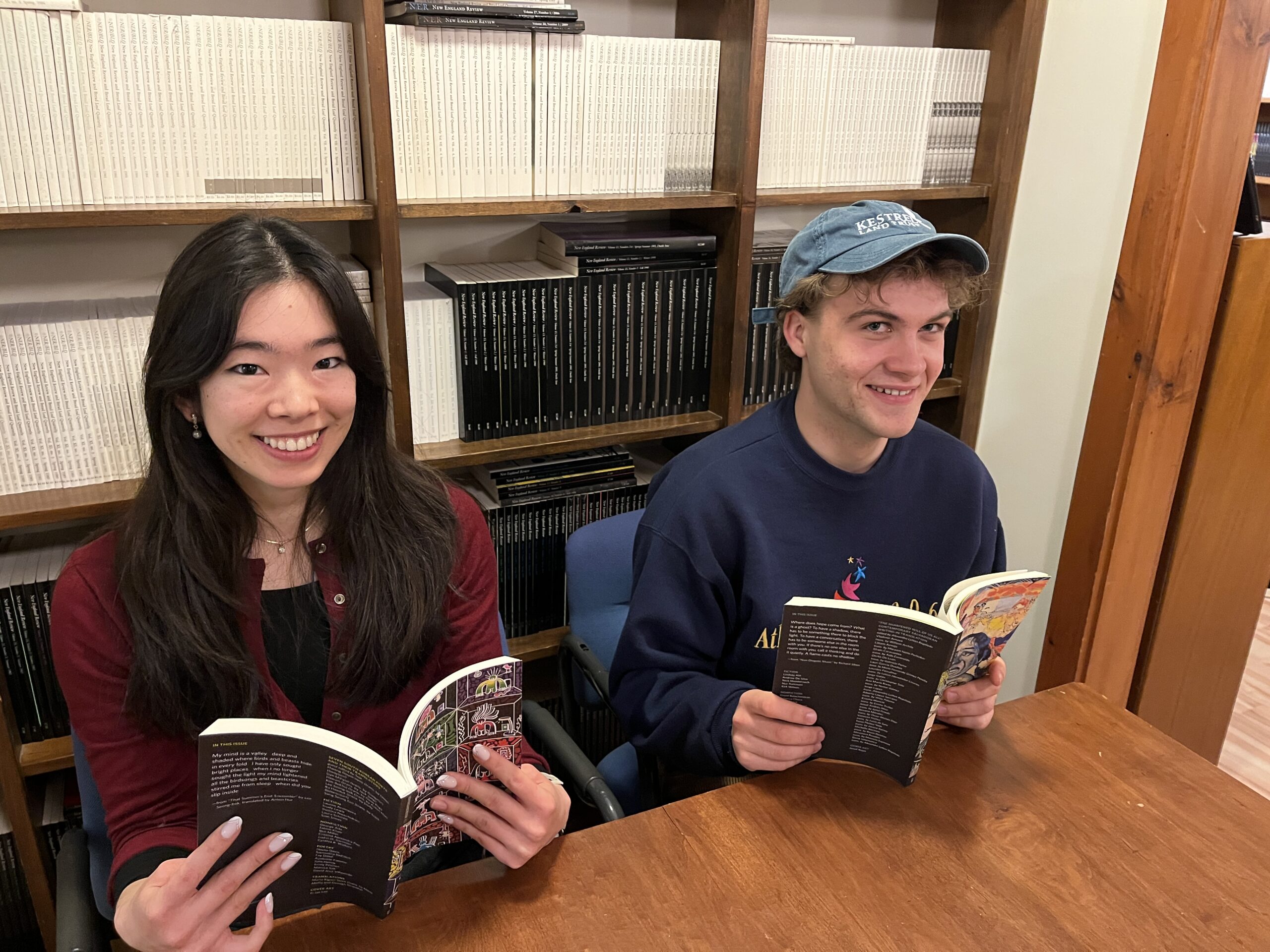
This fall Sydney Alexander and Gus Morrill spent their Monday and Wednesday afternoons in the New England Review office. They read paper submissions in all genres, performed in our special NER Out Loud presentation for President Baucom’s inauguration, conducted research on literary magazine contests, and much more. Here they interview each other for our “Meet the Interns” series.
Gus Morrill: My first question for you is what’s your major and where you are from?
Sydney Alexander: I’m an English and geography joint major. I’m from Ellicott City, Maryland, if you know where that is, but if you don’t, I’m from the Baltimore area.
How about you?
GM: So, my major is comparative literature, and it has been focused in Spanish and Arabic, but I think I’m changing it to English and Arabic. I’m from Tennessee.
SA: What’s your favorite thing that you did at NER this semester?
GM: Off the top of my head, it was probably the reading we did at the NER Out Loud event in honor of President Baucom’s inauguration. I just feel that it was a really cool opportunity to be able to share my work in front of people. That experience was really meaningful to me.
SA: Yeah, my answer would be the same. I also really enjoyed reading at the inauguration event. I don’t think I’m a very good reader of my own work, so having Leslie coach us on how to perform our own writing was really valuable. But again, it was also just really fun, and I enjoyed all of our co-readers from Oratory Now who read actual pieces published in NER.
GM: Your story was unfinished as of when you read it. Did reading it give you more ideas about how to finish it?
SA: I don’t think it’s given me more ideas about how I’m going to finish the story, but I think that it’s maybe given me a little bit more motivation to finish since it was so well received! People are invested now.
What was the poetry you read about?
GM: One that I read was about a time that I ran over a Copperhead with a car on my way to my grandma’s house in high school. That freaked me out, so I wrote a poem about it. Another was about a time I went to the State Fair in Lebanon, Tennessee with a childhood friend. Shout out to Tennessee!
SA: What does your day to day look like at NER?
GM: It’s been a lot of work with translations this semester because the NER is involved with publishing translated works for translations issues as well as within normal issues, and translation has always been an area that really interests me. It’s really cool that NER does a lot of work with translated poetry and prose. I have been working on the translator spreadsheet project, where I’m going back and collecting data on all the translators and translated work we’ve had.
Actually, another one of my favorite things I have gotten to do with NER was attend a Zoom of translators and authors from El Salvador featured in the most recent translations issue. It was cool to see all those pieces I had read or done research on being performed with all the feeling and emotion that the translators and the authors felt creating that work. Besides that, my work has consisted of reading submissions and editing audio files.
What about you?
SA: I’ve been working a lot with contracts and spreadsheets, which doesn’t sound that fun off the bat, but it’s actually really interesting to see who does fiction, who does prose and poetry, or who does translations, and then starting to recognize pieces that they’ve written. I’ve learned to use a lot of different contract software because there’s been some migrations between platforms.
Otherwise, I used WordPress to create monthly wrap ups for NER authors who recently published books. That’s actually been one of the most fun things that I’ve done, just because I’ll see the books online when I’m working on the web page, and then I’ll go to bookstores later and see the same books on shelves.
GM: Speaking of, we should talk about what we like to read! If you had to choose four books to bring to a deserted island, what would you choose to hold you over?
SA: I could answer by saying every single collection of short stories that Karen Russell has written! Not actually, but I would still include either Swamplandia! or one of her short story collections. My favorite one is St. Lucy’s Home for Girls Raised by Wolves. Otherwise, Her Body and Other Parties by Carmen Maria Machado, and We Were the Mulvaneys by Joyce Carol Oates. I’m not sure what my fourth would be. I have to think about it.
GM: I read the Song of Solomon over the summer, and that quickly became one of my favorite books. Toni Morrison’s mind works on a different plane than ours with the way she’s able to write characters so vividly. The other ones would be The Glass Essay by Anne Carson, which is a long form poem that takes up the span of a book, and No Country for Old Men recently by Cormac McCarthy, which I thought was really good. Very intense and visceral.
SA: I thought of an answer for my fourth. It would be Housekeeping by Marilyn Robinson. I love that book. It’s like a spiritual journey, a sort of coming of age, but also there’s a lot of complicated family dynamics. It takes place in Idaho, where I’ve never been. The novel is just so beautiful.
GM: I just thought of my fourth as well. Another Anne Carson book, Autobiography of Red. I just love Anne Carson. She brings such a modern and fresh perspective to older texts, and just the way she writes is so counterintuitive, but still somehow makes a lot of sense.
Moving on. Why should someone apply for the NER internship?
SA: Well, for one, Carolyn, Leslie and Mary Heather are all fabulous people to work with. More generally, it’s a very rewarding experience. You really don’t realize how much goes into running a lit mag behind the scenes until you’re in the thick of it. Also, if you’re interested in writing, it’s good to see what people are submitting so you can sort of gauge where you’re at, and if you should be submitting too.
GM: Yeah, absolutely. Mary Heather, Leslie, and Carolyn have been such kind, warm, and understanding people. Additionally, I think it’s just really cool to know that this is a really well known journal where people want to be published, and yet it’s just, like, run out of a small building. It’s intimate. We have readings, and you can meet the people that read. I just like how accessible and small scale NER is for how impactful it is.
SA: I also think that it’s so easy to just submit to magazines left and right on Submittable and whatnot, or just with the internet, publishing just seems really big and scary, so it’s nice to see the people who are involved and get the human aspect of it.
GM: Very true. Moving on, we’re both English adjacent/English direct majors, so if you had to pick one essay that you’ve written at Middlebury, which one’s your favorite?
SA: One of my favorite classes that I’ve taken is Critical Conditions with Marion Wells. We got to write these hybrid essays at the end of the semester that combined critical analysis with personal narrative, so I wrote about Mrs. Dalloway. I wrote about being a young woman at the precipice of graduating and having a lot of existential dread about it. I was thinking a lot about wanting to pursue a career in the arts but how it’s not the most practical thing, and how the moment I’m in right now when I’m about to graduate is the moment when I have the most potential, so to speak. It’s the question of whether or not to walk up Bond Street…
GM: I think it’s really cool that in an essay for a class, you can touch deep down on something you’ve been thinking about on your own.
SA: Yeah, and it’s just nice to have some existential dread and then get, you know, an A for it!
How about your favorite essay you’ve written for school?
GM: I wrote this one essay my sophomore year, when I was just coming out to my parents and my friends, about queer and modernist readings of the show Fleabag. It’s my favorite show. Phoebe-Waller Bridge is so talented, and I love Andrew Scott in it! This was for Antonia Losano’s Intro to Contemporary Lit Theory class, and I wrote about how Fleabag turns the camera onto the audience, taking them in and out of the narrative. Like you, it was an important topic that I was grappling with that I was able to put on paper in a classroom context, which I loved.
SA: Last question! What was your favorite genre of submissions to read at NER?
GM: I really like poetry, but actually of the works we’ve read through, I have enjoyed the prose more because it reveals a lot more about people and how they craft a story separate from themselves. I think in poetry it’s easier to self insert and be very personal, but with prose, you have to create an airtight world separate from yourself. It’s cool to see how people put that into being. And you know, reading work from people with different life experiences from my own, such as from incarcerated people, gives a very different perspective, and it’s really cool to see how their stories are crafted.
SA: Yeah. I have a general bias towards prose because that’s what I like to read, but I feel like having to read poetry critically has given me a new appreciation for it! Also, watching Leslie coach you through reading and editing your own poetry for the inauguration reading was interesting because there were considerations that I never even knew existed.
GM: Before we go, I quickly want to shout out two pieces from NER that I really loved. One was “The Trials of Sebu Vedam,” which is a really interesting nonfiction piece about this trial, how it relates to Indian American heritage, and a broken judicial system. The other was “Young Sheldon Room Tone,” which was also performed at the inauguration event. I had read it and liked it before the reading, but it was cool to see how things I had imagined a certain way were read and interpreted differently.
Thanks for tuning in, and thanks for being my co-intern!
SA: Yeah, thanks for being my co-intern and for a great semester at NER!