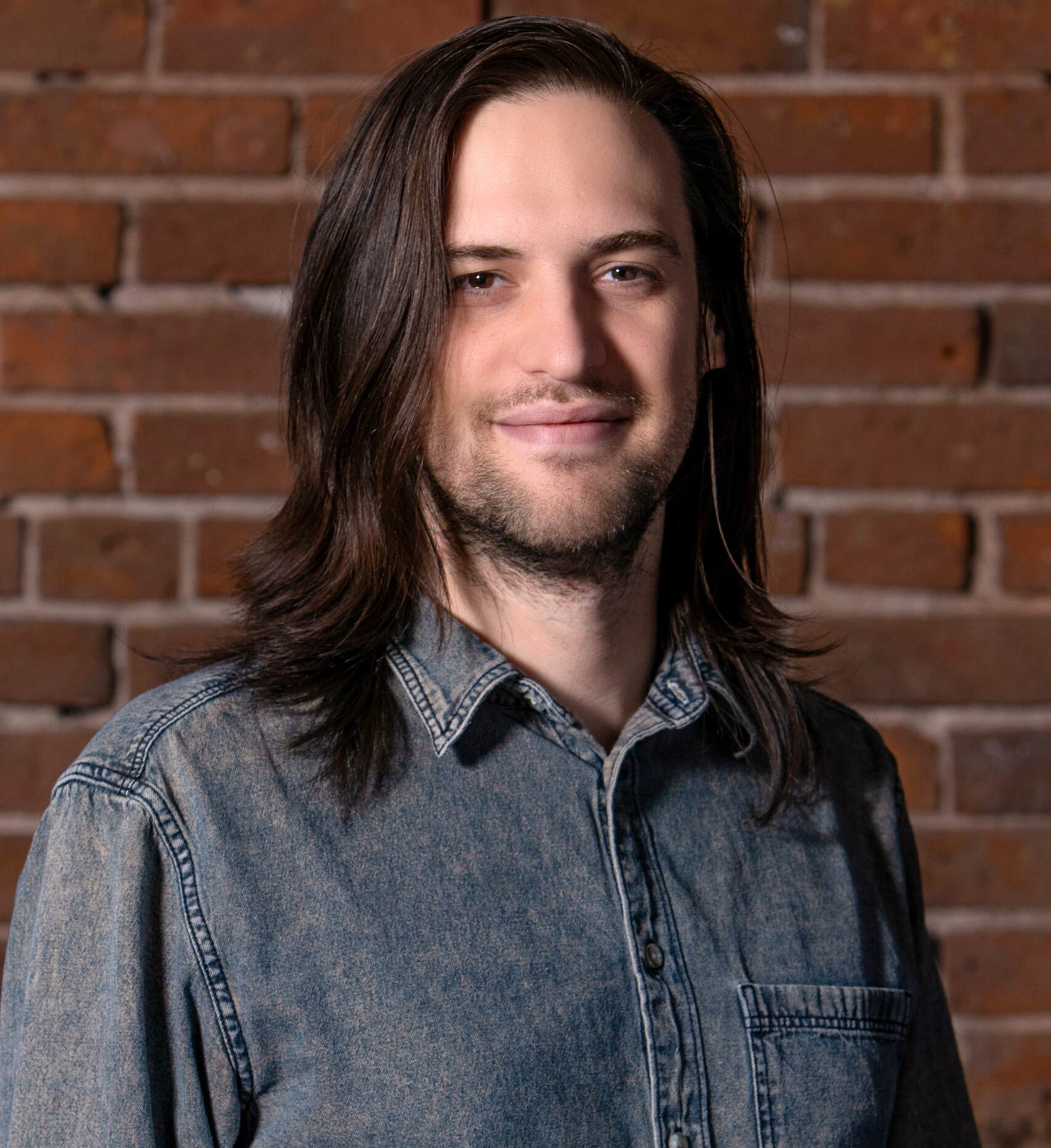
Editorial intern Josue Solis ’26 speaks with former NER intern J. P. Allen ’11 about not defining yourself by your job, the benefits of meditation, and his translations of Clementina Suárez’s poems.
Josue Solis: What was your major at Middlebury? Did you have a difficult time deciding on what to study?
J. P. Allen: I majored in Political Science. I found it extremely difficult to choose a major: I have a lot of interests, from poetry to translation to international policy to urban infrastructure. I also took a ton of language courses (Spanish, French, Russian, Portuguese), which made it a bit harder to “squeeze in” an actual major.
I chose poli sci partly because I was inherently interested in the subject and partly because I felt it would give me tools for tackling intellectual problems of many kinds, across many fields. Honestly, if I’d spent an extra year at Middlebury, I might have switched to geography. I took Geography 101 in my junior year, and it profoundly changed how I thought about research, information, and the world.
JS: Where are you now, geographically and professionally?
JA: I live in Durham, North Carolina. I work for a fully-remote tech startup, helping make the company’s marketing, sales, and customer success teams more effective. My job is a mix of understanding systems so I can make them more useful, and understanding people so I can set up systems that are actually useful for them.
JS: After you graduated from Middlebury, did you expect your career journey to unfold as it has? What were some of the steps you took to get to where you are today?
JA: That’s a difficult question. I don’t think I had a clear set of expectations for my career. I was interested in local and international politics; I applied to a ton of jobs in both and got accepted into a local government fellowship, where my love of writing led me to the communications office. After that, I my interest in urbanism led me to a ridesharing startup that was trying to work in cooperation with cab drivers. I pursued marketing because I figured it was my best shot at getting into the company with my writing background. After that, I took a risk and committed more deeply to writing by applying to an MFA in poetry.
At the end of my MFA, my ideas about work changed in a subtle but fundamental way: I decoupled my job from my identity. Before, I thought along the lines of, “I am in an MFA program, therefore I am a poet and an academic, and those labels define everything about me.” By the end of my MFA, I came to the liberating conclusion that I can just have a job: my job does not need to constitute my entire purpose or self-definition. Middlebury taught me to seek meaningful work (a good outlook in many ways) but I think I took the wrong lesson at first, namely, that I was my job. Growing out of that fixation has helped me think more critically about drawing meaning from multiple aspects of my life, without expecting a job to bear the entire weight of my personhood.
JS: What do you remember most from your time as an NER intern?
JA: An image: I remember sitting in the atrium of the then brand-new Axinn Center, next to the floor-to-ceiling windows, talking through submissions with Carolyn and the other interns. And a lesson: the NER internship taught me to articulate why a piece of writing did or didn’t resonate with me, so that I could have more fruitful conversations with others about what makes writing magical for each of us.
JS: Alongside various positions through the years, you’ve been an editorial assistant, a speechwriter, and a teacher. What is one skill you developed during your time as an undergraduate that you still carry with you?
JA: Meditation! My freshman seminar was Gödel, Escher, Bach, a course centered on the book of the same name, taught by Steve Abbott, a math professor. Both the book and Steve’s teaching were a beautiful, multidisciplinary mix of science, math, art, and philosophy. (Not coincidentally, the class included a unit on translating poetry!) We were all learning together; Steve even had each of us present to each other on topics branching off of the main material of the book. One of those presentations was on the basics of meditation. Meditation is a lifelong skill that has helped me immeasurably, and one of the images I still go back to when I meditate is that first ten-minute lesson in the classroom.
JS: NER just published your translations of three poems by Clementina Suárez in issue 47.1. Could you tell us about your relationship to Clementina and her work?
JA: Long story short, I read an article in a Spanish-language publication that offhandedly mentioned Suárez in the same sentence as Pablo Neruda. I was shocked: Why had I never heard of her? From there, I looked up some of Suárez’s poems and got hooked on their commanding energy. As I learned and read more, I got in touch with Janet Gold, Suárez’s biographer, and Frances Simán, a Honduran editor and translator who keeps Suárez’s work alive in the original Spanish. Both of them have been wonderfully encouraging and helpful as I’ve worked on these translations.
JS: What do you read for pleasure? Have you read anything lately that you’d like to recommend?
JA: I mostly read novels and nonfiction. I think these are my favorites of the past three years:
Fiction: Parable of the Sower by Octavia Butler. One of the greatest novels of all time. Everyone on earth should read it to understand the U.S. Babel by R. F. Kuang. Want an exciting fantasy novel with a brilliant magic system? Read this book. Want a complete education in literary translation theory? Read this book. Want Harry Potter with anti-colonial politics? Read this book.
Nonfiction: Rare Earth Frontiers by Julie Klinger. On the surface, this is a book about rare-earth mining, an interesting and relevant enough subject on its own. But on a deeper level, it’s about how political power structures invent and then exploit “frontier” spaces. If that sounds boring, trust me, it’s not. This book changed the way I see the world, just as much as the two novels above. Reading it, I was reminded of this Emily Dickinson quote: “If I feel physically as if the top of my head were taken off, I know that is poetry.” Clementina Suárez: Her Life and Poetry by Janet Gold. Even if you aren’t into poetry, this is a great read. I found Gold’s approach to biographical writing innovative, fascinating, and deeply engaging; plus, Suárez’s life is inherently adventurous and full of dramatic source material.
And one book I want to read: The Black Utopians, by Aaron Robertson. I saw the author read an excerpt last summer and instantly knew it was the kind of book I’d love.
And one book I want to read: The Black Utopians by Aaron Robertson. I saw the author read an excerpt last summer and instantly knew it was the kind of book I’d love.
JS: Is there anything else you’d like to share?
JA: Throwing this out there in case of serendipity: My other obsession over the past few years besides translation has been housing policy. If anyone who reads this is interested in coops, land trusts, or converting single-family homes to duplexes, come find me on LinkedIn.