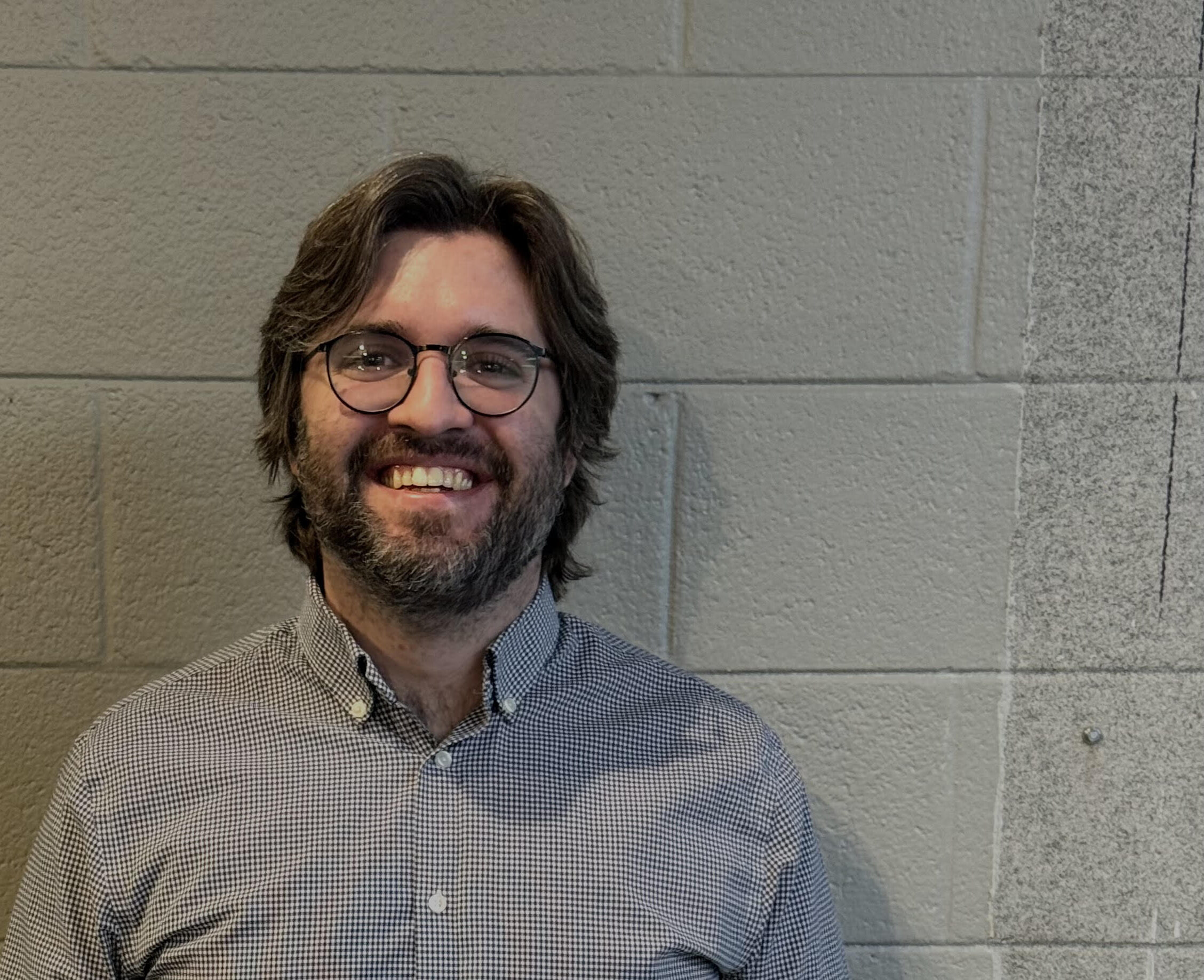
“I think a difficulty with metaphor is that it isn’t a comparison; it is a prescription.” Jarrett Moseley talks with Wheeler Light about the extent to which a poet wants to be understood and the influence of Waiting for Godot on his poem “You Should Be Reading Poetry and I Should Be Going to the Theater” from NER 47.3
Jarrett Moseley: First of all I want to say I love this poem. I’m moved to chills every time I read it. I’m so glad the editors chose “You Should Be Reading Poetry and I Should Be Going to the Theater” for publication in most recent issue of NER.
I want to start off by asking what might be the most obvious question about the poem, but which I think will be a good pathway for the reader into the work. The poem circles around the Samuel Beckett play Waiting for Godot and the relationship between the speaker and a beloved. What in Waiting for Godot moved you, especially in the context of relationships and intimacy?
Wheeler Light: I wrote this poem after seeing Waiting for Godot for the first time, which is a play that I understand to be about the obligatory madness of desire. Barring a reading that positions it as an allegory for purgatory, it is a play about two men who, despite all evidence that what they want will never happen, want it anyway. They want the job without knowing how they may be compensated, they want time to pass, they want the boy to remember them. In the same way, my poem is very much about eros. The speaker of the poem isn’t exactly rational. They’re in a relationship with someone without knowing very much about them—how they like their eggs, for instance. The speaker wants what love promises and is curious about their partner—the line between wanting to be in love vs. being in love as a consequence of knowing somebody. The speaker, very much like Didi and Gogo, is sort of an idiot hoping for the best.
JM: The poem places the relationship between the characters Gogo and Didi in tension with the relationship between the speaker and the beloved. This dichotomy drives the poem forward, but I find the poem is full of other dichotomies. At some points, it even uses syntax to create dichotomies that may or may not be true. For example, “People also do not fall in love / and nor does literally always refer to the real.” Or “While not every poem / is a love poem, every night sky might show us stars.” In what way are dichotomies (real or false) important to this poem?
WL: This might not be the most direct answer, but I am always thinking about colloquial American English and the banality of metaphor. I read Metaphors We Live By by George Lakoff and Mark Johnson in college and it changed how I think about language. It is very hard to say something directly without employing metaphor. Phrases like “What’s up?” and “I’m feeling down” are metaphors we don’t think about as metaphors. In the same way, the meaning of “literal” is debated and “falling” in love, which is hopefully a trust fall, is a metaphor.
I feel that language is something that we can only try our best with, and a poem provides a space for me to untie the shoelaces of words and let them trip over themselves. If I set up that there are two ways to think about one word, it changes that word for the entire poem. A side note is that every Wednesday, I go to a dance studio at night to write poems with my friends. Everyone there knows that if I define something in a poem, I will offer the definition’s negative. I think tasking ourselves with multiple definitions allows us to make new kinds of meaning.
JM: One thing I’m particularly interested in is how the poem approaches naming. Even more specifically, how the poem names the two main characters of Waiting for Godot. At first the speaker refers to them by their nicknames (Didi and Gogo) but then switches, without explanation, to using their actual names (Vladimir and Estragon). Eventually, the speaker even mixes the two, referring to the pair as “Didi and Estragon” and “Vladimir and Gogo.” Could you speak a bit about this move and maybe the importance of naming in this poem more generally?
WL: This was a musical move, I felt, but it also deals with definition and signifiers. I loved how names slid between given and nicknames in the play and wanted to offer that complication in the poem. While I was writing I was also thinking, “Oh my gosh, what if someone hasn’t seen or read Waiting for Godot?” and wanted to make it very clear that I was using all the names available to me for the characters. At the same time, though, while still thinking about meaning making and alternative definitions, I wanted to try to establish that, while Didi and Gogo have names and identities, their identities are faulty. Their names aren’t just names, they are marked by hope and recognition, forgetting and desire. They are characters in a play and they are lunch for a buzzard. Naming something is not the same as noticing it—there are so many ways to know somebody that have nothing to do with a name.
I hope the poem offers the intimacy of identification as well as the empathy that comes with understanding somebody beyond the language we use for them. The speaker and the beloved in the poem are never named, just idealized. The sun is just the sun—the desert, the desert. Even the armrest between the speaker and their beloved has thoughts and beliefs. The sun doesn’t set; it stays in place while we turn toward it. I think a difficulty with metaphor is that it isn’t a comparison; it is a prescription. When the poem says, “The logic of intimacy is a dead tree growing living leaves,” that is what the logic of intimacy becomes. In the same way, a name is a prescription that has very little to do with meaning, or a name is a meaning that is made in real time.
JM: The poem is written in a series of mostly declarative sentences, which gives the piece a confident tone, but the sureness of the speaker’s declarations shifts throughout the poem. I’m most interested in the verbs that modify the sentences’ subjects, that shift between the more certain “will” and “should” and the less certain “might.” How do you understand the speaker’s relationship to certainty in the poem?
WL: This is a good question that highlights something I wasn’t aware I was doing when I was writing the poem, which is delightful. Charles Simic wrote about the importance of surprise and now I am surprised by my own poem—how fun. This poem deals significantly in hypotheticals—the eggs, the roles of Didi and Gogo, what it might be like to be in love, what the night sky does for itself. The speaker is largely guessing and hopefully conveys what it’s like to think you have a unique interpretation of a ubiquitous piece of art. “I assume” shows up four times toward the end of the poem as an anaphoric nod. There are some things that the speaker is confident “will” happen: Didi and Gogo will come back to the desert, the speaker will have desire and make assumptions. I guess there’s a line between what the speaker understands and what they want, and that line is regularly blurred.
JM: I’m always interested in the use of the direct address in poetry, but I also find it slippery. The “I” of the poem is easily accessible to a reader just by value of the reader stepping into the role of the speaker. In contrast, I think a poet must more intentionally build a “you” when they use direct address. In this poem, what were your main concerns in constructing the beloved “you” and how did you approach that process?
WL: When I look at this poem and think about it as a love poem, I am not sure it does the “you” much justice. The complicated part of writing poems with a “you” in them is manyfold. In one reading the “you” can be a reach outward to the reader, in another, entire poems are written with the second person as a placeholder for the first. As Megan Falley wrote in “Holy Thank You for Not,” “Once, you said you in a poem / because you were too ashamed to say I.” Or, if the “you” is a character, a reader can still have a shaky relationship with the distance. The “you” in the poem is an object of obsession, of compulsive, recurring thinking. There is intimacy and desire but no history or personality. Poetry does this—forgoing narrative logic for emotional logic. I do hope that readers might come to this poem and think, “Wow, the speaker is totally nuts.”
Obsession is an unnamed character in the poem who I think may be the main character. The lines “I am at the center of my life. My life wraps heliocentric / around me” feel grandiose and delusional, but that’s sort of the point. I guess all this is to say that when I am writing with a “you,” it is hard to give the “you” the same generosity I give the “I.” The “you” of this poem is a complicated person just like the speaker. I agree that the direct address is slippery. And then there is the “you” of an elegy, which is another topic altogether.
JM: One could read this poem as an ars poetica. At the very least, the poem is concerned with the ability of language to “approximate feeling and logic.” When you write poetry, what is your relationship to, as the poem gestures toward, “wanting to be understood”?
WL: I think everything I write can be read as an ars poetica and I’m not sure that’s a good thing. As far as wanting to be understood goes, I was introduced to poetry through slam poetry in high school when my teacher, Jeff Winston, showed us Brave New Voices back when it was on HBO. I spent many years dedicated entirely to the craft of concise, understandable performance poetry. A slam poem is a poem that must make sense on the first listen to be successful. I would write explicit poems about trauma, mental illness, and so on, that were extremely revealing. I’m glad they’re almost entirely not on the internet. I still write poems about trauma and mental illness but with more secrets and strange imagery.
Nowadays, I am more interested in creating a reading experience that allows a reader to ask questions that aren’t always answered. I do feel I have a responsibility to write poetry that is, in some way, accessible. I want the reader to feel welcomed into a poem and I, as a reader, struggle with certain more experimental poems. At the same time, I love Aram Saroyan and think Jos Charles’s Feeld is one of the most incredible books I’ve ever read. Maybe in a decade I will not worry so much about understanding and instead use the page as an improvisational landscape. I took a workshop with Heather Christle (NER 39.2 contributor) recently and she had us split into pairs and write poems one word at a time handing the poem back and forth. The poems largely made no sense whatsoever but were colorful and exciting. For now, I am making sense. Maybe one day I will stop.
Wheeler Light received his MFA in creative writing from the University of Virginia and lives in Denver, Colorado. He is a Pushcart Prize and Best of the Net Nominee. His work has appeared or is forthcoming in Rattle, The Penn Review, Tupelo Quarterly, Barely South Review, and South Broadway Press, among other publications. He is the dad of a cat named Betty and twenty-something plants, and can kickflip on a good day. You can find his work at www.wheelerlight.net.
Jarrett Moseley is the author of the forthcoming collection Rehumanization Litany (University of Arkansas Press, 2027), chosen by Patricia Smith for the Miller Williams Poetry Series, and the chapbook Gratitude List (Bull City, 2024). His second collection, As If I’d Never Been Destroyed, was a 2026 National Poetry Series finalist. Winner of the North American Review’s 2026 James Hearst Poetry Prize selected by Danez Smith, his poems have also won awards from the Baltimore Review and the Academy of American Poets. Individual poems have been published in Ploughshares, AGNI, The Missouri Review, and elsewhere. He currently reads submissions for the New England Review.