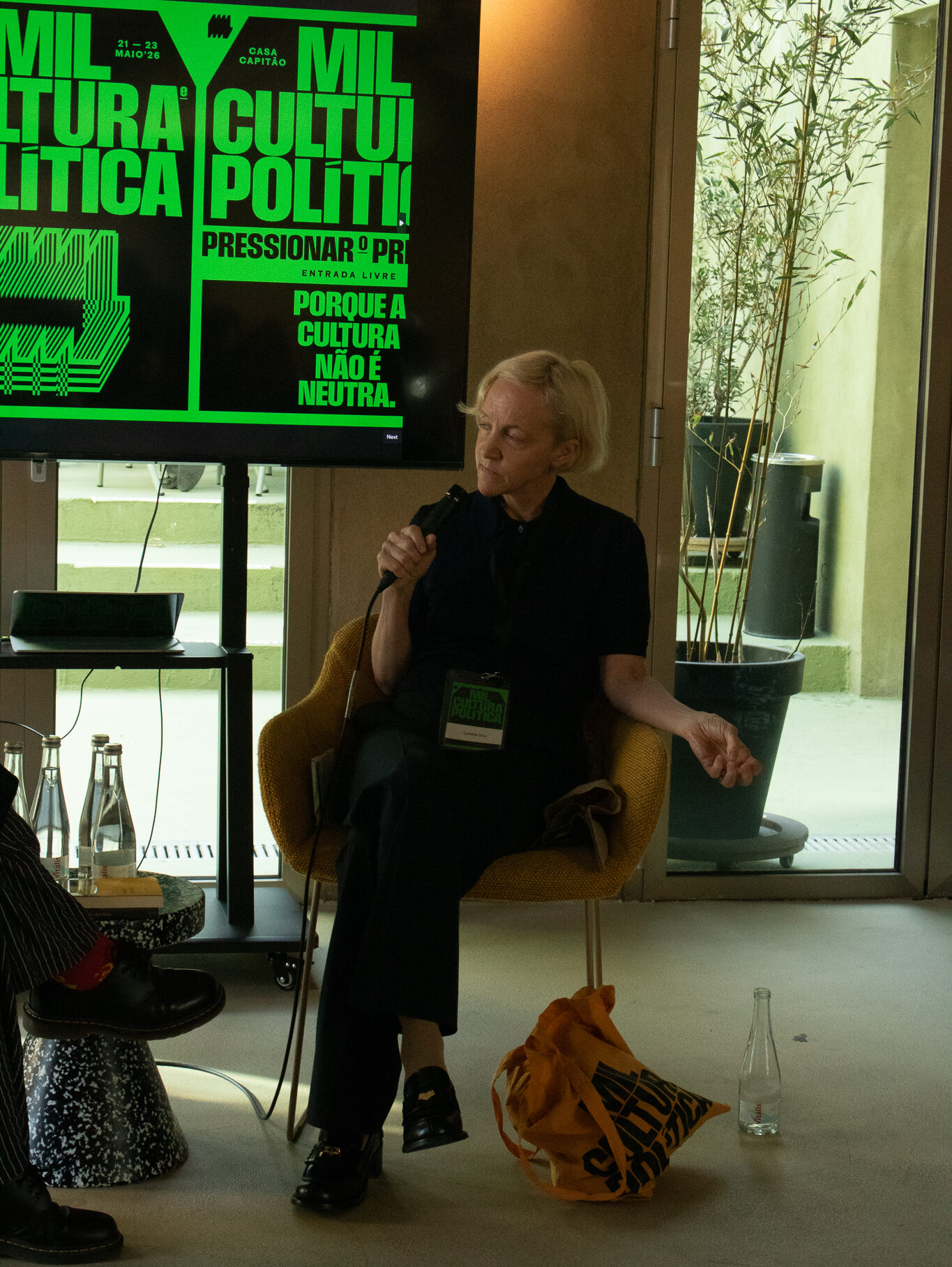
Staff reader Maggie Wang speaks with NER 47.2 poet Cynthia Cruz on Hegelian philosophy, shared desire, and the complexities of movement.
Maggie Wang: All three of your poems in issue 47.2 deal with life and death, endings and beginnings. In each, the speaker is apprehensive about death and yet understands it as a life-giving force. In “Twilight,” for example, you write that “Survival is the remainder / of death.” These are perennial themes, but everyone relates to them differently. Could you talk about what draws you to these themes and what you are trying to understand about them?
Cynthia Cruz: For Hegel, spirit becomes spirit through the process of negating—or annihilating—what it is not. In other words, spirit becomes spirit through its many (psychic) deaths. And it is only through this long laborious process that what spirit is—what spirit always already was—comes to the fore.
As others have shown, this process corresponds to the process of Lacanian psychoanalysis. Through the long rigorous work of analysis—by discarding what she is not—who the analysand is and always already was, is brought to the fore.
This structure—working through what one is not, moving through a series of psychic deaths—is crucial to my understanding of how a poem is made. But it is also, as you note, crucial to the text. For both Hegel and Lacan, twilight is the suspension that appears when we let go of one form of knowledge and have not yet acquired another. In other words, twilight is the suspension between who I was and who I am becoming. It is a momentary state of radical disorientation, or madness.
MW: You also refer in all three poems to dreams, madness, and psychology. The speaker in “Twilight” identifies with “Freud’s / hypothetical boarding school girls,” and in “The Riddle of the Modern World,” the speaker dreams that they are “asleep inside a dream.” I understand that you did your doctorate on Hegel and madness. What is the place of dreams in madness, of madness in dreams, and of madness and dreams in literature?
CC: In The Phenomenology of Spirit, Hegel introduces the concept of Befreiungskampf, or liberation process, through which spirit awakens from its slumber. The three-stage process consists of Durchträumen, madness (Verrücktheit), and habit. In Durchträumen, spirit exists in the slumber of its being, immersed in a dreamscape, surrounded by images without meaning. In the Jena Lectures, Hegel refers to this hypnotic suspension from which all subjects emerge as the “Night of the World.”
Madness and Durchträumen overlap. Our unconscious—that which forms us, driving us to do what we do without our conscious knowledge—produces dreams. It is this site out of which we are formed. Habit, the third step in the liberation process, is what allows spirit to tame madness and, in doing so, pass safely through this momentary madness.
MW: The theme of the boarding school recurs in “Ether,” where you write of a “sisterhood” in a “secret Swiss / Boarding school.” Boarding schools have a certain mystique as places of suspension, confinement, and refinement. Their appearance heightens the melancholy, Gothic elements in these poems—for example, “the deathly Rhine / Of the Mississippi” in “Ether,” and the “crypt of . . . white Dresden / bones” in “Twilight.” What attracts you to this register?
CC: I became interested in Freud’s hypothetical case of boarding-school girls upon reading an article by the French psychoanalyst Silvia Lippi, “Feminism and Psychosis: Concerning the Delusion of Valerie Solanas.” In the piece, Lippi analyzes Freud’s hypothetical case—included in Group Psychology and the Analysis of the Ego—and offers an intervention. In the original case, Freud describes a group of girls at a boarding school who are infected with the contagion of hysteria after one girl receives a letter from a boy she is secretly in love with. In his analysis, Freud explains that the girls are infected with a desire to share the object of the first girl’s desire. They want also to have their own boy. Lippi suggests that, instead, what the girls desire is to share the first girl’s desire itself.
This case fascinated me for a number of reasons. In particular, I became interested in desire as a binding force. How, in other words, can a shared desire—between a group of individuals—bind the group while—and this is crucial—allowing each subject to retain their autonomy? Lacan, in his analysis of Poe’s “Purloined Letter,” presents a similar case, where individuals are bound to one another through their desire. In his reading of the story, Lacan shows that desire can bind an unlimited number of subjects through a shared ideal.
I applied for the Guggenheim Fellowship in 2024 with these concepts in mind. My proposal was to write a collection of poems based on the case. The collection, “The Encyclopedia of the Not-All: An Epic,” is concerned with the alienation and helplessness of the individual in capitalist society and with the immanent potential—both for the individual and for society—that this imagined psychoanalytic case suggests.
MW: You are working in a longer tradition of writing about the Gothic and the surreal, death and the body. “The Riddle of the Modern World” is after Frank Stanford, and “Ether” is after Lucie Brock-Broido. What is your relationship with these poets and their work, and how do you see yourself in conversation with them?
CC: Both poets are formative to my becoming a poet. I was fortunate to have the opportunity to work with Lucie Brock-Broido when I first began writing, and it was she who introduced me to the work of Frank Stanford. Though their aesthetics differ, their poems, nonetheless, share the structure of complexity and a resistance to the flat language of communication.
Furthermore, I have always been acutely aware that my poetry does not arise out of nothing. It is always in conversation with the poets whose work I have read and studied over the years.
None of us are writing in isolation: all of us are writing in conversation—in particular, with the dead, those poets who have gone before us. It is to these poets that I have apprenticed. It is to these poets that my work owes an infinite debt of gratitude. I have, over the years, attempted to make this inherent connection explicit by invoking various writers in my work (i.e., Bachmann, Duras, Lispector), by including allusions to the work of such poets, and also by writing “after poems.”
MW: There is pain and illness in these poems, as is maybe natural when handling questions about death and madness. But the pain and illness are not one-dimensional; the “tiny silver mania” in “Twilight” is “caught, kept, and suspended,” like a jewel. And in “The Riddle of the Modern World,” there is “a yellow fox / warm with illness,” who seems almost serene. In “Ether”, you speak of the “Sweet, infinite / Symptom.” There is a thesis here about the body, and especially about women’s bodies. Could you tell me more about that thesis?
CC: To answer, specifically, the latter part of your question: death, pain, and madness, are constructive through their destruction.
Death, for instance, hangs like a star over our lives, and awareness of it is what gives rise to the awareness of the fragility of life—how dear life is, how ephemeral. Without an awareness of death, one drops back into a state of undeadness: one is alive but unaware of one’s life.
Likewise, by our symptoms—the cause of our suffering—we become able to undo them, bringing their causes to the fore.
Madness is a moment of radical disorientation, a state we all pass through each time we acquire a new form of knowledge. For Hegel, madness is inherent to all and only becomes destructive if we become stuck in this zone—which is why movement is crucial.
MW: What is the role of form and movement in these poems? I admire how the form of “The Riddle of the Modern World” and “Ether”—short lines, mostly couplets—seems to simultaneously speed up and slow down the poem. This sense of movement carries over to the substance of the poems too, as in these remarkable lines from “Ether”: “If I had a mind, it would be / Restless, pure relentless / Movement, / The annihilation of every fixed idea and / Determination.” Might a good poem also be said to annihilate every fixed idea and determination? How do you carry that idea in your work?
CC: Movement has always been primary in my work—not as one fluid, seamless, motion but rather, motion akin to a cell that breaks apart into many disparate pieces only to reform again, but now with difference.
Such a structure results in a rich, complex texture I have always admired, the opposite of what Walter Benjamin describes as the flat language of journalism, with its intention of keeping the reader from experiencing what is being depicted. This is the flat, distanced language of the advertising world, an economical means of communicating which has become ubiquitous. What Benjamin describes in his analysis of Proust is, instead, a structure that allows for a complexity that resists simple reduction. In other words, by presenting, for instance, one long sentence, followed by a series of short, sharp sentences, the reader, as she reads the poem, experiences the contradictions inherent to the poem. Such a structure—a kind of totality in which various contradictory elements can exist at once—mirrors the experience of being a human subject.
Cynthia Cruz earned a BA in English literature at Mills College, an MFA in poetry at Sarah Lawrence College, an MFA in art writing at the School of Visual Arts, an MA in German language and literature at Rutgers University-New Brunswick, and a PhD from the European Graduate School, where she wrote her dissertation on Hegel and madness. She is the recipient of fellowships from Yaddo and the MacDowell Colony, as well as a Hodder Fellowship from Princeton University and a Guggenheim Fellowship. Her recent collection of poems, Hotel Oblivion (Four Way Books, 2022), was a finalist for the Kingsley Tufts Award and the winner of the National Book Critics Circle Award. She is currently a visiting assistant professor at the University of Notre Dame.
Maggie Wang is interested in the environment, the absurd, and the relationship between text and power. She is the author of a chapbook, The Sun on the Tip of a Snail’s Shell (Hazel Press, 2022).