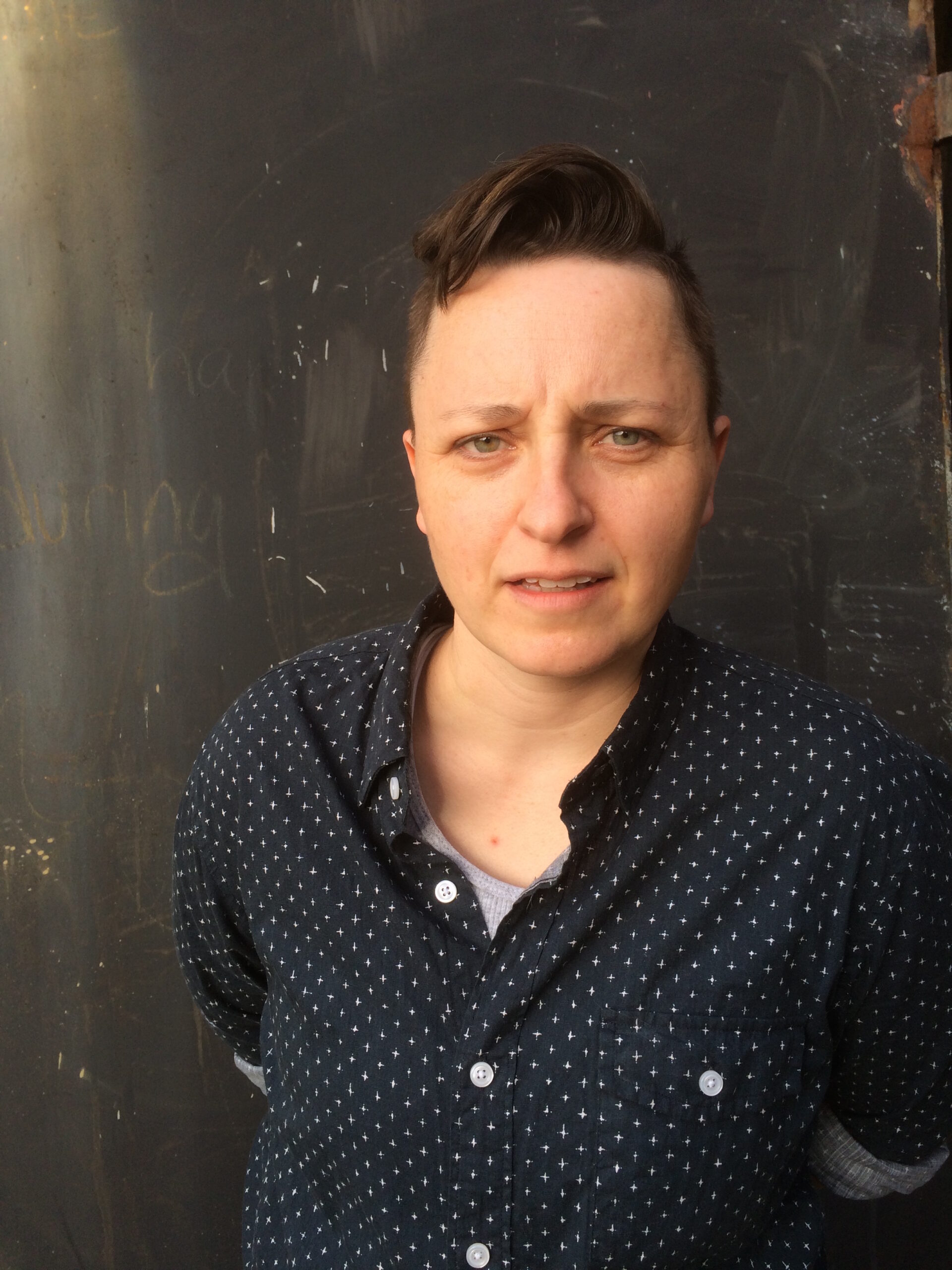
Staff reader Nico Amador speaks with NER 47.2 contributor Jenny Johnson about the nuances of writing into eros and the prose poem as a form for sensory immersion.
Nico Amador: The most recent issue of NER features a suite of three poems, all short prose pieces that gesture at kink and other consensual forms of erotic play—a subject that shows up in your other recent poems and personal essays. How is this series in conversation with other parts of the body of work you’re building around these themes?
Jenny Johnson: This selection of poems is a part of an unfinished ten-page series. My personal prompt for these prose poems has been to record instances where I’ve felt whelmed by erotic experiences, and to permit images—no matter how contradictory in tone—to collide.
This series is a part of a larger manuscript of poems currently titled “Good Bully.” Many of the poems in this body of work reflect on queer BDSM experiences. I appreciate how writing about consensual kink experiences invites alertness to pleasure, pain, and power dynamics. I’ve been asked before, How can you write about pleasure in this political moment? Arousal comes from the verb rouse—to awaken or to stir. For me, writing into eros is choosing to feel, in other words, to stay sensitized.
NA: I’m curious, too, about your particular style of representation, the close-up attention you give to what’s being described in these poems and some of your others. I’d liken it to a photographer with a zoom lens producing a series of stills; the reader is made aware of positioning and action, how each part of the body both reacts to and becomes a set of textures and stimuli. What’s informed your poetics in this regard?
JJ: It’s true—I have been thinking a lot about camera work when depicting people in my recent poems. Thom Gunn has been an influence in this sense. His poems have served as lyric models for ways to zoom in, pan out, and note how sightlines function in erotic poems. “Bally Power Play” is a good example. I’m always asking myself: Who’s gazing at whom and how? Also, how can I cue when such gazing is consensual?
In the first poem in this suite, a bunch of urges are revealed in quick flashes. No one moment or desire is held for too long. It’s also a rather switchy poem in terms of the positioning and action that you mentioned. I was interested in keeping the reader on their toes by refusing to pin down any one predilection. I suppose my favorite part of being a pleasure-seeker is being surprised by my own desires and surprised by all the highly specific, sensual, and outrageously bawdy wishes, wants, and kinks that other folks are into as well. I wanted this poem to embody a swell of possibilities.
Meanwhile, in the second poem, we start in medias res with a “you” bottoming in a mud scene. This poem has a trackable storyline. The shots are tight, capturing skin, mud, and boots up close. But the shots are also relational. The three figures in the scene are intimately connected and energized by the arc of their power exchange. I was trying to convey their responsiveness to one another, too, through the poem’s camerawork.
NA: The poems in this suite share the title “Whelm,” a word that eschews a precise interpretation. To be whelmed could mean, literally or figuratively, to be engulfed, overpowered, immersed—but it could also suggest a more controlled middle ground between the sensation of overwhelm and underwhelm. Could you talk about the choice of title as a frame for these poems?
JJ: Thank you for digging into the word “whelm.” I’m experimenting with immersion in these prose poems, in lieu of trying to drive each poem towards some kind of epiphany. I’ve found the prose poem to be a safe container for a flooded sensorium. In a BDSM scene, sometimes the exact moment when a person feels the most overwhelmed by sensation is also the moment when their senses are the most acutely heightened. I am interested in finding ways to play responsibly at such limits through description.
NA: The short prose style, at first glance, communicates a sense of containment and uniformity, yet individually the poems are reaching toward distinct ideas or memories. Rhythmically they’re quite different, and even within each poem there are moments where one thought seems to clash against another. In what ways did the pressure of this form support those generative and spontaneous contradictions?
JJ: I read somewhere that Gerard Manley Hopkins chose to shorten the sonnet to a curtal sonnet, because he didn’t think the sonnet held enough pressure at fourteen lines. I’m not writing sonnets right now, but I am interested in maximizing pressure within the prose poem. Treating this form as an exploratory container, I’ve tried to stay as inquisitive about craft (i.e., sound, rhythm, and image) as I am about content. There’s pleasure for me in letting different sonic and rhythmic pressures smack, kiss, and clash, and then paying attention to whatever sparks to the surface.
NA: In your essay “Butch Blow Job,” you cite the scholarship of Gayle Salamon and her term slow phenomenology. “From her,” you write, “I have learned that we can unknow what we think we know about gender and embodiment if we describe that which seems implicit explicitly.” I wondered if that’s part of what’s happening in these poems—there’s a sort of unraveling of assumptions about pleasure, power, and identity happening through this chain of short meditations and juxtapositions.
JJ: I love this connection you’re drawing between my poems and this essay. When writing “Butch Blow Job,” I was interested in giving slow explicit attention to the titular sex act—just to see what might emerge, and yes, to unravel assumptions about pleasure, power, and identity. In a parallel way, I have been giving explicit attention to small erotic gestures in my poems. I’m curious about what emerges as implicit in an explicitly drawn chain of gestures. I believe that what makes erotic exchanges meaningful and memorable—whether they be quiet or steamy or hardcore—is the intentional build of actions and reactions between friends and lovers. In the third poem in the series, the speaker is caught between the flirtatious volleys of two friends on a morning walk, and the candid build of their energy—their beaming—permits vicarious joy.
Jenny Johnson is the author of In Full Velvet (Sarabande Books, 2017). Her poems and essays appear in American Poetry Review, BOMB Magazine, The Georgia Review, and Sinister Wisdom. Her honors include a Whiting Award, a Hodder Fellowship, and a NEA Fellowship. She is an associate professor of creative writing at West Virginia University, and she is on the faculty of the Rainier Writing Workshop.
Nico Amador’s writing has appeared in the LA Review of Books, The Adroit Journal, American Poetry Journal, Pleiades, fourteen poems, and elsewhere. His chapbook, Flower Wars, was selected as the winner of the Anzaldúa Poetry Prize and was published by Newfound Press in 2016. He earned his MFA from Bennington College and has been recognized with the Blue Mesa Review Poetry Prize, the Outpost Vermont Fellowship, the Fine Arts Work Center Emerging Writer’s Fellowship in Provincetown, and the Gregory Djanikian Scholars in Poetry Prize. He reads poetry manuscripts for NER.