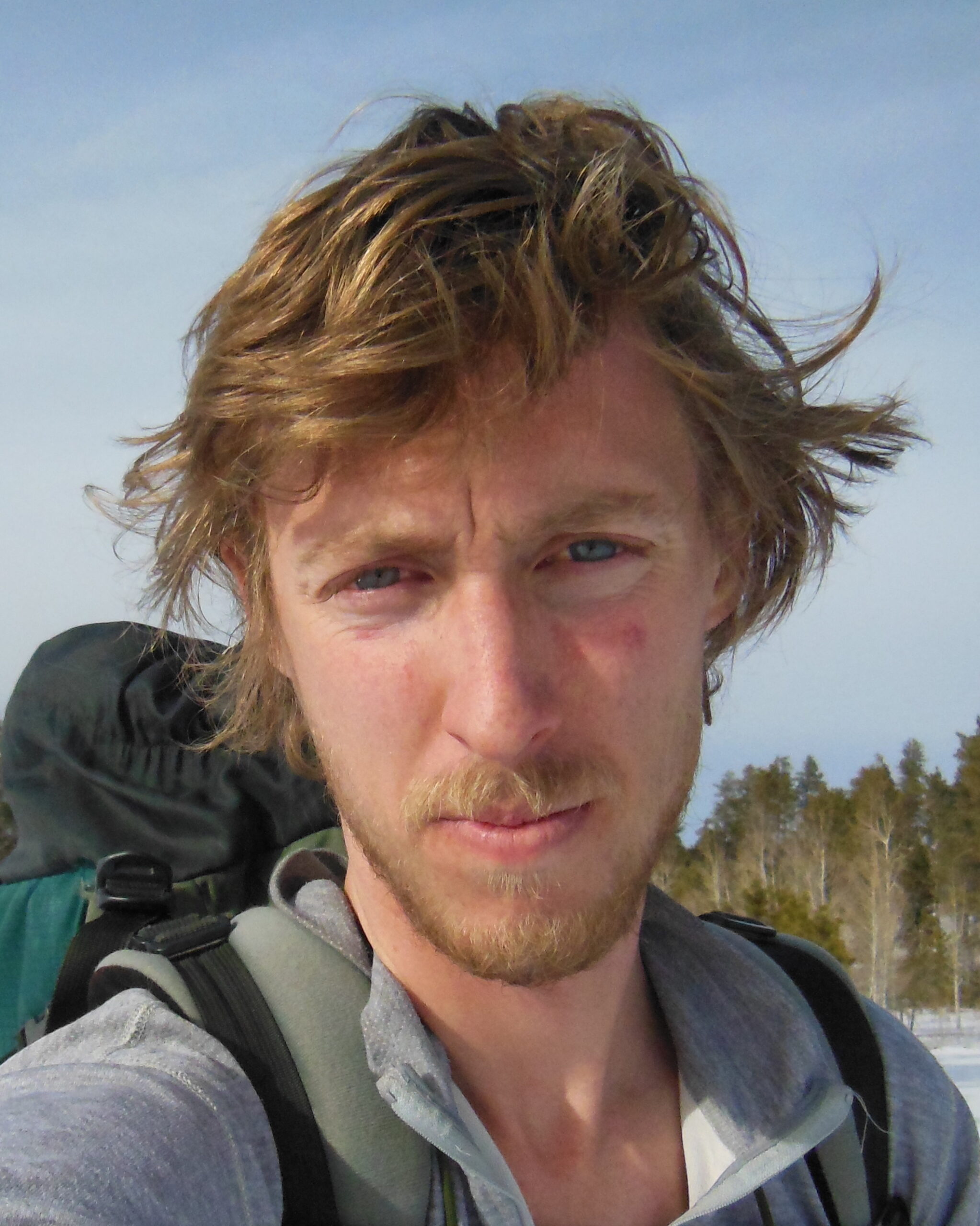
Staff reader Thomas Nath speaks over the phone with NER 47.2 contributor Leath Tonino about constellations, gossip ladders, and why you should write down quotes when you read.
Thomas Nath: I’d be curious to know where the germ of the idea for this piece began. Did it start with a desire to interrogate certain themes, or from playing around with the form of using other quotes, or were there readings you collected that seemed to speak to each other?
Leath Tonino: Two things to mention.
When I was about twenty, I started pulling quotes out of every single book that I read and typing them up in a giant Word doc. At a certain point, the doc got too big, very unwieldy, and so I switched to organizing the quotes annually, one doc per year of reading. I’ve been doing this for two decades now, pulling quotes with no program or specific intention, based on my curiosity, my idiosyncratic interest, my sense that a line is written beautifully or strangely, or that it contains a special fact or perspective. If it catches my eye or ear or mind or heart, I pull it. And because I’m me, not you or somebody else, certain patterns emerge. Themes. Preoccupations.
Now bring in John McPhee, the nonfiction master. He’s got a trick that he calls a “gossip ladder.” Picture him in a room with his journalist cap on. He’s taking notes on everything around him, eavesdropping, gathering lines of speech. He goes home to his desk and arranges these lines, orders them, stacks them up vertically on the page, but he strips away the attributions, the sources.
I first encountered this technique in his book Encounters with the Archdruid, a profile of the conservationist David Brower. McPhee’s trying to give readers an idea of this character, what makes him tick, but of course Brower is multifaceted, as we all are, and so it’s best to hit him from as many angles as possible. With a gossip ladder, McPhee can pack seven or eight quotes into a small space, like half a page. It’s at once dizzying and clarifying, dense and spacious. Again, there are no attributions. The connective tissue has all been stripped away. The quotes just sort of float there. Voices riffing on a subject, a variable, an X.
TN: Speaking of connective tissue, I kept thinking about how those gaps speak to the X variable in this piece: that theme of “becoming nobody.” Is there a way that you saw the form of the piece speaking to its content, the theme of self-renunciation?
LT: The short answer is yes.
A while back, just for nerdy kicks, I began messing around with my giant quote hoard, making gossip ladders of a sort, though I usually think of them as more like choruses, because the idea is polyphony, many voices coming together. You can imagine how it works. I’ll wander around in my docs and bump into a theme: interspecies communication! And another theme: philopatry, allegiance to place! And another: soil, decay, filth! And another: goodbyes!
With many of these experiments, the form and content aren’t necessarily integrated. But when I started messing with “Becoming Nobody,” it dawned on me that something else was going on here—namely, that for this theme, it really does make sense to erase, or at least downplay, the author. My name is at the top of the piece, and my fingerprints are all over the thing, but my actual voice is absent. I find that delightful. It’s why I couldn’t resist ending on the line from one of Elena Ferrante’s novels where the narrator mentions a character making an art of her own disappearance.
TN: I actually had a question about that very Ferrante quote, in which she writes that “eliminating herself was a sort of aesthetic project.” Since that is the final line, does that quote’s idea of self-elimination serve as a kind of resolution for some of the subjects that the piece is wrestling with, or do you think that ending is still an open question?
LT: I don’t think that quote answers anything or ends anything. One of the reasons I’m attracted to this form is because it’s overwhelmingly multivocal, omnidirectional, a swirl, you know? It doesn’t argue a point, marshal evidence, march forward in lockstep fashion to bludgeon the reader with “the correct idea” or “the truth,” and that’s because, of course, I don’t personally possess “the correct idea” or “the truth.” What I possess is a life of reading. Well, it’s actually more like I’m possessed by that life of reading, but you know what I mean.
TN: When you were composing this, is there a way—or a multitude of ways—that you envisioned it being read, e.g., as a poem, a koan, a meditation, a constellation of thoughts, or even as a linear movement through something?
LT: All of the above.
I really like that word “constellation.” The piece is a constellation of scraps, snippets, aesthetic fragments, literary fragments, thoughts that are decontextualized, then recontextualized. As with a constellation of stars, these sparkly little bits and pieces come together to sort of, kind of form a whole, a gestalt, a shape, a picture. But there’s a lot of empty space in the Big Dipper, too, right?
Presumably, a reader moves through “Becoming Nobody” from beginning to end, so in that sense it’s linear. On the other hand, it is indeed this constellation that both does and doesn’t hang together and hum. Again, the quality of overwhelm is important to me. I once published one of these ladder-chorus things and explicitly framed it as a performance piece, to be recited aloud by a bunch of readers. The key idea was that the readers would speak over one another, each quote bleeding for a few seconds into the next, the words overlapping and fuzzing out. That was one try at balancing linearity and simultaneity, the line-by-line energy and the all-at-once energy.
I’d like to think you could almost crawl into the middle of “Becoming Nobody” and be physically surrounded, immersed. I fantasize about the possibilities of a gallery space, a big installation, five thousand quotes printed out and cut into strips and arranged into sequences. Choruses within choruses within choruses! Ladders climbing into and out of other ladders! Everything swerving and colliding and merging and separating and flying all over the place! It would be a three-dimensional experience. Cheap red wine and ambient synths would be involved, for sure. Beanbag chairs.
TN: How much conscious thought did you give to ordering the quotes in a specific way—or to consciously not ordering them—to achieve that constellation effect?
LT: I’m highly attentive to the sequencing of the quotes. That said, there’s a good amount of intuition and feel involved, too.
The creative process begins with content, with meaning, with me wandering around inside my docs and pulling quotes that seem to circle a given theme. And the theme really is given: I find it in the docs, in the quotes themselves, perhaps in the spaces between the quotes. Once I have a bunch of snippets of text separated out and dumped into a new doc, I start cutting them down even more, deconstructing them, deleting some outright, moving the survivors around, looking for resonances and juxtapositions and connections and leaps. Some of it is intellectual—this idea leads to that idea. But much of it has do to with rhythm and tone, like maybe there’s a repeated word or phrase, maybe even a rhyme.
I have a few rules. One is that I’m not allowed to use ellipses to elide material. Another is that I’m not allowed to use multiple paragraphs. I can’t use the same author twice. And I don’t use lines from poems. Am I aspiring to a kind of found-text collage poetry? I don’t know. What I can say is that I absolutely want these things to move, to start somewhere and end somewhere rather different, but I don’t want to control and orchestrate that movement the same way I would if I were writing a conventional essay in the manner of Montaigne or Emerson or whoever. As the subtitle suggests, “Becoming Nobody” is something slightly different: “An Essay in Quotes.”
TN: Since you write across a variety of genres—poetry, travel writing, personal essays, etc.—I’m curious how you see poetry and nonfiction speaking to each other, and how you think about genre, or if genre is something you think about at all.
LT: I’m a freelance writer, so I do tons of journalism, magazine writing, projects with contracts and editors, strict word counts. But I also love writing weird stuff that never gets published, or if it does get published it’s in some obscure online journal or tiny chapbook. I like received forms and constraints and traditions. I also like kicking out the jams and exploring.
With journalism, I have to hold the reader’s hand a lot. There’s an emphasis on transitions and clarity, spelling stuff out, filling in the gaps. I’m all for that kind of writing, but it can be exhausting to sit at my desk and craft it, not to mention boring, sapped of mystery. Often, I’d prefer not to connect the dots myself. Hemingway’s iceberg theory: Leave out! If I’m remembering correctly, George Saunders once said in an interview that the more you remove, the more respect you give the reader: I don’t need to connect these dots for you, dear reader, because you’re smarter than I am and will connect them in better ways than I could ever imagine.
TN: As a final question—for someone who really connected with your piece in some way—what other readings, pieces, or practices would you recommend?
LT: Jot down quotes when you read. It’s a chore, quite annoying, but it’s a great practice, especially if you’re a writer. And even if you’re not a writer, it’s still a wonderful thing to do. I’m tempted to say it’s a way to be. My quote docs map a lot of the spaces I’ve moved in over the past two decades. It’s a very intimate, personal terrain, yet it’s constructed out of public texts.
Leath Tonino is a freelance writer and the author of two essay collections, most recently The West Will Swallow You (Trinity University Press, 2019). He lives at nine thousand feet in the Colorado Rockies.
Thomas Nath is a Trini-American writer, researcher, and inartificial intelligence. His work has appeared in the Brooklyn Review and the journal Regulation & Governance. He recently graduated with an MFA from the Iowa Writers’ Workshop and is finalizing his first novel. He reads fiction submissions for NER.