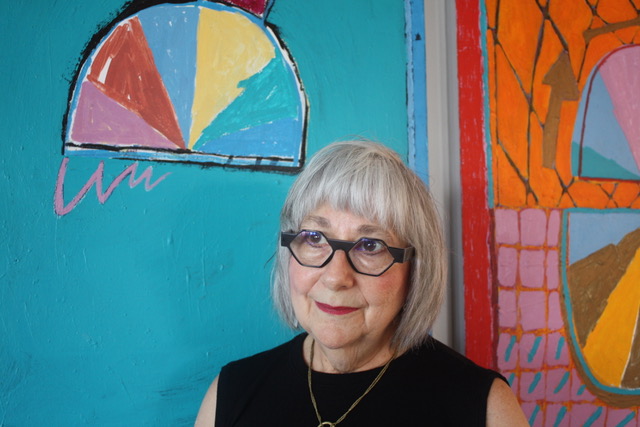
NER intern Eliza Tiles speaks with 47.2 contributor Yerra Sugarman about inherited trauma, the ethics of Holocaust representation, and crafting hybrid texts.
Eliza Tiles: In your essay “Because Here,” you reference the concepts of “identity thinking” and “postmemory” as ways of understanding your relationship to the Holocaust. How have these frameworks shaped the way you understand your own experiences and sense of self? Did encountering these concepts help you articulate something you already felt, or did they fundamentally change the way you understand your relationship to this history?
Yerra Sugarman: The concepts of Theodor Adorno’s “identity thinking” and Marianne Hirsch’s “postmemory” helped me clarify thoughts and feelings that I had, and allowed me to trust some of my own instincts relative to my experience and sense of self as a daughter of Holocaust survivors growing up in a community of survivors. Still, postmemory was a revelation to me. It helped me grasp that I was, that I am, a vicarious or indirect witness, part of postmemory’s second generation, and closely connected to survivors and their memories. I felt, as a child, haunted by the fragments of my parents’ stories, and those of the survivors in my community. Their fractured memories were ghosts, as were family members who had not survived, like my Aunt Feiga, about whom I speak in my essay, and about whom I write in my most recent book of poems, Aunt Bird (Four Way Books, 2022). My parents’ memories felt, to me, etched on my DNA. They seemed, in some ways, to supersede my own memories and experience.
As for Adorno, he claimed that Western philosophy has the tendency to reduce unique, complex objects into neat, universal categories. In avoiding identity thinking, we can avoid doing this. Adorno asks us not to engage in identity thinking because it levels unique objects into mere abstractions, serving as a tool of domination and control. In a sense, “identity thinking” turns people into things, something Simone Weil warns against. This concept made me question the morality of comparing catastrophes. Can I? Should I? It also encouraged me to focus on the individual experience of specific victims and survivors to arouse the reader’s sense of connection to them. His concept motivated me to give voice to individuals in intimate ways, and to erase their silences and absences.
Adorno and Hirsch’s ideas have enabled me to be more discerning in my quest to represent the extremity of the Holocaust as a writer and a poet, and to avoid stock and clichéd imagery and ideas. Finally, their concepts made me feel that I am accountable as to what the ethics of remembering and witnessing means post-Holocaust. I’m accountable in order to help stop current and prevent future collective catastrophes worldwide, and I’m accountable because I don’t want my own trauma to bring about trauma in others.
ET: The essay is formally unique and moves between personal narrative, historical inquiry, and reflection in a series of fourteen sections. What led you to format the piece in this particular way?
YS: Because I also write poetry—my first three books are volumes of poems—this essay leaps, and is a disjunctive and discontinuous narrative, much as a poetic sequence can be, in that it follows the movement of the heart and mind. That is what inspired me to work this way because this form allows for discursiveness and digressions, while seeking coherence and connection. It’s a circuitous approach, what Emily Dickinson advises, I think, when she says, “Tell all the truth but tell it slant—,” suggesting that brutal, direct facts can be unbearable. Instead, truths should be delivered slowly and obliquely to enable them to be received with compassion. The wandering taking place in “Because Here” is inherent to my ways of thinking and feeling. The essay’s series of fourteen sections allow for a hybrid form of writing, blending history, politics, philosophy, and personal reflection with tactile, poetic lyricism. Mixing modes also asks that I implicate myself in the world of collective traumas in different ways, both intellectual and emotional, in order to consider how they can be remembered and prevented.
ET: Images of the sky and migration recur throughout the essay. You write of turning to the sky “for any crack of brightness” and reflect on migration as you compare it to your mother’s life. What role does the natural world play in this essay, and in your work more broadly?
YS: In my first books of poems, Forms of Gone (Sheep Meadow Press, 2002), there is a poem (interestingly titled “Because”) that contains the following lines:
“What I still don’t understand—the simultaneity:
beauty fringing horror, the everyday
lined like a coat with the fabric of the extraordinary. A glitter
of lakes, the plush of trees alongside the route of freight trains
from Drancy to Auschwitz. On Deportation Convoy 23,
there was a girl with my name, my name exactly,
just another language.”
The natural world in all of my work is a touchstone for the world outside of collective trauma, in this case the Holocaust, nature seeming to stand by indifferently while the horror takes place. As I say in the poem, I don’t grasp the “simultaneity” of how crimes against humanity are committed while a river continues to run freely and a tree blossoms. The world continues, and so I juxtapose the dispassionate beauty of nature with the unspeakable crimes we humans commit against those we perceive as “other.” I try to embed a post-Holocaust message in each natural image—often this is unconscious—as I attempt to engage with the human problem of evil. We can see the natural world, find reprieve in it at times, but we cannot, ultimately, take reprieve in it; we cannot, or should not, take consolation in it while there is unspeakable human suffering occurring. To “find reprieve” means discovering temporary relief from pain. To “take reprieve” means to actively grant yourself a break in order to recover. It is a break that I don’t want to permit myself, even while I take pleasure in nature.
ET: In response to Adorno’s claim, what does responsible artistic engagement with the Holocaust look like to you in practice as a writer? At the same time, do you see any risks in treating traumatic histories as wholly singular? How do we honor the specificity of an experience while still allowing for connection and dialogue across different histories of suffering?
YS: As I mention in “Because Here” in reference to Adorno’s famous caveat that “To write poetry after Auschwitz is barbaric,” (a statement he later retracted), Adorno argued for the ethical responsibilities of the artist in a post-Auschwitz world, and that neither the individual writer nor the collective culture can, after the Holocaust, continue to consider and create art as before. The writer must think and feel deeply and carefully about this history, which always looms over us, and what follows it.
Marianne Hirsch, in an interview, mentions that the Holocaust, in the twenty-first century, “can no longer serve as the limit case in discussions of historical trauma, memory and forgetting. Indeed, the multiplication of genocides and collective catastrophes in the last decades and their cumulative effects have made the study of memory and transmission ever more urgent.” I think that we need to honor the singularity of the Holocaust, as well as other collective traumas and crimes against humanity, before making connections and comparisons. Hirsch mentions that the future is both “comparative and connective” and that the “Holocaust is one event in a global space of remembrance that looks toward a future that will [I would say that should] know the past deeply but that will not be paralyzed by its darkness.”
In my efforts to maintain responsible artistic engagement with the Holocaust in itself and as a historical benchmark, I think of Walter Benjamin’s “Angel of History” as an unforgettable allegory from his 1940 essay “Theses on the Philosophy of History.” It was inspired by Paul Klee’s monoprint Angelus Novus. In his allegory, Benjamin describes an angel whose “face is turned toward the past,” observing “a singular catastrophe” pile “wreckage upon wreckage, while the storm of “progress” brutally thrusts him into the “future.” Rather than perceiving a neat sequence of events, he sees history as one continuous accumulation of catastrophe. In the same essay, Benjamin writes, “There is no document of civilization which is not at the same time a document of barbarism,” which I take to mean that we must avoid simplistic narratives celebrating progress without acknowledging the costs: the suffering and exploitation of others.
ET: What was the research process behind this essay? You write that your mother often shared stories only in fleeting moments and at the time of publication she is no longer with us. How much of the essay emerged from your family, and how much from outside research?
YS: In a sense, my research has been lifelong for both this essay and all of my work relating to the Holocaust, which is to say, mostly all of my work: my visual artwork, my poetry, and prose. From my earliest years, when among the first words that I remember were the Yiddish for “in the camp” (in lager), I believe that I began doing “research.” Like many Holocaust survivors, my parents were reticent about their experiences, and about the Nazi extermination of our family members. My father was especially reticent, even when I interviewed my parents when I was well into my adulthood. It was only through one of his surviving cousins—whom my father found still alive when I was ten—that I learned the fate of my dad’s murdered family.
My mother spoke to me about her two murdered older sisters in fragmentary, intermittent memories, which stayed with me from my childhood on. There was one photograph I discovered when I was a little girl of my Aunt Feiga, the aunt elegized in Aunt Bird. (Feiga comes from the Yiddish word feygele, which means little bird.) This is when my mom told me about this sister, just enough for me to maintain a lifelong preoccupation with her. Specific information about my mother’s exterminated family, I discovered fortuitously in 2006 by means of random Internet searches. At the time, the results of my searches seemed miraculous to me. One search brought to light a page of testimony about Feiga, in the Central Database of Shoah Victims’ Names at Yad Vashem—The World Holocaust Remembrance Center. I then visited Kraków because it was in the Kraków ghetto that both of my mother’s eldest sisters were murdered. My mother didn’t actually know this. I came upon this information online six years after her death. Importantly, I have, for more than thirty years, immersed myself in both the history of the Holocaust, as well as in theories of Holocaust representation.
ET: The use of figurative language within this essay gives the inherited trauma a unique emotional texture. Migration “walks with heavy steps,” grief is “twilight,” the dead leave “scratch-marks on the walls.” What do you think lyricism makes possible in nonfiction that historical fact alone cannot? And when you’re writing such heavy material, how do you think about the work that metaphor does?
YS: The use of figurative language, because I am also a poet, comes intuitively to me. My poetry is, I think, quite saturated in figurative language: in metaphor, simile, and personification, for example. My nonfiction and my poetry are in dialogue with each other, always. I write them simultaneously. As I mentioned earlier, I want to blend tactile, poetic lyricism with historical and political inquiry. I want to engage in creating something hybrid. Also, I believe that lyricism makes prominent the paradoxical; it brings us closer to new ways of speaking the unspeakable and holding in our hearts and minds more than one truth at a time. In this way, I find that figuration avoids an abuse of language in which binaries and platitudes engage. The fact that in my writing I address heavy material makes my expressing it without stock or clichéd images especially important. Metaphor brings a freshness to literature that hopefully prevents the work and the subject matter from seeming, to the reader, banal and overly-familiar. George Orwell thought that using prepackaged language, or run-of-the-mill language, as political writing often does, conceals the truth and “is designed to make lies sound truthful and murder respectable.” Metaphor, for me, can preclude dangerous euphemisms used by authoritarian regimes to reduce people into things.
Yerra Sugarman is the author of three volumes of poetry, most recently Aunt Bird (Four Way Books, 2022), a finalist for the National Jewish Book Award. She is the recipient of a National Endowment for the Arts Fellowship and PEN America’s Joyce Osterweil Award. She holds an MFA in painting from Columbia University and a PhD in creative writing and literature from the University of Houston. A Canadian American poet, essayist, and teacher living in New York City, she currently serves as a mentor in the low-residency MFA in creative writing program at the Jewish Theological Seminary in New York.
Eliza Tiles is currently a New England Review summer intern and an undergraduate at Middlebury College, where she studies environmental studies and creative writing. Her work explores the intersections of ecology, community, and place. Originally from Santa Monica, California, she is the President of Middlebury Geographic, a student-run outdoor interdisciplinary magazine, and an alumna of the Bread Loaf Environmental Writers’ Conference.