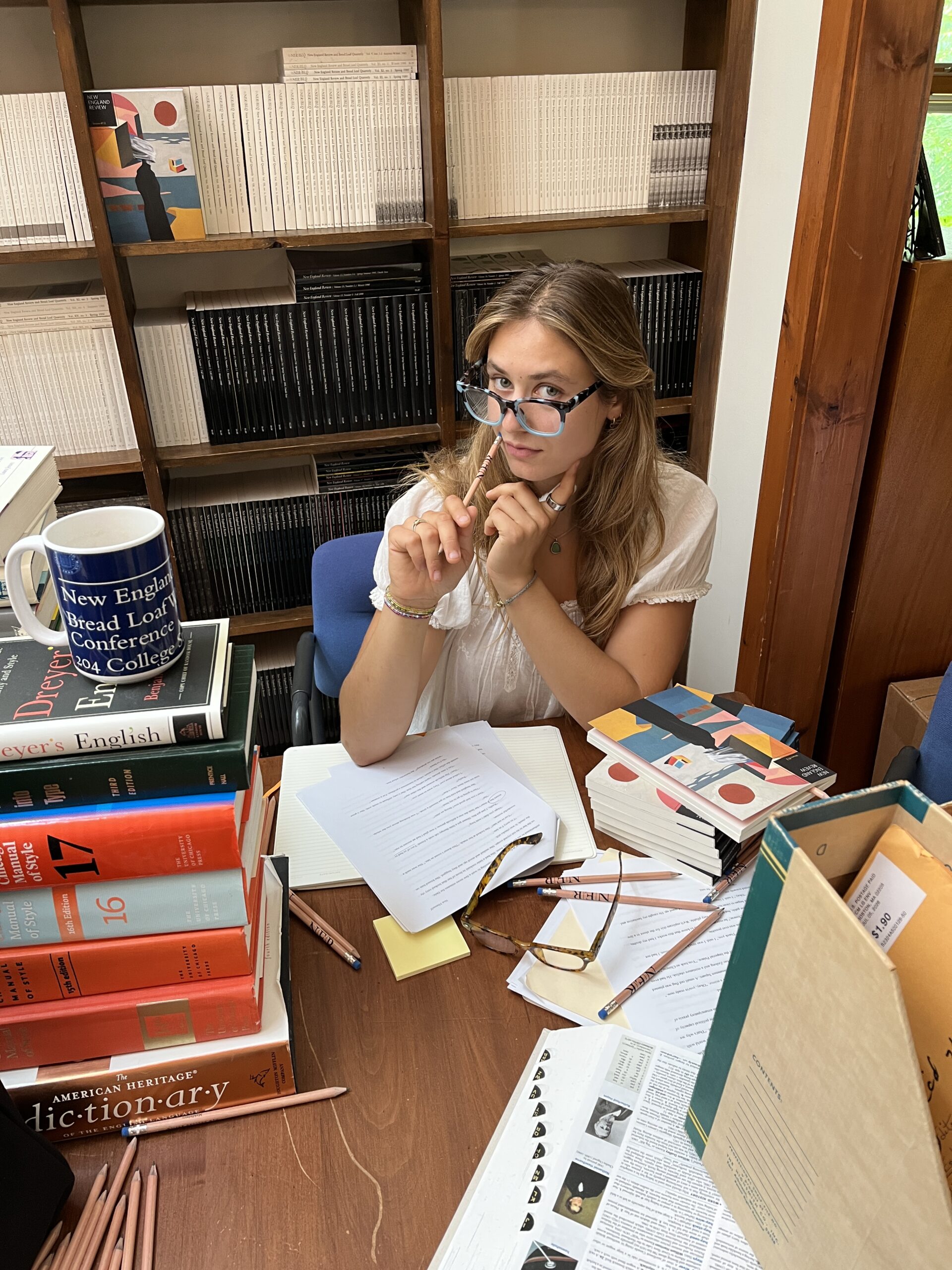
This summer Eliza Tiles ’27.5 worked at the New England Review as part of Middlebury College’s MiddWorks for Vermont internship program. She read submissions, assisted with copyediting and social media, conducted market research, completed a Behind the Byline interview, and much more. Here she answers a handful of questions about how she got here and what she learned.
Where are you from, and why did you choose to spend the summer in Middlebury?
Eliza Tiles: I am from Santa Monica, California. Part of what attracted me to Middlebury was the seasons! Something so simple but that I didn’t really grow up with in Los Angeles. I wanted to experience a summer here, especially after enduring so many long Vermont winters only to leave the moment the lilacs start to bloom. After coming back from studying abroad last semester, I knew this summer would be the perfect opportunity to reconnect with Middlebury. And I wanted to intern with the New England Review, obviously!
How did you discover the New England Review?
ET: I don’t recall an exact moment when I first became aware of NER, but one of my earliest interactions with the magazine was attending a student reading series in the NER office my sophomore year. It was exciting to hear the wonderful work my peers were producing. Around that time, I also stumbled upon a display in the lobby of the Davis Family Library, which gave me a more formal introduction to the magazine and its work. I quickly became aware of the range of opportunities NER offers students, and I knew I wanted to intern with the magazine at some point during my time at Middlebury. I also signed up for the student reading group in the fall and had a fun time evaluating a small number of submissions over the course of the semester.
What are some of your favorite tasks in the internship?
ET: There wasn’t much that I didn’t enjoy doing this summer! On top of reading poetry submissions weekly, I found the occasional editorial conversations with Carolyn, Mary Heather, Leslie, or Maggie to be rewarding. It was a joy to be able to pick apart their brains and understand the ways they evaluate submissions, often putting words to similar sentiments I had about a piece but couldn’t quite articulate. Surprisingly, I felt similarly about copyediting. I found that I really liked the small, detail-oriented parts of working at a literary magazine, something I never would have guessed about myself before. How rewarding it is to find that one misplaced apostrophe or change the spelling of a word according to The American Heritage Dictionary. I greatly enjoyed the intimacy with the text that copyediting demanded. Another highlight I’ll mention was the cataloging of the exchange subscriptions. I spent two days with my headphones listening to music and going through our bookshelves. During the process, I would discover a lit mag that piqued my curiosity, flip through the pages, and find some good nuggets. A lot of the magazines on our shelves had also stopped publishing before I was even born, and I felt like I was opening a time capsule where I got to see what the literary world was like back then and the types of things people were writing and publishing.
What’s something you learned about NER or literary journals more broadly?
ET: I hate to admit it, but coming into the internship, I still wasn’t 100 percent confident in the definition—or impact—of the literary magazine. Within my first week, that completely changed, and now I understand that they are essential parts of the literary world. While reading cover letters or just having general conversations, I began to see the impact that NER has had and will continue to have on writers and readers, offering a much-needed sense of freshness and newness in the literary landscape. Funded by Middlebury College, NER is able to publish work for its literary merit without needing to worry about whether, for example, a particular author’s Instagram following will translate into more readers or sales. That freedom from some of the commercial pressures facing the larger publishing world allows literary magazines to occupy a necessary niche: one devoted to discovering and publishing the best and most innovative work, regardless of whether the writer already has an audience.
Did anything you read this summer get selected for publication?
ET: Yes! And it was really encouraging. As a new reader it was difficult to find the confidence in my editorial perspective and taste at first. I was fortunate enough to be assigned a poetry and fiction packet that were accepted for the fall and winter issues, respectively. It was inspiring to have my taste validated by Carolyn and Leslie as well as get an even better sense of the kind of work that NER is looking for, especially in comparison to the greater submissions queue. Seeing the submissions in their most nascent form also allowed me a great sense of the work that gets done with a piece after acceptance but before publication.
What are some of your favorite pieces from recent issues of NER?
ET: I really enjoyed Yerra Sugarman’s nonfiction piece, “Because Here.” I interviewed Yerra for the Behind the Byline series, which really deepened my appreciation of her work. I connected with her ability to balance intellect and lyricism within the essay, and I found myself thinking about the concept of “post-memory” all summer. I similarly enjoyed Leath Tonino’s “Becoming Nobody: An Essay in Quotes,” which was a fun read. I’ve previously read some of the texts that he pulls from, and it was inspiriting to see him juggle with form and inherent meaning in a way I didn’t know was possible. Finally, I will always have a sweet spot for the poem “If You Were a Wild Beast” by Anzhelina Polonskaya in NER 43.1. Although not the most recent issue, it was the first issue of NER I flipped through, and I remember just being so moved by the translation and thinking that NER had some good stuff.
What do you recommend for a perfect Vermont summer day?
ET: My perfect Vermont summer day starts off with an iced latte from Royal Oak, which was also a great first bonding moment with our managing editor, Leslie, who also greatly enjoys their coffee. Then perhaps a run on the TAM or a hike in the Green Mountains while the air is still cool. Then as it warms up, spending time by a river at some secret swimming spot with my friends, my current knitting project, and a journal. After a lazy afternoon in the sun, stop at a farm stand and pick up tons of fresh veggies and some meat to grill for a BBQ at Lake Dunmore. Eat, play some Spikeball, and go for another swim before getting creemees on the way home. As long as a dip in a body of water and a creemee are involved, I don’t think you can go wrong!